

Silvergate Capital (SI), a crypto-friendly Californian bank and a former partner of many crypto companies, is on the verge of bankruptcy. On March 3, it announced the suspension of the Silvergate Exchange Network (SEN) adding that “other deposit-related services remain operational.”
The news came only an hour after Moody’s had downgraded the bank’s deposit rating to Caa1 from Ba3. Basically, this means that the bank’s obligations are assessed as being subject to very high credit risk.
Echoes of the FTX meltdown
In November, the company faced both financial and regulatory losses due to the crash of important clients including FTX and its sister hedge fund Alameda Research.
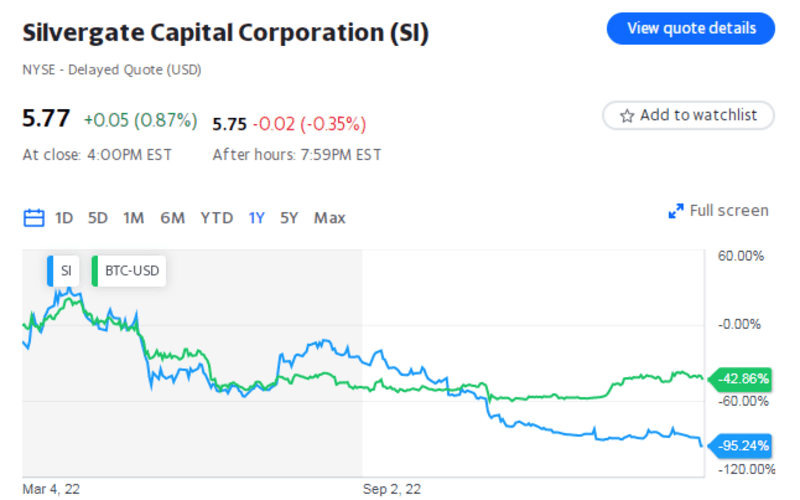
Silvergate Capital’s shares crashed on March 2 and 3. Over the twelve-month period, they have decreased by 95%.
On March 2, the company announced that it would miss its deadline to file its annual report and that it expected to record further losses than it announced earlier. In January, Silvergate Capital reported an almost one billion drop in net losses in its preliminary results for the fourth quarter.
The company also mentioned pending regulatory and other inquiries and investigations, and its “ability to continue as a going concern for the twelve months following the issuance of these financial statements.”
Numerous companies, including Coinbase, Paxos, and Galaxy Digital, have made statements to distance themselves from the bank and withdrawn their deposits.
What’s next?
If the worst comes to the worst, Silvergate Capital may declare bankruptcy. A more likely scenario, however, is that the FDIC-insured bank could use a receivership.
Receivership and bankruptcy are not the same. A receivership is kind of a protective umbrella for a company in financial distress. A receiver or trustee steps in to take over the business management, to help the company’s creditors recover outstanding amounts, especially under secured loans. Unlike bankruptcy, this is not a legal action, and it is aimed at protecting creditors instead of borrowers.
Jesse Austin, who used to be a partner in the Financial Restructuring Practice at King & Spaulding, commented that in this case the decision on a potential receivership is to be made by two banking regulators — the Federal Deposit Insurance Corporation (FDIC) or California’s Department of Financial Protection and Innovation (DFPI). They could determine whether the company has inadequate capitalization.
“If California’s banking regulator or the FDIC finds Silvergate under-capitalized, the FDIC will then come in and close down the bank,” Austin commented.
According to Austin, even though banks are prevented from filing for chapter 11 or chapter 7 bankruptcy by the bankruptcy code, Silvergate Capital as a holding company could be allowed to do that — especially since it owns other valuable assets in addition to customer deposits.
Apart from the SEN network, Silvergate owns stablecoin assets acquired from the Diem Group in January 2022. Under the terms of the agreement, Silvergate issued over 1.2 million shares to Diem and additionally paid 50 million US dollars in cash.
In their joint statements, the Federal Reserve, FDIC, and OCC spoke of crypto-asset risks to banking organizations. Taking Silvergate’s crisis into account, these statements may also mean that U.S. banks might become somewhat more risk-averse in their dealings with the crypto industry and limit access for crypto companies.
How the bank ended up this way
Silvergate became a regional bank in 1996. However, it was only in 2014 that its Chief Executive Officer Alan J Lane decided that the bank should start working with crypto clients, such as Genesis that eventually filed for bankruptcy protection in January 2023.
The company created a niche for itself by providing banking services to an increasing number of crypto-related startups. The bank eventually established the Silvergate Exchange Network — a formalized payments platform, where crypto clients could transfer and loan money in US dollars outside normal daily banking hours.
As of the end of 2018, the bank had total deposits in the amount of 1.8 billion US dollars and assets in the amount of 2 billion US dollars. During the crypto summer in 2021, these figures reached the values of 14.3 billion US dollars and 16 billion US dollars, respectively.
After the collapse of Sam Bankman-Fried’s exchange, Silvergate’s total deposits and assets dropped to 6.2 billion and 11.3 billion by the end of fourth quarter. As a result, the company’s capital relative to its assets decreased by half. The leverage ratio dropped from 10.7% in the third quarter to 5.3%, raising concerns for banks, since regulatory authorities have a right to interfere in the case of any U.S. bank with a ratio below 5%.
According to experts, Silvergate was not a huge bank but instead strategically increased their deposits by servicing crypto companies. Eventually, their crypto-related deposits became larger than the rest of their business.
