
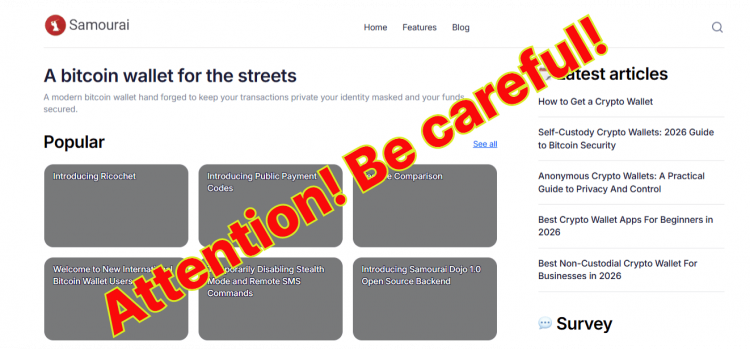
- Why Samourai Wallet Was Shut Down
- What Happened to Users’ Funds
- How the Domain Ended Up With Scammers
- Why This Matters for All Crypto Users
- Security Recommendations
In 2026, the confiscated domain of a privacy-focused Bitcoin wallet resurfaced under the control of criminals, turning into a phishing trap for unsuspecting users.
Why Samourai Wallet Was Shut Down
Samourai Wallet was a non-custodial Bitcoin wallet designed with maximum privacy in mind. Users retained full control over their private keys, while the service offered advanced tools for transaction anonymization:
• Whirlpool — a CoinJoin implementation for mixing transactions
• Ricochet — multi-hop transaction routing
• Dojo — the ability to run your own infrastructure to enhance privacy
The project was shut down on April 24, 2024. U.S. authorities arrested co-founders Keonne Rodriguez and William Lonergan Hill. According to prosecutors, more than $2 billion in transactions passed through the wallet, with over $200 million allegedly linked to illegal activities, including darknet marketplaces, fraud, and sanctioned entities.
Following the arrests, Samourai’s infrastructure — including servers and its primary domain — was seized. The app was removed from app stores, and the project effectively ceased operations. In 2025, the founders pleaded guilty and received prison sentences, along with fines and asset forfeiture.
What Happened to Users’ Funds
A key feature of Samourai Wallet was its non-custodial design. This meant the service never held users’ funds — coins remained on the blockchain and were accessible only to the wallet owner via their seed phrase.
Even after the wallet was shut down and the domain seized, users could still recover access to their funds using their backup seed phrase in other compatible wallets.
How the Domain Ended Up With Scammers
In March 2026, the previously seized domain samouraiwallet.com apparently expired or was auctioned off and ended up in the hands of unknown actors. The website now poses as a legitimate continuation of the original wallet, using the same branding, feature descriptions, and even publishing fake 2026 news updates.
Security researchers and crypto enthusiasts quickly identified the phishing scheme. The site offers downloads of “updated” software or upgrades that are actually designed to steal users’ seed phrases and private keys.
“Warning: A scammer has taken control of the samouraiwallet.com domain. Do not be fooled and do not download malicious software,” security experts warn.
Why This Matters for All Crypto Users
The Samourai Wallet incident has become a textbook example of how attackers can exploit a well-known brand even after a project has been shut down and its domain seized. It highlights the gap between law enforcement actions and long-term protection for cryptocurrency users.
Security Recommendations
• Never enter your seed phrase on third-party websites
• Download wallets only from official, verified sources
• Be skeptical of “revived” projects or domains, especially if the original service was shut down
• Use hardware wallets to store large amounts of cryptocurrency
The Samourai Wallet case serves as a reminder that in the world of cryptocurrencies, security ultimately rests with the user. Even the most advanced privacy tools cannot protect you if basic digital hygiene practices are ignored.
