
- Grinex Exchange in Kyrgyzstan: License and Legal Status
- Links to Garantex and the A7A5 Token
- The Grinex Hack on April 16, 2026
- Can Grinex Be Considered a Typical Alternative to Major Exchanges?
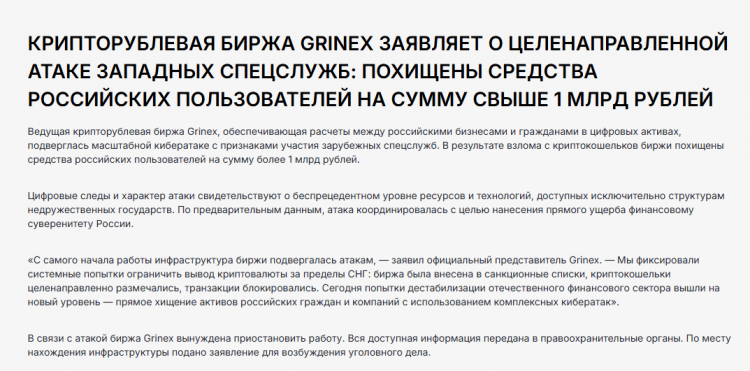
In April 2026, attention around the cryptocurrency exchange Grinex reached its peak. The platform, which positions itself as a service for working with rubles, cash, and the A7A5 token, found itself at the center of several high-profile developments at once—from sanctions and allegations of ties to Garantex to a large-scale hack resulting in losses exceeding 1 billion rubles. Why is Grinex being called the successor to Garantex, and what exactly happened on April 16, 2026?
Grinex Exchange in Kyrgyzstan: License and Legal Status
According to the Kyrgyz registry, LLC “Grinex” was granted an indefinite license (No. 161, dated April 25, 2025) to operate as a virtual asset exchange operator. The company is legally registered in Bishkek. For some users, the existence of a license is seen as a sign of legitimacy and reliability.
However, it’s important to understand that a license alone does not eliminate sanctions risk, compliance concerns, or counterparty exposure. For banks, auditors, and financial monitoring authorities, this type of service offering—especially with a focus on cash transactions and P2P activity—often signals elevated risk. Grinex openly lists offices in Moscow and other Russian cities, which further increases regulatory scrutiny.
Links to Garantex and the A7A5 Token
In August 2025, the U.S. Treasury’s Office of Foreign Assets Control (OFAC) explicitly identified Grinex as a successor to Garantex. According to the official statement, after international sanctions were imposed on Garantex (March 6, 2025), its staff allegedly built new infrastructure to migrate client balances to a new platform—Grinex. The same document references the A7A5 token, which was used as a mechanism for users to regain access to their funds.
Sanctions against Grinex were later introduced by the United Kingdom and the European Union. European documents describe the platform as a major hub for trading A7A5, while UK materials identify Grinex and Meer as part of the broader infrastructure surrounding the token.
As a result, Grinex is not viewed as “just another exchange,” but rather as a node within a larger settlement ecosystem combining ruble liquidity, sanctions-sensitive operations, and crypto assets. According to blockchain analytics estimates, the turnover of A7A5 and related transactions quickly scaled to billions of dollars, although exact figures vary.
The Grinex Hack on April 16, 2026
On April 16, 2026, Grinex announced a cyberattack, a halt in operations, and the theft of assets worth approximately 1 billion rubles. The platform claims that user crypto wallets were targeted and suggested that entities from “unfriendly states” may have been behind the attack. However, there is currently no independent verification of this claim.
At this stage, only the service outage and the reported scale of losses have been confirmed. The exact attack vector, the composition of the stolen assets, the distribution of losses among users, and any compensation mechanisms remain unknown. In the crypto market, such a gap between bold claims and verifiable details is not uncommon.
Can Grinex Be Considered a Typical Alternative to Major Exchanges?
No. Even setting political factors aside, there are three key layers of concern:
• Sanctions risk: The platform is already subject to restrictions from the U.S., UK, and EU.
• Infrastructure risk: A major cyberattack has already occurred.
• Reputational risk: Working with such a counterparty may raise concerns for banks, compliance teams, and business partners.
The simple formula “licensed equals safe” does not apply here. For a crypto platform, factors such as the origin of the business, regulatory perception, operational transparency, and incident response matter significantly. In Grinex’s case, nearly all of these aspects remain contentious.
Conclusion
Grinex illustrates how a formal license and legal registration do not guarantee safety or transparency. The platform’s history is closely tied to sanctions, the Garantex controversy, and a major security breach. For users, this serves as a clear signal: engaging with such services inherently involves elevated risk.
