
- How Neural Networks Are Being Used in Cryptocurrency
- The Risks of Using Neural Networks in Cryptocurrency
Solana co-founder Anatoly Yakovenko recently made a controversial statement: artificial intelligence is becoming the biggest short-term threat to cryptography. According to him, modern algorithms—including post-quantum cryptography (PQC) signature schemes—may be vulnerable to AI systems capable of breaking them long before these technologies are widely adopted.
Yakovenko emphasized that the industry still does not fully understand the mathematical and technical weaknesses of PQC. He urged crypto wallet owners to use layered security systems, particularly “2-of-3” multisignature setups. This approach increases wallet resilience even if one of the signature schemes becomes compromised.

“The biggest risk is that AI will break PQC signature schemes. We don’t even fully understand the implementation vulnerabilities yet, let alone the mathematical flaws,” Yakovenko said.
At the same time, Bitcoin developers are debating the future of Satoshi Nakamoto’s dormant holdings. Estimates suggest that around 1.1 million BTC are stored across 22,000 P2PK addresses. Experts believe that cracking these wallets would require enormous computational resources, and exchanges would likely have enough time to move funds to secure post-quantum accounts before any critical threat emerges. Core ownership rights, meanwhile, would remain intact, and the market is expected to withstand even large-scale sell-offs.
How Neural Networks Are Being Used in Cryptocurrency
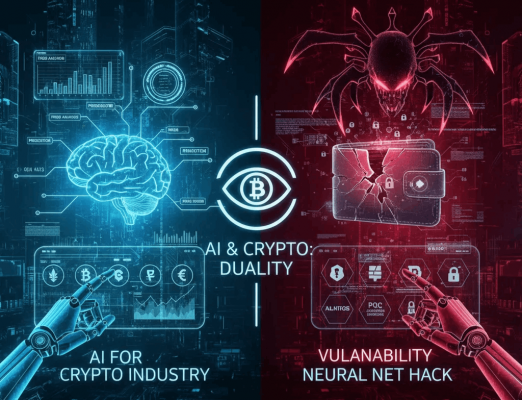
Artificial intelligence is already playing a major role in the crypto industry and delivering tangible benefits:
• Automated analytics. AI can process massive amounts of data, identify trends, forecast price movements, and evaluate market sentiment based on news and social media activity. This helps traders make more informed decisions and respond faster to market changes.
• Automated trading. AI-powered trading bots can execute trades independently according to predefined parameters, reacting instantly to even minor price fluctuations. This reduces the impact of human error and improves trading efficiency.
• Fraud prevention. AI helps detect suspicious transactions, track fund movements, and identify fraudulent schemes, contributing to greater transparency and security across the crypto market.
The Risks of Using Neural Networks in Cryptocurrency
Despite its clear advantages, the use of AI in crypto also introduces new risks:
• Vulnerabilities in cryptographic systems. Neural networks could potentially be used to crack even advanced encryption and signature algorithms, putting users’ funds at risk.
• Automation of cyberattacks. Malicious actors may use AI to launch large-scale and highly sophisticated cyberattacks that are more difficult to detect and stop.
• Market manipulation. AI systems are capable of analyzing crowd behavior and could be used to manipulate cryptocurrency prices through coordinated market activity.
Ultimately, the rapid development of AI requires the crypto industry not only to adopt new technologies, but also to continuously strengthen its security infrastructure. Only a comprehensive approach will allow the industry to maintain the balance between innovation and security in the world of digital assets.
