
- The Mechanics of Sanctions: A Ban at the Code Level
- What Is AML Tagging—and Why Is It Dangerous?
- The Belarusian Precedent and the “Trojan Horse”ь»
- Global Isolation or Adaptation?
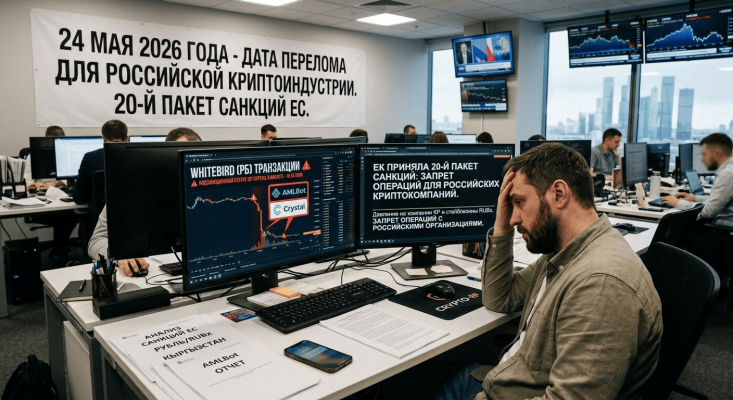
May 24, 2026 may become a turning point for the entire Russian crypto industry. On that day, the EU’s 20th package of anti-Russian sanctions comes into force, and its cryptocurrency provisions are expected to be especially painful. This is not merely an expansion of the sanctions list—it is effectively a sector-wide ban targeting the very infrastructure of cross-border payments. Yet the biggest threat may come not from the legal text itself, but from how private Western analytics firms choose to interpret it.
The Mechanics of Sanctions: A Ban at the Code Level
Formally, the new EU package prohibits transactions involving any Russia-established crypto organizations engaged in money transfers. But, as always, the devil is in the details. The measures affect not only future Russian market participants—whose regulatory framework will not take effect until July 1, 2026—but also services operating in “friendly” jurisdictions that work with the Russian ruble.
Pressure is mounting on Kyrgyz companies and ruble-backed stablecoins such as RUBx. However, the most dangerous precedent has been set by the analytics platform Crystal (owned by Bitfury) and its affiliated service AMLBot. Even before the sanctions officially came into force, on May 18 they began tagging transactions associated with the Belarus-based service WhiteBird—popular among Russian users—as sanctioned activity.
What Is AML Tagging—and Why Is It Dangerous?
To understand the scale of the problem, it is important to understand how crypto compliance systems work. Major global analytics providers such as Crystal, Elliptic, and Chainalysis analyze blockchain activity and assign “tags” to wallet addresses. For example: “address belongs to Binance,” “address linked to a darknet marketplace,” or now, “sanctioned address.”
Most centralized exchanges and financial services worldwide rely on these databases for risk assessment. If your wallet receives a “red flag,” you effectively become persona non grata within the Western financial system. Your funds may be frozen when attempting to transfer them to any exchange using Crystal’s compliance data.
“The fact that a Belarusian service’s addresses were tagged by one of the leading—albeit rather specifically oriented—analytics agencies demonstrates just how broadly sanctions restrictions can be interpreted,” notes analyst Viktor Pershikov.
The Belarusian Precedent and the “Trojan Horse”ь»
Почему именно WhiteBird? Сервис зарегистрирован в Белоруссии, работает легально и поддерживает обмен на российский рубль. Однако информация о том, что им активно пользуются россияне, была публичной. Как выразился эксперт Григорий Осипов, западныWhy WhiteBird specifically? The service is legally registered in Belarus and supports ruble exchange operations. However, it was publicly known that Russians actively used the platform. As expert Grigory Osipov put it, Western AML services decided to act “proactively and independently,” effectively expanding EU sanctions according to their own interpretation.
This has created a dangerous precedent. If a single company—Crystal, which has Ukrainian roots and is headquartered in the Netherlands—can unilaterally label the addresses of a legal service as sanctioned, then the entire Russian crypto ecosystem may be at risk.
“Crystal is leading the way. Elliptic and Chainalysis have not yet introduced similar tagging, but that does not mean it will not suddenly appear there on May 24,” warns Exved CEO Sergey Mendeleev.
The situation is further complicated by the fact that tagging can be applied retroactively. As expert Taisiya Romanova explains: “All user addresses that have ever interacted with a sanctioned address in the past may now also receive a tag.” In practice, this means that even if you stopped using a particular service long ago, your old wallets could still become “toxic.”
WhiteBird director Maksim Shabanov insists that customers will not feel the impact of these restrictions: the platform has updated its security architecture and can reportedly exchange “tainted” crypto for “clean” assets. However, this is only a localized solution to a much broader problem.
Global Isolation or Adaptation?
The key question is what happens next. According to Sergey Mendeleev, if other major AML providers follow Crystal’s lead after May 24, the Russian crypto ecosystem could effectively become isolated from the global market.
“It would be wrong to say that sanctions tagging is not a problem. But within the internal framework of the Union State, such unfriendly actions are unlikely to have a critically negative impact,” believes Viktor Pershikov.
Russian companies have increasingly relied on payment solutions in “friendly” jurisdictions such as Belarus and Kyrgyzstan. But that foundation is now under pressure. The cryptocurrency landscape is changing rapidly: businesses will either have to move deeper into the shadows by using unregulated channels, or begin building a fully sovereign infrastructure independent of Western analytics systems.
“The new Russian legislation does not account for the nuances of sanctions pressure, and the Russian crypto business is facing the toughest challenges in its history,” Sergey Mendeleev concludes.
May 24 will become a survival test. Russia’s crypto market now faces a strategic choice: accept the role of an isolated enclave, or begin building its own compliance and security infrastructure independent of the political decisions of Western analytics firms.
