
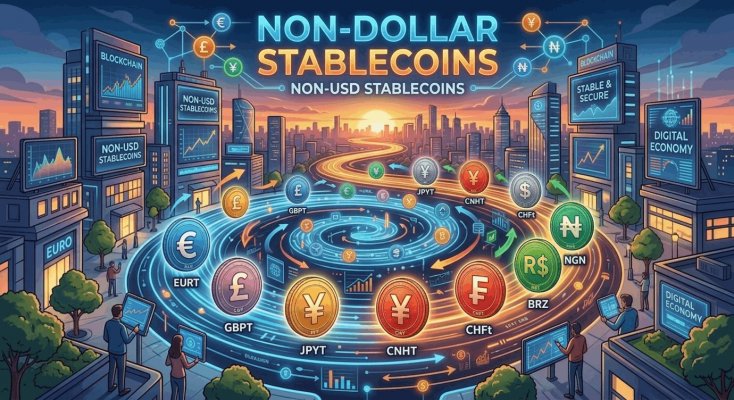
- From Fringe Assets to Trillions in Transaction Volume: The Evolution of Stablecoins
- Why Is the World Looking for an Alternative to the Dollar?
- The Ecosystem of the Future: From Digital Bills of Exchange to AI Agents
The global financial system is undergoing a fundamental transformation. Just a few years ago, cryptocurrencies were widely viewed as speculative instruments. Today, however, they are evolving into a full-fledged global payments infrastructure. At the recent Crypto South forum, A7A5’s Director of Government Relations and International Affairs, Oleg Ogienko, presented an analytical report shedding light on the forces driving explosive demand for alternative financial instruments. The report’s key takeaway is straightforward: the era of a dollar-centric global settlement system with no viable alternatives is coming to an end.
From Fringe Assets to Trillions in Transaction Volume: The Evolution of Stablecoins
To begin, let’s clarify the terminology. A stablecoin is a cryptocurrency whose value is pegged to another asset, most commonly a fiat currency such as the U.S. dollar, euro, or yuan, or to gold. Its primary purpose is to combine the advantages of blockchain technology—speed, transparency, and borderless transactions—with the stability of traditional money.
Initially, the stablecoin market was almost entirely dominated by the U.S. dollar. Industry giants such as USDT (Tether) and USDC account for roughly 99% of the global market. However, geopolitical shifts, sanctions pressure, and the growing demand for financial sovereignty have fueled a powerful trend toward the development and adoption of non-dollar alternatives.
The numbers speak for themselves. According to Oleg Ogienko, transaction volume across all stablecoins reached an astonishing $33 trillion in 2025. For comparison, the combined transaction volume of the world’s two largest payment networks, Visa and Mastercard, amounted to approximately $28 trillion. This means that decentralized crypto infrastructure has already become a larger channel for value transfer than the traditional card networks that have shaped the financial landscape for decades.
“Stablecoins have effectively become a genuine payments infrastructure. They’re no longer just tokens,” the expert emphasized.
Why Is the World Looking for an Alternative to the Dollar?
The growing popularity of non-dollar stablecoins is not a random phenomenon. It is a logical response to the challenges facing the modern global economy. Oleg Ogienko highlighted several key drivers behind this trend:
1. Reducing Dependence on the Dollar
Many countries and major corporations are seeking to diversify their payment and settlement systems in order to reduce exposure to U.S. Federal Reserve monetary policy and mitigate risks associated with fluctuations in the U.S. dollar.
2. Minimizing Sanctions Risk
In an increasingly unstable geopolitical environment, the possibility of account freezes and exclusion from international payment networks such as SWIFT has become a tangible threat. By using their own digital currencies and stablecoins, countries can establish independent channels for international trade that are far less vulnerable to external control.
3. Development of National Payment Instruments
Governments around the world are actively testing and implementing central bank digital currencies (CBDCs) while also supporting private-sector initiatives, creating ecosystems for faster and more cost-effective cross-border payments.
Against this backdrop, A7A5 has demonstrated impressive growth, accounting for approximately 43% of the global non-dollar stablecoin market. The project’s success stems from the fact that it offers more than just a token—it is building a comprehensive financial ecosystem.
The Ecosystem of the Future: From Digital Bills of Exchange to AI Agents
One of the defining characteristics of successful modern crypto projects is the shift from the concept of a “single coin” to the creation of a complete financial environment. A7A5 is developing solutions designed to make digital assets more practical and accessible for both businesses and everyday users.
• Fiat On- and Off-Ramps: The ability to seamlessly buy and sell digital assets for rubles directly addresses key challenges related to liquidity and accessibility.
• Exchange Infrastructure: Integrated solutions for rapid conversion between different stablecoins, such as A7A5 and USDT, provide users with greater flexibility when conducting transactions.
• Digital Bills of Exchange: This innovative instrument combines traditional debt obligations with blockchain technology, creating a new level of trust, transparency, and automation in financial settlements.
Looking ahead, Oleg Ogienko outlined a vision of even deeper technological integration. Several factors are expected to shape the market’s development through 2030:
• Intelligent Payment Platforms: Blockchain-based systems will emerge that can automatically analyze hundreds of payment routes and select the optimal option based on cost, speed, and compliance requirements.
• Programmable Money: Payments will become conditional and automated. For example, funds could be released to a supplier only after a smart contract receives confirmation of product delivery through GPS-enabled tracking systems.
• The AI Agent Economy: One of the most promising scenarios is the emergence of autonomous economic agents—AI systems capable of independently performing tasks and receiving payment in stablecoins for their services.
We are witnessing more than the rise of another financial instrument. What is emerging is a new paradigm for the global economy. Non-dollar stablecoins are moving beyond their niche origins and becoming a foundational layer for a more transparent, resilient, and inclusive financial system—one in which participants have greater freedom to choose how they transact, without relying exclusively on a single dominant national currency.
