
- Custodial vs. Self-Custody: What’s the Difference?
- The Bank of Russia’s Position: “Outside Russian Jurisdiction”
- What Could You Be Penalized For?
- Conclusion
The sweeping cryptocurrency regulations expected to be introduced in Russia in the near future are raising numerous questions among retail investors. One of the key issues is the Bank of Russia’s approach to storing digital assets. Speaking at the Financial Congress, First Deputy Governor Vladimir Chistyukhin clarified the regulator’s position, revealing a nuanced approach: while there is no outright ban on self-custody, independently managed wallets will be subject to strict limitations based on the concept of being “outside Russian jurisdiction.”
Custodial vs. Self-Custody: What’s the Difference?
Understanding the proposed regulations begins with distinguishing between the two primary methods of holding cryptocurrency.
Custodial storage. Under the custodial model, a licensed third party is responsible for safeguarding users’ assets and providing access to them. This intermediary may be a cryptocurrency exchange, a broker, or, under Russia’s proposed regulatory framework, a licensed digital asset custodian. When using a custodial wallet, users must complete Know Your Customer (KYC) verification, and their assets are effectively held by the service provider. While users manage their accounts through an online interface, they do not directly control the private keys.
Self-custody. Self-custody is the exact opposite. The wallet owner has exclusive control over their digital assets because only they possess the private keys. Creating a self-custody wallet requires no identity verification or disclosure of personal information. Examples include software “hot wallets” such as MetaMask and Trust Wallet, as well as hardware “cold wallets” like Ledger and Trezor.
The Bank of Russia’s Position: “Outside Russian Jurisdiction”
According to the proposals outlined by the regulator, only custodial storage provided by licensed intermediaries would be permitted within Russia. However, the Bank of Russia makes an important distinction: self-custody wallets will not be prohibited, but only if they are considered to operate outside Russian jurisdiction.
As Vladimir Chistyukhin explained, this creates an unusual legal situation. Yuri Brisov, a partner at Digital & Analogue Partners, summarizes it as follows:
“It’s neither a ban nor formal recognition. The government simply won’t consider those assets to be part of Russia’s financial system.”
The contradiction lies in the nature of blockchain technology and hardware wallets themselves. Brisov explains:
“This means that a hardware wallet sitting in an apartment in Moscow could legally be treated as being stored abroad because no Russian intermediary has access to it.”
A hardware wallet, such as a Ledger device, does not actually store cryptocurrency—it stores only the private keys that provide access to assets recorded on the blockchain. The cryptocurrency itself exists on a decentralized blockchain network with no physical location.
Dmitry Machikhin, founder of AML provider BitOK, points to another important aspect:
“Wallets such as Ledger and Trezor are developed, registered, and operated under foreign jurisdictions, so they have no legal connection to Russia.”
In his view, this is precisely what the central bank is referring to. At the same time, Machikhin emphasizes that enforcing a complete ban would be technically impossible.
“It’s impossible to prohibit self-custody because it’s technically unenforceable. You can’t ban something that cannot be effectively monitored.”
What Could You Be Penalized For?
Although there is no direct prohibition on owning a self-custody wallet, the regulator has clearly defined what it considers permissible. According to Yuri Brisov, cryptocurrency transactions conducted through self-custody wallets while operating within Russia could expose users to legal liability.
The crucial distinction lies in the type of activity involved.
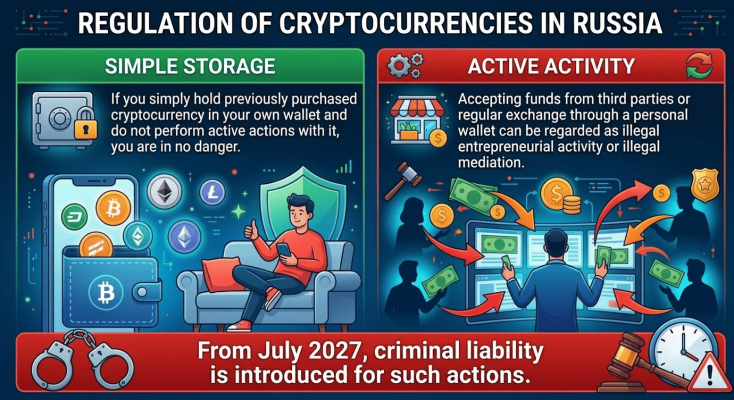
Passive holding: Simply holding cryptocurrency previously purchased and stored in a personal wallet is not expected to result in penalties.
Commercial activity: Receiving cryptocurrency payments from third parties or regularly exchanging digital assets through a personal wallet may be treated as unauthorized business activity or illegal financial intermediation.
Beginning in July 2027, criminal liability is expected to apply to such activities.
Brisov advises:
“Those who simply hold cryptocurrency purchased in the past have nothing to fear. However, they should retain documents proving when and how the assets were acquired. Without evidence of lawful acquisition, owners are unlikely to lose the assets themselves, but they could lose the ability to defend their ownership rights in court.”
In other words, the government appears willing to tolerate passive ownership of legally acquired cryptocurrency while reserving the right to prosecute individuals who use self-custody wallets to conduct business, such as accepting payments from customers.
Conclusion
The Bank of Russia’s approach can best be described as an attempt to regulate the entry and exit points of the cryptocurrency ecosystem—the fiat on- and off-ramps—while acknowledging that citizens can continue to store digital assets independently from a technical standpoint. The regulator aims to create a system in which all lawful cryptocurrency transactions pass through licensed, transparent intermediaries that perform mandatory customer identification.
For retail investors, this effectively means choosing between two approaches. One option is to use licensed Russian custodians and cryptocurrency exchanges, accepting identity verification and regulatory oversight. The other is to continue using self-custody wallets while recognizing the trade-offs: limited legal protection and potential liability for conducting commercial cryptocurrency transactions within Russia. Regardless of the chosen approach, investors should keep clear records documenting how and when their cryptocurrency was acquired. Such documentation may prove essential in establishing lawful ownership and protecting their rights in the future.
