
- Progress or an Illusion of Control?
- New Threats: From North Korea to Artificial Intelligence
- AI in the Hands of Criminals
- High-Profile Cases Expose Systemic Failures
- Enforcement Priorities: Who Will Be Targeted Next?
- What Does This Mean for Everyday Users and Businesses?
- How to Protect Your Assets from Being Frozen
- Why Use a Bitcoin Mixer to Protect Your Assets?
- The Risks of Using Low-Quality Services
On July 16, 2026, the Financial Action Task Force (FATF) published a comprehensive report that reads like an ultimatum for the entire virtual asset industry. Although most countries have already enacted cryptocurrency regulations, criminal organizations continue to exploit regulatory gray areas to move billions of dollars.
The report, “Targeted Update on Implementation of the FATF Standards on Virtual Assets and Virtual Asset Service Providers (VASPs),” highlights a striking paradox: while legal frameworks now exist in most jurisdictions, enforcement remains weak in practice.
Progress or an Illusion of Control?
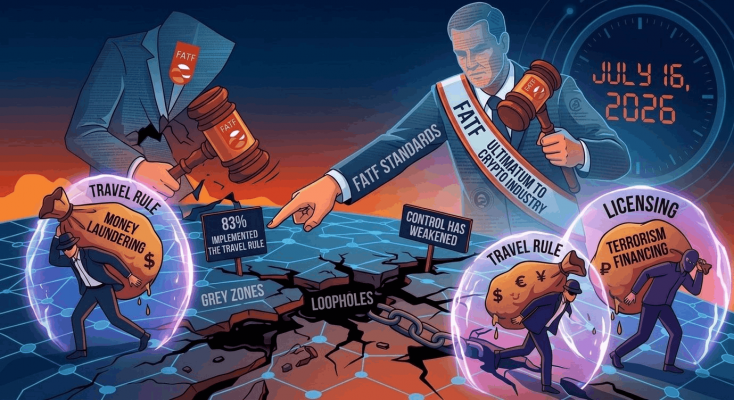
The report’s statistics show clear progress on paper. In 2025, only 73% of jurisdictions had implemented the Travel Rule—the requirement to share sender and recipient information for virtual asset transfers. By mid-2026, that figure had risen to 83%, while another 11% of countries are currently implementing the rule.
However, FATF warns that passing legislation is not the same as enforcing it. The primary challenge is no longer the lack of legal frameworks, but regulators’ inability to:
• Identify individuals and businesses providing crypto services without a license.
• Turn written regulations into meaningful inspections, enforcement actions, and penalties.
• Combat offshore service providers that deliberately establish themselves in jurisdictions with weak oversight.
FATF President Giles Thomson summarized the problem directly:
“Criminal networks continue to exploit virtual assets for illicit purposes… taking advantage of legislative gaps and the uneven implementation of FATF standards across jurisdictions.”
New Threats: From North Korea to Artificial Intelligence
The report paints a troubling picture of how crypto-related crime continues to evolve. Criminal activity is no longer limited to simple theft—it has become highly sophisticated, technologically advanced, and international.
Stablecoins Become Criminals’ Preferred Tool
Most identified cases of illicit activity now involve stablecoins. Their liquidity, speed, and global accessibility make them attractive to everyone from North Korean hackers financing the country’s nuclear program to terrorist organizations.
FATF also warns about the emergence of “protected stablecoins”—tokens reportedly developed by organized crime syndicates (including groups operating in Cambodia) that are intentionally designed to resist freezing or seizure by law enforcement.
AI in the Hands of Criminals
According to FATF, cybercriminals have rapidly adopted artificial intelligence throughout 2026. The report identifies three major threats:
• Deepfakes: Fake videos and cloned executive voices used to authorize fraudulent transactions.
• Synthetic identities: AI-generated fake individuals with convincing financial histories used to bypass Know Your Customer (KYC) procedures at cryptocurrency exchanges.
• Automated fraud: AI-powered systems used to recruit money mules and manage large-scale laundering networks.
High-Profile Cases Expose Systemic Failures
FATF cites several major investigations demonstrating how regulatory weaknesses continue to enable large-scale financial crime.
1. Cambodian financial network: Between 2021 and 2025, at least $4 billion in proceeds from scams and North Korean cybercrime was allegedly laundered through a single financial network.
2. Spanish operation (June 2025): Spain’s Civil Guard dismantled an international investment fraud network that stole approximately €460 million from around 5,000 victims worldwide. The case illustrates how modern crypto scams operate globally, with organizers based in one country while simultaneously targeting victims across multiple continents.
Enforcement Priorities: Who Will Be Targeted Next?
Because jurisdictions representing approximately 97% of the global virtual asset market account for most of the industry’s risks, FATF has outlined several key priorities for governments and the private sector.
• DeFi and non-custodial wallets: Regulators are expected to stop treating decentralized protocols as outside the regulatory perimeter. Since DeFi increasingly interacts with regulated exchanges, it can provide pathways for laundering illicit funds.
• Stronger Travel Rule compliance: Information sharing between service providers should become fully automated and instantaneous rather than relying on manual processing.
• Cross-border cooperation: Individual countries cannot effectively combat criminal networks capable of moving assets across dozens of jurisdictions within minutes.
What Does This Mean for Everyday Users and Businesses?
The crypto industry is entering an era of significantly stricter compliance. Anonymous peer-to-peer transactions and unregulated exchange services are steadily disappearing.
For exchanges: Automated AML systems will increasingly freeze suspicious transaction chains. Any association with high-risk offshore jurisdictions could result in account restrictions or frozen funds.
For users: KYC procedures are expected to become more demanding. Exchanges may increasingly request proof of the origin of funds, tax documentation, or evidence of income—even for relatively modest transactions.
FATF’s message is clear: the era of regulatory experimentation is ending. Virtual assets have become part of the global financial system and will increasingly be expected to comply with standards similar to those governing traditional banking—or risk greater international isolation.
How to Protect Your Assets from Being Frozen
As regulation continues to tighten and users face growing restrictions on how they can use their digital assets, many seek tools that can help reduce the risk of exchange-related asset freezes.
For example, if you unknowingly receive Bitcoin previously associated with hacking incidents or fraudulent activity, blockchain analytics used by exchanges may flag those coins. As a result, your account could be temporarily frozen while the exchange investigates the origin of the funds.
One tool commonly used to address this issue is a Bitcoin mixer, also known as a Bitcoin tumbler.
Why Use a Bitcoin Mixer to Protect Your Assets?
The primary purpose of a mixer is not to conceal criminal activity but to restore financial privacy by breaking the publicly visible transaction history associated with specific coins.
The mixed coins lose their digital trace. A typical mixing process works as follows:
1. The service receives Bitcoin deposits from multiple users.
2. The coins are split into smaller amounts, mixed together, and routed through multiple intermediary addresses.
3. The user receives an equivalent amount of Bitcoin that is no longer directly linked on-chain to the original wallet.
From the perspective of blockchain analytics systems, the outgoing transaction appears to originate from a different source, making direct transaction tracing significantly more difficult.
The Risks of Using Low-Quality Services
Choosing an unreliable mixing service may result in losing your assets or receiving coins that have already been associated with suspicious activity. For that reason, selecting an established provider with transparent operating principles is essential.
Mixer.Money: Technology for Delivering Clean Assets
Among existing solutions, Mixer.Money has operated since 2016. According to the service, its distinguishing feature is its anonymization model. While many mixers simply redistribute customers’ coins among one another—which can result in receiving someone else’s tainted Bitcoin—Mixer.Money states that it uses its proprietary bitcoin.mixer 2.0 algorithm.
Verified Clean Asset Mode
The platform offers an advanced anonymization option. In certain operating modes, it claims not to mix customers’ coins together at all. Instead, users receive Bitcoin that has undergone strict AML screening and has been purchased directly from verified investment partners.
According to the service, this approach ensures that the outgoing coins have a clean transaction history and minimizes the risk of future exchange freezes triggered by AML monitoring systems.
Privacy Guarantees
To minimize metadata exposure, Mixer.Money states that it follows a strict no-logs policy:
• No personal information is requested.
• Transaction histories and IP addresses are not stored.
• All operational data is encrypted.
Each transaction receives a unique identifier that is automatically deleted after 168 hours. After that period, the service states that the transaction can no longer be technically reconstructed.
Support communications are protected using PGP-signed guarantee letters, helping users verify the authenticity of service messages.
Technical Security
For additional privacy, the platform offers access through a Tor mirror. In this environment, both the transaction detector and calculator are intentionally disabled because they require JavaScript, which could potentially reduce user anonymity.
Cost of Protection
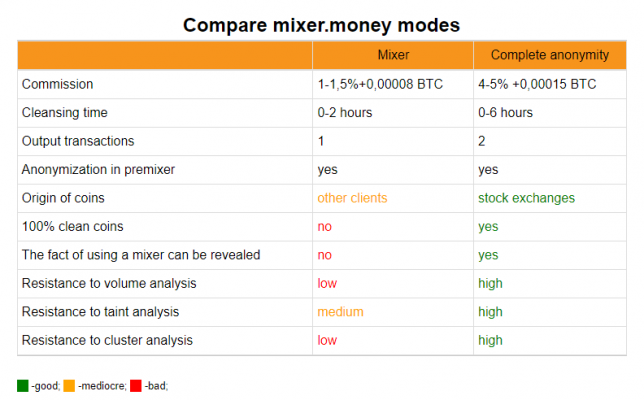
Mixing services are paid services, and pricing depends on the desired level of anonymity. Mixer.Money offers three operating modes with different fee structures. Its highest-tier option, “Full Anonymity,” is designed to maximize the separation between incoming and outgoing transactions.
Conclusion
For many privacy-conscious Bitcoin users, mixers are viewed as tools for preserving financial privacy rather than facilitating illegal activity. If you regularly engage in cryptocurrency trading, peer-to-peer transactions, or freelance work that involves crypto payments, there is always a possibility of receiving coins that trigger additional AML scrutiny.
Services such as Mixer.Money are designed to help users improve transaction privacy before transferring funds to their primary cold wallet, potentially reducing the likelihood of prolonged compliance reviews or account restrictions by cryptocurrency exchanges.
