
- The Leverage Revolution: How BitMEX Built the Modern Crypto Market
- The Pioneers of Crypto Derivatives Trading
- The Liquidation Phenomenon and the REKT Culture
- The Agony of a Titan: Regulatory Pressure and Collapsing Trading Volumes
- What Comes Next for the Market?
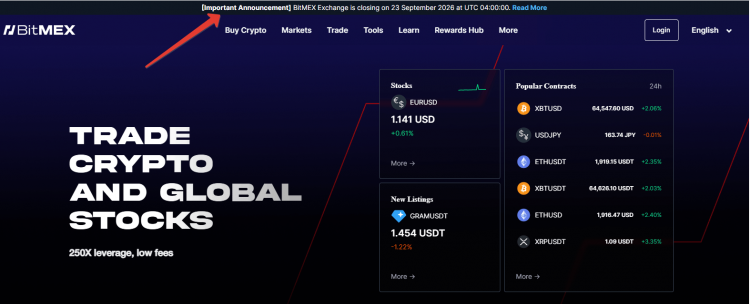
In the cryptocurrency industry, where headlines change by the second, some events mark the end of one era and the beginning of another. September 23, 2026, will be remembered as one of those dates. On that day, the legendary exchange BitMEX—the birthplace of perpetual futures and the go-to platform for high-risk traders—will officially shut down.
Twelve years after its launch, the platform that once processed trillions of dollars in annual trading volume has finally succumbed to mounting regulatory pressure and fierce competition from newer, more sophisticated exchanges. Industry observers see the closure as more than the end of a business—it represents the symbolic end of the unregulated crypto derivatives era.
The Leverage Revolution: How BitMEX Built the Modern Crypto Market
To understand why BitMEX mattered, it’s worth remembering what crypto trading looked like between 2014 and 2016. Back then, investing in cryptocurrencies was simple—and, by today’s standards, rather boring. You bought some asset on the spot market and hoped the price would rise. BitMEX founders Arthur Hayes, Ben Delo, and Samuel Reed are often compared to engineers who built the engine for a Formula 1 race car.
The Pioneers of Crypto Derivatives Trading
BitMEX’s greatest innovation was the perpetual futures contract, also known as the perpetual swap. Unlike traditional futures contracts, perpetuals have no expiration date, allowing traders to hold positions indefinitely—as long as they maintain sufficient collateral.
• The funding rate mechanism. To keep perpetual contract prices aligned with Bitcoin’s spot price, BitMEX introduced the funding rate. When perpetual contracts traded above the spot market, long positions paid funding to short positions; when they traded below spot, the payment flowed in the opposite direction.
• Up to 100x leverage. BitMEX became the first major exchange to let traders control positions worth up to 100 times their initial margin. A trader with just $1,000 could open a position worth $100,000.
This transformed crypto trading from investing into a high-speed game of risk and reward. Today, derivatives trading volumes routinely exceed spot market volumes by a wide margin, largely because of the model BitMEX pioneered. Ben Zhou, CEO of Bybit, described the BitMEX founders as “legends,” noting that perpetual futures have become “the heart of the crypto market.”
The Liquidation Phenomenon and the REKT Culture
BitMEX didn’t just change trading technology—it reshaped crypto culture. Before BitMEX, liquidations were little more than a technical detail. With the arrival of 100x leverage, forced liquidations became dramatic market events watched by traders around the world.
The term REKT—a misspelled version of “wrecked”—entered mainstream crypto vocabulary thanks to the famous BitMEX REKT bot. The bot posted updates on X (formerly Twitter) whenever traders lost hundreds of thousands of dollars within seconds after a mere 1% price move.
Platforms such as Coinglass built entire businesses around aggregating and visualizing liquidation data. Today, liquidation statistics—where, for example, the forced closure of a $1,000 position using 10x leverage is recorded as a $1,000 liquidation—are considered one of the market’s most important indicators of fear and greed.
Arthur Hayes himself became one of crypto’s first celebrity entrepreneurs. His image as a rebellious former banker turned crypto pioneer inspired thousands to enter the digital asset industry. Today, as CIO of the Maelstrom investment fund, he remains one of the most influential macro commentators in crypto.
The Agony of a Titan: Regulatory Pressure and Collapsing Trading Volumes
BitMEX’s decline from industry leader to shutdown happened surprisingly quickly. At its peak in 2019, the exchange processed approximately $16 billion in daily trading volume. However, much of its business model relied on operating outside U.S. regulatory requirements.
$250 Million in Penalties
The turning point came in October 2020, when U.S. prosecutors charged the company’s leadership with violating the Bank Secrecy Act (BSA).
The primary allegations included:
• Failure to implement an effective Anti-Money Laundering (AML) program.
• Failure to enforce Know Your Customer (KYC) requirements.
• Providing services to U.S. residents without the required authorization from the Commodity Futures Trading Commission (CFTC).
Although the founders pleaded guilty years earlier, the legal consequences continued to mount. In the summer of 2024, BitMEX agreed to pay a $110 million settlement, but the court ruled that the amount was insufficient. In January 2025, the exchange was ordered to pay an additional $100 million penalty.
Notably, President Donald Trump pardoned the founders in the spring of 2025. However, the reputational damage had already become irreversible. Institutional investors migrated to licensed exchanges such as Binance, Bybit, and OKX, while many retail traders moved to DeFi protocols.
The decline is stark. BitMEX once handled more than $1 trillion in annual trading volume, but by mid-2026 its daily trading volume had fallen to just $175 million. A management reshuffle in late June 2026 only reinforced what had become increasingly obvious: the BitMEX brand could no longer be saved.
What Comes Next for the Market?
BitMEX’s closure marks the crypto industry’s final transition from its anarchic beginnings to a regulated financial ecosystem. Ironically, however, many of the risk management tools that power today’s trading platforms originated at BitMEX. Modern exchanges continue to rely on the same core principles of margin monitoring, liquidation engines, and automated risk management that BitMEX engineers developed in the early 2010s.
For many crypto veterans, the shutdown is deeply nostalgic—a farewell to Bitcoin’s pioneering years. As the crypto news aggregator Unfolded aptly put it: “Rest in peace. I remember my first liquidation like my first love: expensive, fast, and unforgettable.”
The Wild West era of cryptocurrency has officially come to an end. What follows is an industry defined by regulation, transparent balance sheets, compliance, and tax reporting.
