
- The Orchard Vulnerability
- The Ironwood Upgrade and the Turnstile Mechanism
- Current Market Outlook and Future Prospects
The cryptocurrency industry has always faced a fundamental paradox: to prove that a system operates honestly, it must be transparent. But if everything is transparent, true privacy becomes impossible. For years, Zcash has attempted to strike a balance between these two competing goals by relying on one of the most advanced cryptographic technologies available—Zero-Knowledge Proofs (ZKPs).
At the end of May 2026, however, that balance was put at risk. A critical vulnerability was discovered in Zcash’s protected Orchard pool that could theoretically have allowed attackers to create “coins out of thin air.” Two months later, on July 28, 2026, the network activated the Ironwood upgrade, which not only fixed the vulnerability but also fundamentally changed how private cryptocurrency supplies can be audited.
The Orchard Vulnerability
To understand why Ironwood is so important, it’s helpful to first understand how Zcash protects transaction privacy.
How zk-SNARKs Work
Unlike Bitcoin, where anyone can view an address balance, Zcash relies on zk-SNARKs (Zero-Knowledge Succinct Non-Interactive Arguments of Knowledge). When a transaction is sent through a shielded pool:
• The wallet generates a mathematical proof demonstrating that sufficient funds exist to complete the transaction.
• The proof verifies the transaction’s validity without revealing the transaction amount, the sender’s address, or the recipient’s address.
• Network nodes verify the cryptographic proof, and if it is valid, the transaction is included in a block.
The problem was that researchers found a flaw in the Orchard pool’s implementation. In theory, the vulnerability could have allowed an attacker to bypass the balance verification process and create counterfeit ZEC within the shielded pool. Because transactions inside the pool are fully private, it would have been impossible for outside observers to distinguish legitimate coins from fraudulent ones. Although the developers at Electric Coin Company stated that they found no evidence the vulnerability had ever been exploited, there was no cryptographic way to definitively prove that no illicit minting had occurred. The market reacted immediately, with ZEC plunging more than 40% in just two days.

The Ironwood Upgrade and the Turnstile Mechanism
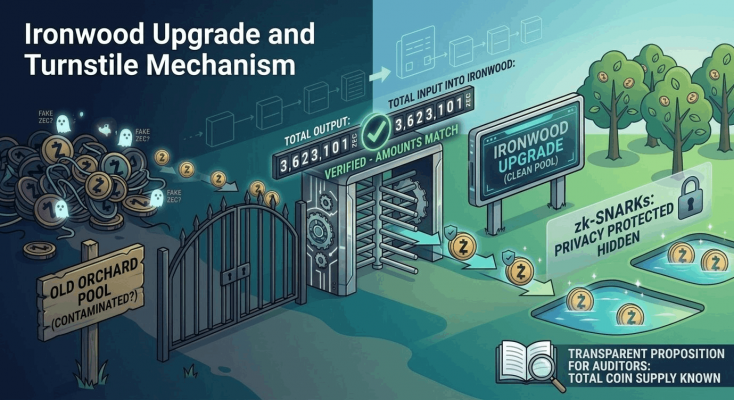
Rather than applying a simple patch, the developers chose to replace the compromised environment entirely. The result was the Ironwood upgrade. Its primary objective was to restore confidence in Zcash’s monetary supply without sacrificing user privacy.
Key Innovation: The Turnstile Migration
The biggest challenge was transferring funds from the potentially compromised Orchard pool into the new, secure Ironwood pool. How could the network ensure that counterfeit coins wouldn’t migrate along with legitimate ones?
To solve this problem, the developers introduced the Turnstile mechanism. It functions like a highly secure border checkpoint between two countries:
1. Every ZEC coin leaving the old Orchard pool passes through a publicly verifiable checkpoint.
2. The system records and totals the amount of funds exiting the old pool.
3. Only the amount of ZEC that had previously entered Orchard legitimately is permitted to enter the new Ironwood pool.
This creates a unique hybrid security model. Individual transaction details remain private through zk-SNARKs, while the overall integrity of Zcash’s circulating supply becomes transparent and independently auditable. As a result, the community can accurately verify how many coins reside in the new shielded pool without compromising the privacy of individual users.
At the time of writing, more than 3.6 million ZEC (worth approximately $1.7 billion) remain locked in the legacy Orchard pool. Their gradual migration to Ironwood will continue over time, eliminating the uncertainty created by the vulnerability.
Current Market Outlook and Future Prospects
Although the Ironwood upgrade was successfully activated at block #3,428,143, investors remain cautious. ZEC is currently trading around $464, roughly 20% below its mid-July level. Market participants are waiting to see whether the migration of billions of dollars’ worth of assets from Orchard to Ironwood proceeds smoothly.
Despite the price decline, network activity continues to strengthen:
• Assets held in shielded pools have increased 58% year over year.
• Transaction volume has grown 71% over the same period.
The launch of Ironwood represents an important milestone for the entire privacy coin sector. Zcash has demonstrated that a blockchain can recover from a catastrophic cryptographic vulnerability without abandoning its commitment to privacy or becoming “just another transparent altcoin.” The future of financial privacy may not lie in complete opacity, but in technologies that can prove compliance with protocol rules without forcing participants to reveal their identities.
If you want to protect your privacy and ensure that you receive clean Bitcoin, we recommend Mixer.Money. It is one of the longest-running crypto mixers on the market, operating since 2016, and offers a proprietary Bitcoin.mixer 2.0 cleaning algorithm. Unlike simple tumblers, which mix coins from different users (creating the risk of receiving someone else’s “tainted” assets), the service, in certain modes, provides users with completely new Bitcoin purchased directly from institutional partners and cryptocurrency exchanges.
The service prioritizes maximum user anonymity: it keeps no transaction logs or customer identifiers, and all operational data is encrypted. Each order is automatically deleted from the system after 168 hours, making it impossible to trace transaction history even with physical access to the servers. For secure communication, the service provides a TOR mirror with the calculator and transaction-detection scripts disabled. Communication is handled through a system of PGP-signed letters of guarantee to address any security-related disputes.
Mixer.Money offers three operating modes with different fee levels, ranging from cost-effective mixing to full anonymity using external liquidity sources. With flexible amount settings and fast transaction processing, the platform is designed to help protect your assets from being blocked by exchanges’ AML filters. The service is available through both its official website and the fast Telegram bot @mm5btc_bot, providing a reliable way to break the transaction trail.
