
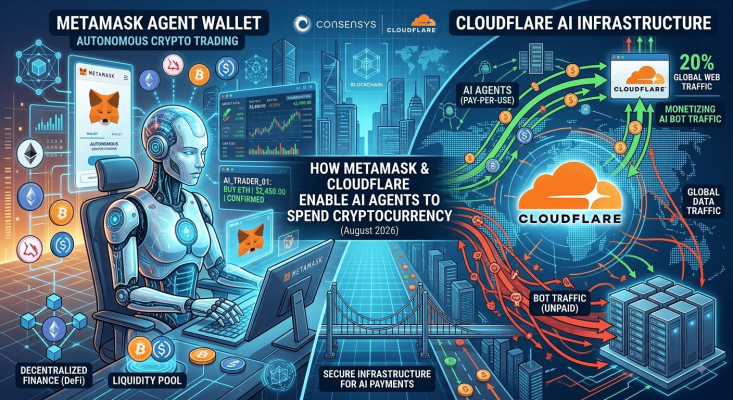
- MetaMask Agent Wallet: Automated Trading
- Cloudflare Wallet: Bots Pay for Content
- Why It Matters: The Rise of AI Agents in Crypto
The cryptocurrency industry has taken a decisive step from serving people to serving algorithms. In early August 2026, two industry giants—the developer of the world’s most widely used crypto wallet, MetaMask (Consensys), and web infrastructure leader Cloudflare—almost simultaneously unveiled specialized solutions for autonomous AI agents.
This development may mark the beginning of a new economy in which machines not only analyze data but also own digital assets, execute transactions, and pay one another for services without human intervention.
MetaMask Agent Wallet: Automated Trading
For the Ethereum ecosystem, this launch is a natural extension of DeFi’s evolution. The new MetaMask Agent Wallet transforms an AI model into a fully autonomous crypto trader with access to the entire decentralized finance ecosystem.
Technical Foundation and Network Support
At launch, the wallet supports all major EVM-compatible networks, including:
• Layer 1: Ethereum
• Layer 2 (L2) networks for lower transaction fees: Arbitrum, Optimism, Base, and Linea
• Alternative blockchains: Polygon, BNB Chain (BSC), and Avalanche
• Specialized platforms: Hyperliquid for perpetual futures trading
The wallet can be managed through a command-line interface (CLI) and integrates with popular AI development frameworks such as OpenAI Codex, Claude Code, and Cursor. This allows developers to define trading strategies—for example, “Buy ETH if the RSI falls below 30″—link them to an agent wallet, and let the system execute trades around the clock.
Security: Guard Mode vs. Beast Mode
The biggest challenge in allowing AI to control financial assets is preventing rogue behavior or security breaches. MetaMask addresses this with a two-tier security model:
• Guard Mode: A strict supervision mode where every transaction requires approval from the wallet owner using two-factor authentication (2FA). Designed for large-value transactions.
• Beast Mode: Full autonomy within predefined spending and trading limits. Ideal for high-frequency trading (HFT), where execution speed is critical.
All transactions are additionally screened by Blockaid’s Transaction Shield, which protects against common Web3 threats, including sandwich attacks, where trading bots manipulate prices immediately before a user’s transaction is executed. Consensys is sufficiently confident in the platform’s security that it has pledged to reimburse up to $10,000 in losses from its insurance fund if users incur losses due to service failures.
Cloudflare Wallet: Bots Pay for Content
While MetaMask focuses on automated trading, Cloudflare is addressing a fundamental infrastructure challenge for the future internet. According to the company, roughly 20% of global web traffic passes through its network. Today, much of that traffic consists of bots that scrape websites for free, consuming resources without generating revenue for content owners.
Solving Data Monetization
AI agents require continuous access to fresh data for training and information retrieval. Traditional payment methods, such as subscriptions and credit cards, are too slow and require human involvement. Cloudflare’s solution is to enable machine-to-machine payments through paid APIs.
Its new wallet is part of the broader Monetization Gateway platform, allowing website owners to charge for every API request. If an AI agent wants to access a scientific paper or retrieve live stock prices, it can automatically send a stablecoin micropayment and receive immediate access to the requested data.
The x402 Protocol and Digital Identity
The system is built on the open x402 standard, originally introduced by Coinbase in May 2025. Its goal is to make payments as seamless for software applications as loading an HTML page.
Cloudflare’s architecture separates financial management into two types of wallets:
1. Account Wallets – Wallets controlled by individuals or businesses that manage the overall budget.
2. Virtual Wallets – Dedicated sub-wallets assigned to individual AI agents, each with strict spending limits (for example, no more than $5 per day).
To prevent abuse, Cloudflare is also introducing an AI agent identity system—essentially the reverse of CAPTCHA. Instead of verifying that a user is human, it verifies that a bot is legitimate, distinguishing beneficial AI agents and search crawlers from malicious scrapers.
Why It Matters: The Rise of AI Agents in Crypto
The launches by MetaMask and Cloudflare reinforce the growing momentum behind AI-powered crypto infrastructure. Earlier this year, Coinbase introduced its own infrastructure for AI wallets, while technology leaders including Google, Visa, and Stripe have also begun developing solutions in this space.
Industry experts increasingly view AI agents as one of the primary drivers of blockchain adoption over the coming years. Until now, the biggest obstacle has been the inability to give software direct control over digital assets without exposing private keys. New custodial and non-custodial protocols are designed to solve exactly this problem.
The industry now stands on the threshold of an era of machine commerce. MetaMask enables machines to trade financial assets, while Cloudflare enables them to purchase information. Together, they are laying the foundation for a financial system in which the primary participants are no longer humans—but autonomous algorithms.
