
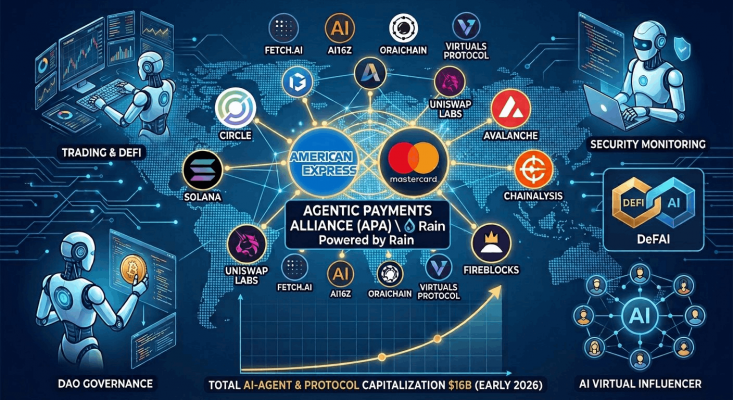
Payment giants Visa and Mastercard have joined the Agentic Payments Alliance (APA), an industry consortium established to develop standards for integrating autonomous artificial intelligence (AI) agents into payment systems.
The alliance also includes major players from the crypto industry, such as Circle, Solana, Uniswap Labs, Avalanche, Chainalysis, and Fireblocks, along with more than a dozen other fintech and blockchain companies. The initiative is being spearheaded by Rain, a provider of stablecoin payment infrastructure.
What the APA Aims to Achieve
The alliance’s primary objective is to develop standards that enable AI agents to operate safely and efficiently within the broader payments ecosystem. Its key areas of focus include:
• Joint research initiatives;
• Developing industry frameworks;
• Testing new standards for AI agent identity and authentication;
• Working with regulators on policy issues related to AI-powered commerce.
“The risk isn’t that the industry is moving too slowly—it’s that innovation is outpacing coordination,” said Sherri Haymond, Executive Vice President of Global Digital Partnerships at Mastercard.
According to McKinsey, the AI agent market could reach $3–5 trillion by 2030. However, the supporting infrastructure remains immature, with companies pursuing fragmented and often incompatible approaches. Without common standards, the industry could face significant interoperability issues, costly integration challenges, and operational inefficiencies as AI agents begin interacting with payment networks.
The APA’s mission is to bring together key industry participants to develop shared solutions and prevent market fragmentation.
How AI Agents Differ from Bots
Most people are already familiar with AI-powered chatbots, whether through automated customer service or conversational assistants. However, traditional AI bots operate within predefined rules and respond only to user prompts—they do not make independent decisions.
AI agents are fundamentally different.
An autonomous AI agent is a software system capable of setting goals, planning the steps required to achieve them, and executing tasks with minimal human intervention. Unlike conventional chatbots or AI assistants, an AI agent doesn’t simply respond to requests—it proactively initiates actions, adapts to changing circumstances, and manages entire workflows on its own.
How It Works
AI agents typically operate in a continuous decision-making loop often referred to as ReAct (Reason + Act):
1. Task Reception. The agent receives a goal from a user or a trigger from another system.
2. Analysis and Planning. A large language model (LLM) analyzes the objective, breaks it down into subtasks, identifies the required tools, and determines the execution sequence.
3. Action Execution. The agent uses the necessary tools—searching the web, accessing CRM systems or databases, sending emails, or working with files.
4. Result Evaluation. The agent assesses whether the objective has been achieved. If not, it revises its plan and repeats the cycle.
By early 2026, the combined market capitalization of projects centered on AI agents exceeded $16 billion. This figure represents the aggregate value of tokens and protocols where AI serves as the core technology, including Virtuals Protocol, Fetch.ai, ai16z, Oraichain, and others.
Today, AI agents do far more than execute trades. They manage DeFi portfolios, participate in DAO governance, monitor smart contract security, interact with Web3 applications, and even serve as virtual influencers. The emerging convergence of decentralized finance and artificial intelligence has given rise to a rapidly growing sector known as DeFAI (DeFi + AI).
Overall, AI agents are expected to become one of the most promising areas of the cryptocurrency industry and a major driver of its future growth.
The APA is not the first initiative focused on building standards for AI-powered payments. Earlier this year, Coinbase began developing similar infrastructure for autonomous AI transactions, while companies such as Google and Stripe are also contributing to the ecosystem’s evolution.
Nor is the APA the first collaborative effort in this space. Last September, Cloudflare and Coinbase launched the x402 Foundation to promote AI-native payments based on the x402 protocol.
What sets the APA apart is its scale. By bringing together many of the largest companies in payments, blockchain, and digital assets under one umbrella, the alliance has the potential to establish industry-wide standards that could shape the future of AI-driven commerce.
