
- Anatomy of a Heist Without a Hack
- The Governance Attack Explained
- Why It Happened
- History Repeats Itself
- The Team’s Response and the Aftermath
- How to Protect Yourself: Lessons for Investors
Decentralized finance (DeFi) has always been built on the premise of mathematical security: code is law. However, the recent incident involving the lending protocol Term Finance demonstrated that the weakest link in Web3 isn’t smart contracts—it’s governance.
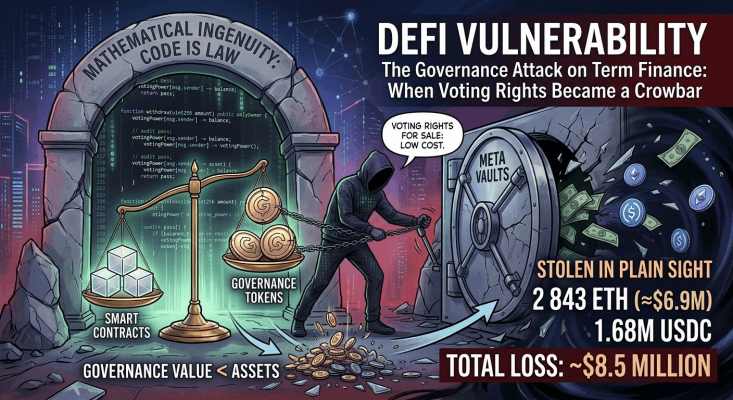
The attacker stole approximately $8.5 million, not by exploiting a bug in the code, but by legally acquiring enough voting power to approve a proposal that transferred the protocol’s funds. The incident exposed a fundamental flaw in the tokenomics of many DeFi projects: when the cost of controlling governance is lower than the value of the assets held by the protocol, theft becomes a profitable business strategy.
Anatomy of a Heist Without a Hack
The attack unfolded rapidly. The attacker drained approximately 2,843 ETH (around $6.9 million) and 1.68 million USDC, stealing roughly 68% of all assets held in the platform’s Meta Vaults.
Before the incident, the vaults managed approximately $12.45 million, with Ethereum accounting for about $8.8 million of that total.
The Governance Attack Explained
Most DeFi exploits rely on vulnerabilities such as reentrancy bugs or flash loan attacks. This time, everything happened through the protocol’s official governance process.
Buying voting power: Blockchain monitoring service Defimon reported that the attacker accumulated a large number of thinly traded governance tokens (TERM or related voting rights) on the open market. Their market value was negligible compared to the assets they ultimately controlled.
Passing a proposal: After securing a majority of voting power, the attacker submitted and single-handedly approved a governance proposal that modified the security parameters of the Meta Vaults.
Draining the funds: The newly approved configuration allowed the attacker to either withdraw the assets directly or redirect them to a wallet under their control using administrative privileges.
Yearn Finance, whose V3 infrastructure served as the foundation for the vaults, quickly distanced itself from the incident. According to the team, the exploit affected only the custom governance layer implemented by Term Finance, while Yearn’s underlying vault architecture remained uncompromised.
Why It Happened
The incident raises uncomfortable questions about decentralized governance. If protocol governance is based on tokens that trade freely on the open market, anyone with sufficient capital can effectively become the project’s dictator—for at least one day.
Journalist Shaurya Malwa, who covered the incident, captured the problem succinctly: obtaining control over the protocol cost the attacker far less than the assets the protocol controlled.
This is essentially a 51% attack in economic rather than computational terms. On networks like Bitcoin, taking control of consensus would require billions of dollars in mining hardware and electricity. In many DeFi protocols, however, acquiring governance control may cost only hundreds of thousands—or even less—if the governance token is illiquid.
When a protocol’s Total Value Locked (TVL) is measured in millions of dollars while its governance token can be accumulated for a fraction of that value, a dangerous economic imbalance emerges.
History Repeats Itself
Term Finance’s troubles didn’t begin with this attack.
In April 2025, the protocol suffered a critical oracle failure that supplied incorrect price data, triggering approximately 918 ETH in erroneous liquidations. The team was ultimately able to recover most of the funds and compensate affected users.
Following that incident, the developers pledged to improve governance transparency and introduce external oversight for protocol changes. Just over a year later, it became clear that “transparent governance” had become the protocol’s greatest security weakness. Instead of a technical flaw, the attack exploited the project’s own decision-making framework.
The Team’s Response and the Aftermath
The Term Finance team responded quickly, albeit after the attack had already occurred.
Meta Vaults have been permanently shut down.
New deposits have been disabled.
All administrative permissions have been revoked to prevent the attacker from accessing any remaining assets.
According to the project’s official statement, the protocol’s broader lending and borrowing markets were not affected. The team is now working with external blockchain security firms—potentially organizations such as Chainalysis or PeckShield—to track the stolen assets and, where possible, freeze them if they reach centralized exchanges.
Term Finance has also stated that it is exploring ways to compensate affected users, although no specific reimbursement mechanism or insurance fund has yet been announced.
How to Protect Yourself: Lessons for Investors
The Term Finance incident serves as a warning for anyone depositing assets into smaller liquidity pools or yield-generating vaults. Before trusting a DeFi protocol with your funds, consider the following:
Compare TVL with the governance token’s market capitalization. If a protocol controls $10 million while all governance tokens combined are worth only $50,000, it faces an extremely high risk of a governance attack.
Look for a Timelock. Well-designed protocols implement a Timelock—typically a 24- to 72-hour delay between the approval of a governance proposal and its execution. This gives the community time to detect malicious proposals and withdraw funds if necessary. Based on the speed of the Term Finance attack, either an effective Timelock was missing or it was successfully bypassed.
Examine token distribution. Always check wallet concentration. If 70–80% of governance tokens are held by a single address, the protocol isn’t truly decentralized—the controlling party already has unilateral authority.
The Term Finance incident illustrates how the DeFi industry is evolving from technical exploits toward economic manipulation. Today, the safety of your assets depends not only on the quality of smart contract code and security audits, but also on whether a protocol’s governance model is designed to prevent voting power from becoming a commodity that can simply be bought.
