

- Two Growth Paths for the Ethereum Ecosystem
- The Evolution of a Wallet: From Browser Extension to “Neobank”
- The Battle With the SEC and Lessons in Survival
- A Decade-Long Journey
- What Lies Ahead for Investors?
A major milestone is taking shape within the Ethereum ecosystem—one that could become a turning point for the entire Web3 industry. Consensys, the company founded by Ethereum co-founder Joe Lubin, has officially announced it will split into two independent entities.
Its flagship product, the MetaMask crypto wallet, used by millions of people worldwide each month, will become a standalone company with the goal of pursuing its own initial public offering (IPO). The move marks the end of the “garage startup” era for crypto giants and reflects their transformation into full-fledged financial corporations.
Two Growth Paths for the Ethereum Ecosystem
According to reports by Fortune, later confirmed by The Block, the corporate separation is expected to be completed by the end of 2026. For years, Consensys struggled with an inherent conflict in its business model, trying to serve both enterprise customers (B2B) by providing blockchain infrastructure and developer tools and consumer-facing products (B2C).
The new corporate structure will consist of two separate organizations:
1. MetaMask (Consumer Company)
Focused entirely on the retail market, the new company will be led by Joe Lubin himself. Beyond the wallet, MetaMask will encompass a growing ecosystem of products designed for everyday financial activity.
2. Consensys (Institutional Infrastructure)
The remaining Consensys organization will continue building critical Ethereum infrastructure, including:
• Infura, the backbone powering a large share of Ethereum decentralized applications (dApps);
• the Linea Layer 2 network;
• enterprise blockchain solutions.
The new institutional company will be led by CEO Mike Kriak.
According to Lubin, the restructuring is driven by growth. MetaMask is creating value faster than the company’s other business lines, evolving from a simple private-key wallet into a comprehensive financial platform.
“We see enormous opportunities ahead as MetaMask continues to mature,” Lubin said in an interview with Fortune.
The Evolution of a Wallet: From Browser Extension to “Neobank”
MetaMask has evolved from a modest browser extension launched in 2016 to interact with Ethereum smart contracts into a digital financial hub that brings together dozens of financial services. A major milestone in that transformation was the launch of Money Account.
The product is designed to bridge the gap between cryptocurrency and traditional finance (TradFi):
• Unified balance. Users can hold Bitcoin, ETH, USDC, and fiat currencies within a single account.
• Built-in yield. Integration with DeFi protocols lets users earn interest directly in the app without manually connecting to liquidity pools.
• Everyday spending. A Mastercard debit card lets users spend digital assets anywhere Mastercard is accepted, with cryptocurrency automatically converted to local currency at the point of sale.
Operating as an independent company could also allow MetaMask to pursue its own banking license or establish direct partnerships with major financial institutions without navigating the bureaucracy of its parent technology company. Such a move would pave the way for future products including insurance, credit services, and retirement savings solutions.
The Battle With the SEC and Lessons in Survival
The MetaMask spin-off is also a defensive strategic move.
In recent years, Consensys has faced significant regulatory pressure. Under the Biden administration, the U.S. Securities and Exchange Commission (SEC) pursued an aggressive enforcement campaign against the cryptocurrency industry.
Consensys found itself at the center of that campaign. The company went through multiple rounds of layoffs and lengthy legal disputes with regulators over ETH’s legal status and how decentralized software operates.
By separating the businesses, Lubin effectively isolates the company’s most profitable consumer asset from the regulatory risks associated with its infrastructure business. If regulators once again target services such as Infura or Linea, the MetaMask business would be better protected ahead of its planned public listing.
Lubin declined to comment on reports that Consensys had shelved its own IPO plans—originally expected in early 2026 following the crypto market downturn—or on the long-running community speculation surrounding a potential $MASK token.
A Decade-Long Journey
To appreciate the significance of this milestone, it’s worth looking back at how these companies evolved:
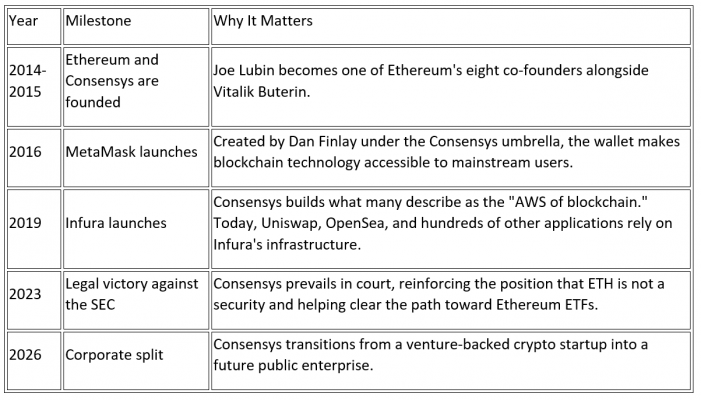
An interesting side note: despite being one of the primary builders of the Ethereum ecosystem, Consensys remained a privately held company for many years and largely stayed out of the public spotlight. However, the success of SharpLink Gaming—a publicly traded company also chaired by Joe Lubin that holds the world’s second-largest Ethereum treasury, with approximately 889,000 ETH worth around $2.17 billion—has demonstrated how effectively traditional capital markets can value and support crypto-focused businesses.
What Lies Ahead for Investors?
Although company executives have not disclosed a listing timeline, analysts believe the newly independent MetaMask could debut on either the Nasdaq or the New York Stock Exchange (NYSE) as early as early 2027.
For everyday users, the transition presents both opportunities and trade-offs.
Potential benefits:
• Faster product development and improved user experience.
• Deposit insurance comparable to FDIC protection.
• Deeper integration with Apple Pay and Google Pay.
Potential drawbacks:
• Pressure from public shareholders could lead to more aggressive monetization.
• Higher swap fees within the wallet.
• Increased promotion of third-party protocols and services.
The Consensys split signals that the cryptocurrency industry has entered a new stage of maturity. To attract trillions of dollars in traditional capital, the sector’s leading companies must increasingly operate according to Wall Street’s expectations. The first major step in that transformation may be turning the familiar fox icon in millions of browsers into a multi-billion-dollar public company: MetaMask Inc.
