
- Who Will Take the Lead—The CFTC or the SEC?
- What Is a “Mature Blockchain”?
- Special Measure 6: A Blow to the Global Market
- The Venture Capital Perspective
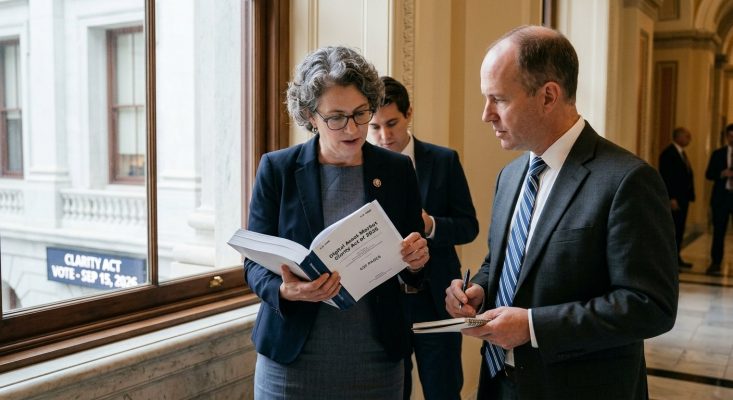
In the halls of the U.S. Capitol, lawmakers are putting the finishing touches on a bill that could shape the future of cryptocurrencies for the next decade. The Digital Asset Market Clarity Act of 2025, better known as the CLARITY Act, is a monumental 635-page piece of legislation.
The bill is designed to end the era of “regulation by enforcement,” during which the SEC, under Gary Gensler, attempted to regulate the crypto industry through litigation based on the outdated 1946 Howey Test. If passed—as the Senate vote is expected on September 15, 2026—the CLARITY Act would establish the first comprehensive legal framework in U.S. history for a trillion-dollar digital asset market.
Who Will Take the Lead—The CFTC or the SEC?
The biggest problem facing the U.S. crypto market has always been the jurisdictional conflict between regulators. The SEC has argued that nearly every cryptocurrency is a security, while the CFTC has maintained that many digital assets should be treated as commodities. The CLARITY Act draws a clear line between their responsibilities by introducing the concept of a “Mature Blockchain.”
Three Categories of Digital Assets
Investment Contracts (SEC): These are tokens sold to investors with an expectation of profits derived from the efforts of others, such as traditional ICO projects. Nothing changes here—the SEC retains strict oversight.
Digital Commodities (CFTC): Once a blockchain network becomes sufficiently decentralized—meeting the criteria of a “mature blockchain”—its native token falls under the jurisdiction of the Commodity Futures Trading Commission (CFTC). This category includes networks such as Ethereum, Solana, Cardano, and other Layer 1 and Layer 2 blockchains. These assets would gain a clearer path toward spot ETFs and regulated derivatives markets.
Stablecoins: Stablecoins are regulated separately alongside the recently enacted GENIUS Act. The legislation requires stablecoins to be backed 100% by U.S. dollars or short-term U.S. Treasury securities.
What Is a “Mature Blockchain”?
The CLARITY Act introduces objective criteria for determining whether a blockchain network is sufficiently decentralized. A network is considered “mature” if:
• Developers no longer control the administrative keys for smart contracts.
• No centralized entity has unilateral authority to change token issuance or freeze transactions.
• Miners or validators are geographically distributed.
• Once a project demonstrates sufficient decentralization, regulatory oversight shifts from the SEC to the generally more crypto-friendly CFTC.
Winners and Losers Under the New Regulatory Framework
The adoption of this 635-page bill would inevitably reshape capital flows across the crypto industry. Analysts estimate that roughly $680 billion worth of altcoins currently exist in a regulatory gray area.
Potential Winners
Infrastructure Networks (ETH, SOL): Institutional investors would finally be able to purchase these assets without the constant threat of SEC enforcement. The market is expected to see an entire wave of new exchange-traded investment products.
Tokenized Real-World Assets (RWAs): Projects such as Ondo Finance and Centrifuge would benefit from clear rules governing the issuance of tokenized securities. Traditional asset managers like BlackRock and Fidelity could significantly expand the tokenization of real estate, bonds, and other financial assets on blockchain networks.
Compliance-Focused DeFi: Decentralized exchanges are expected to integrate institutional-grade KYC gateways. Platforms that implement compliant infrastructure first could capture a significant share of the institutional B2B trading market.
Potential Losers
Privacy Coins (Monero, Zcash): New AML requirements would make listing privacy-focused cryptocurrencies on licensed U.S. trading platforms extremely difficult, pushing much of their liquidity into less regulated markets.
Algorithmic Stablecoins:The era of projects like USN appears to be over. The legislation requires stablecoins to maintain full fiat-backed reserves.
Memecoins: If a token cannot demonstrate meaningful utility or a credible roadmap toward decentralization, it may remain permanently classified as an unregistered security.
Special Measure 6: A Blow to the Global Market
One of the most controversial sections of the bill concerns anti-money laundering (AML) enforcement. It introduces Special Measure 6, a mechanism that would give the U.S. Treasury Department broad authority to rapidly restrict transactions involving specific jurisdictions or categories of financial activity considered high risk.
Trump’s Response and the Senate Battle
The CLARITY Act has become a battleground not only for regulators but also for politicians. The outcome of the September 15 Senate vote remains uncertain. To move the legislation forward, supporters must secure 60 votes to invoke cloture and end debate.
The Donald Trump Factor
One of the biggest obstacles has been ethics concerns surrounding the business interests of the sitting president. Democrats argue that the Trump family’s involvement with World Liberty Financial and several memecoin projects creates a conflict of interest. According to critics, the current version of the CLARITY Act contains loopholes that could allow the president’s family to continue issuing digital tokens without sufficient regulatory oversight.
Republicans counter that the legislation is intended to establish rules for the entire industry rather than target any individual. Donald Trump responded forcefully to the debate during a campaign rally in Pennsylvania, saying:
“Biden and his friends want to kill crypto with mountains of paperwork. They’re writing 600 pages of nonsense! I’ll make America the Bitcoin capital of the world, and we’ll get rid of half these rules on day one!”
At the same time, many analysts point out an apparent paradox: the passage of the CLARITY Act could actually make Trump’s vision of turning the United States into the global crypto capital far more achievable by providing the legal certainty needed to attract institutional capital from Wall Street.
The Venture Capital Perspective
Leading venture capital firms, including Andreessen Horowitz (a16z), have spent the past two years lobbying in support of the CLARITY Act. As early as May, they warned that if the legislation failed to pass, startups, developers, and billions of dollars in investment would continue relocating to jurisdictions such as Singapore, Dubai, and Hong Kong. In their view, the United States risks losing the global Web3 race by creating an increasingly hostile environment for innovation.
If the bill ultimately fails, the industry could face another two years of legal uncertainty and regulatory battles. However, after years of frustration with the regulatory approach pursued under Gary Gensler and given the political support behind the legislation, the chances of the United States adopting its first truly comprehensive cryptocurrency regulatory framework appear stronger than ever. For now, the crypto industry—and the broader financial world—is waiting to see what happens next.
