
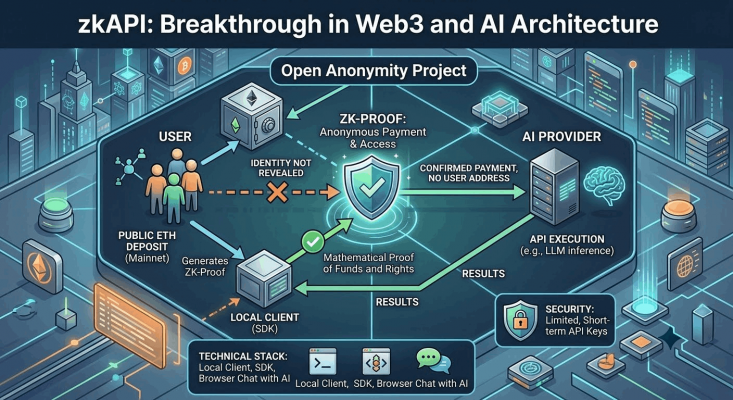
- How to Pay Without Showing Your Wallet
- Technical Stack and Developer Tools
- From Buterin’s Idea to Working Code
- The Limits of Anonymity: What zkAPI Does NOT Hide
- What Does Payment Anonymity Give You?
- The Future: ZK as a Privacy Layer for the Entire Internet
In an era of total surveillance, data has become the new oil, and user identity is a byproduct of any transaction. When you pay for a subscription to ChatGPT, Midjourney, or any other AI-based service, you leave an indelible digital footprint. The service provider knows your name, card details, IP address, and most importantly, the content of your prompts.
The zkAPI project, in collaboration with the Ethereum Foundation, has made a breakthrough that could transform the architecture of Web3 and AI. Recently, the team launched the Open Anonymity Project on the Ethereum Mainnet. This is the first working system that allows payment for API access (including complex AI computations) using zero-knowledge (ZK) proofs, completely separating the payment from the payer’s identity.
How to Pay Without Showing Your Wallet
The traditional API payment model is built on trust and identification. You link a card, create an account, and every action you take is logged. zkAPI flips this scheme by using zero-knowledge cryptography.
How Does the Open Anonymity Project Work?
At its core, the technology is to prove to the system that you have the right to access without revealing the source of this right.
Anonymous Deposit: A user deposits funds (for example, ETH or stablecoins) into a shared “vault contract” on the Ethereum network. At this point, the blockchain records the fact of the funds’ existence, but does not link them to the user’s specific address in the context of future transactions.
ZK-Proof Generation: When a user needs to access an API, their local client generates a cryptographic proof. This proof mathematically confirms: “I have sufficient funds held in the vault to pay for this request, and I am a legitimate participant in the system,” while not revealing specific user deposits or their total balance.
Layer Separation: The payment layer (blockchain) and execution layer (AI server) operate in parallel. The AI provider receives payment confirmation from the smart contract but does not see the wallet address from which the verification request originated.
Vittorio Rivabella, AI coordinator for the Ethereum Foundation’s dAI team, describes this as a shift toward a “pay-as-you-go without identity disclosure” model.
Technical Stack and Developer Tools
Mainnet launch is not just a theoretical concept. zkAPI has released a ready-made toolkit for integration:
Local client: A terminal program that allows developers to route requests through the ZK layer.
SDK (Software Development Kit): Libraries for easy integration of private payments into existing applications.
Browser-based AI chat: A demo interface where anyone can test the system by chatting with a neural network anonymously.
The system issues short-lived API keys with fixed spending limits. This is critical for security: even if a key is compromised, an attacker can only spend a limited amount, and the key itself will expire after a short time.
From Buterin’s Idea to Working Code
The emergence of zkAPI was not accidental. It is the result of the evolution of ideas that underpin Ethereum.
This February, Ethereum Foundation researcher Davide Crapis and network co-founder Vitalik Buterin published a conceptual proposal on “API usage credits based on ZK-proofs”.
Their idea was to solve a fundamental problem: how to make expensive computations (such as video generation or model training) accessible in a decentralized environment without creating centralized billing systems. Buterin and Crapis’s proposal became a roadmap, and zkAPI was the first real-world implementation of those ideas. They aimed to create a system of private prepaid access where trust is replaced by verifiable mathematics.
The Limits of Anonymity: What zkAPI Does NOT Hide
Despite the technological breakthrough, it is important to understand the system’s limitations. zkAPI provides financial privacy, but it is not a panacea for complete anonymity on the network.
1. Prompt contents
The project encrypts the payment itself, but not the request content. If you send confidential data to an AI provider (for example, your company’s source code or medical records), the service provider can still read them in plain text. zkAPI protects your wallet from the provider, but does not protect your data within the prompt.
2. Network metadata
This is the weakest point of any privacy system. API providers can still observe:
IP address: It can be used to determine your approximate location and internet service provider.
Timestamps: Access time can be matched with your other online activities.
Browser fingerprint: Your browser’s unique settings can reveal your identity even when using a VPN.
As the developers note, providers can potentially match users across sessions. If you visited an AI service website without network protection (Tor or VPN), and then paid for access through zkAPI, an advanced analyst could link your identity to your “anonymous” wallet through your device’s digital fingerprint.
What Does Payment Anonymity Give You?
The launch of zkAPI solves a problem that many in Web3 preferred to ignore: the incompatibility of public blockchain and corporate secrecy.
For traders and funds: Using trading bots requires access to exchange APIs or analytics services. Previously, this meant that a hedge fund had to disclose its strategies and balances to any API provider. Now they can pay for data without revealing their identities.
For DeFi: Protocols can request data from oracles or computational networks without revealing the logic of their arbitrage strategies.
For censorship resistance: In authoritarian regimes, paying for subscriptions to independent AI models can be dangerous. zkAPI allows supporting developers anonymously.
The Future: ZK as a Privacy Layer for the Entire Internet
The launch of zkAPI on Mainnet is a step toward realizing the concept of Privacy-as-a-Service. We are moving from an internet where we pay for all “free” services with our data, to an internet where we pay with cryptocurrency while retaining our right to privacy.
However, like with Tornado Cash, the success of the technology will attract the attention of regulators. The ability to anonymously pay for computing power is a powerful tool for both protecting human rights and potential abuse.
The next stage for zkAPI will be integration with decentralized data transmission networks (such as IPFS or Arweave) and the implementation of ZK-contracts that will be able to hide not only the identity of the payer, but also the logic of the computations being performed. For now, developers and users now have the first “invisible wallet” for the AI era.
