
Bitcoin Hack Odds Assessed by AI at 76%: How Quantum Computing Could Rewrite the Rules
How Google Changed the Security Equation
The New Math of Breaking Bitcoin
AI’s Role in the Coming Quantum Apocalypse
The cryptocurrency industry has grown accustomed to worrying about hackers, phishing attacks, and smart contract vulnerabilities. But the next major threat—one capable of undermining digital gold itself—doesn’t come from cybercriminals. It comes from the laws of physics.
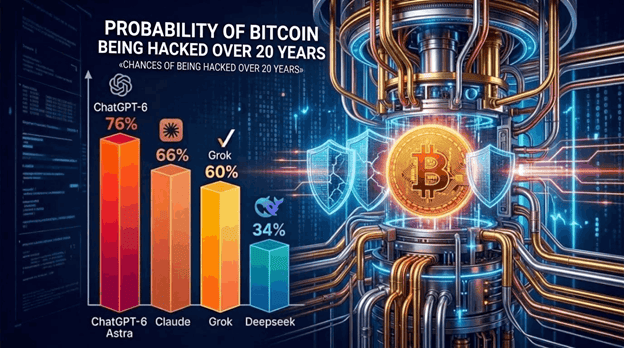
On October 11, market analyst Willy Woo shared findings that prompted many Bitcoin holders to take another look at their hardware wallets. Estimates generated by leading artificial intelligence models suggest a sobering possibility: there is up to a 76% probability that Bitcoin’s digital signature schemes—ECDSA and Schnorr—could be broken within the next 20 years.
This is not science fiction. It is a mathematical forecast based on the rapid progress of quantum computing and machine learning.
AI’s Verdict
According to a report from Bitcoin.com News, researchers asked four leading AI models to assess Bitcoin’s long-term cryptographic security. Their conclusions split the community between skeptics and alarmists:
ChatGPT-6 Astra: The most pessimistic estimate, assigning a 76% probability that Bitcoin’s signatures could be practically broken within 20 years.
Claude: Estimates the likelihood at 66% over the same period.
Grok: Places the probability at 60%.
DeepSeek: The most conservative model, estimating the risk at 34% over 20 years.
The Short-Term Outlook
For now, there is little reason to panic. The AI models estimate only a 1.3% chance of Bitcoin’s signatures being broken within the next two years. Today, there is neither a classical mathematical attack capable of defeating the secp256k1 elliptic curve nor a quantum computer powerful enough to do so.
However, the fact that advanced AI systems assign a 76% probability to a successful attack within two decades suggests that Bitcoin’s cryptographic foundation may have an expiration date.
How Google Changed the Security Equation
For years, quantum computing was viewed as a largely theoretical threat. The prevailing assumption was that breaking Bitcoin’s 256-bit cryptography would require millions of physical qubits.
That assumption changed dramatically in March 2026, when researchers at Google Quantum AI published a white paper that sent shockwaves through the industry. Their work reduced the estimated number of physical qubits required to run Shor’s algorithm—the quantum algorithm capable of breaking asymmetric cryptography—by a factor of 20.
The New Math of Breaking Bitcoin
Previous estimates: Between 1 million and 20 million physical qubits would be required to reliably break ECDSA-256.
Current estimate (2026): Google argues that fewer than 500,000 physical qubits could be sufficient.
That does not mean Google already possesses such a machine. We are still living in the NISQ (Noisy Intermediate-Scale Quantum) era, where quantum processors remain noisy and relatively small. Today’s systems contain only around 100–200 logical qubits.
Nevertheless, reducing the hardware requirements by twentyfold transforms the challenge from something that once seemed impossible within this century into what increasingly looks like an engineering problem that could potentially be solved within the next 10 to 15 years.
Google was quick to reassure the market, stating that its current Willow quantum processor poses no threat to Bitcoin. Researchers at Chaincode Labs and the Quantum Threat Timeline project, however, remain concerned. They estimate a 50% probability that a cryptographically relevant quantum computer (CRQC) could emerge as early as 2032.
A Vulnerable Foundation: Why Satoshi’s Coins Are at Risk
Bitcoin’s security relies on asymmetry. Public keys are meant to be shared openly, while private keys remain secret. A classical computer would need billions of years to derive a private key from its corresponding public key. A quantum computer running Shor’s algorithm could potentially accomplish the same task in minutes.
The Scale of the Threat
The danger is amplified by the architecture of Bitcoin’s earliest addresses.
P2PK (Pay-to-Public-Key): In Bitcoin’s earliest blocks, including those mined by Satoshi Nakamoto, coins were sent directly to public keys, which are permanently exposed. Experts estimate that roughly 1.1 million BTC associated with Bitcoin’s creator could be vulnerable.
P2PKH and address reuse: Modern transaction formats—including SegWit and Taproot—reveal a public key only when coins are spent. However, millions of users repeatedly reused the same addresses over many years, permanently exposing their public keys.
Overall exposure: According to SynxCrypto and Chaincode Labs, between 4 million and 6.9 million BTC—roughly 32% of Bitcoin’s total supply—resides in addresses with publicly exposed keys.
If a sufficiently powerful quantum computer became available tomorrow, an attacker could theoretically scan the blockchain, derive private keys for every exposed public key, and drain hundreds of billions of dollars’ worth of Bitcoin within hours. This scenario has become known as the “Quantum Apocalypse.”
AI’s Role in the Coming Quantum Apocalypse
Why Do AI Models Assign Such High Probabilities?
As Willy Woo noted, this is a textbook example of the gap between the map and the territory.
The map (our cryptography): It tells us Bitcoin is secure because the underlying mathematical problems are computationally infeasible for classical computers.
The territory (reality): Adversaries may already be collecting encrypted data today with the intention of decrypting it years from now, once quantum technology matures.
AI models evaluate more than today’s quantum hardware. They also consider technological growth rates, government investment in quantum research, advances in quantum error correction, and ongoing developments in mathematical cryptanalysis.
It is important to emphasize that AI itself has not produced any breakthrough in classical cryptanalysis.
The secp256k1 elliptic curve remains resistant to attacks powered solely by machine learning. The real threat comes from the physics of quantum computation—not artificial intelligence.
Community Response and the Road to Recovery
Recognizing the long-term threat, Bitcoin developers have already begun preparing.
The activation of Taproot in 2021 introduced Schnorr signatures. While Schnorr signatures are also vulnerable to Shor’s algorithm, they are more compact and provide a more flexible foundation for integrating future post-quantum cryptographic (PQC) schemes.
Bitcoin’s Path Forward
One possible solution is a soft fork introducing new address formats based on quantum-resistant cryptography, such as lattice-based algorithms including CRYSTALS-Kyber and CRYSTALS-Dilithium. The community is also considering a large-scale migration that would require users to voluntarily move funds from vulnerable addresses—such as P2PK and reused P2PKH addresses—to quantum-safe ones. Perhaps the most difficult issue concerns dormant coins, particularly Satoshi Nakamoto’s estimated 1.1 million BTC.
If those coins became vulnerable to a quantum attack, they could suddenly re-enter circulation, potentially triggering a massive market shock. The Bitcoin community would ultimately have to decide whether transactions signed using a quantum computer should be recognized as valid.
From Abstract Theory to Concrete Deadlines
Throughout the 2010s, quantum computing was largely viewed as an abstract concern discussed primarily among cryptographers. During the 2020s, as IBM and Google demonstrated increasingly capable quantum processors such as Eagle and Sycamore, the threat became more tangible.
The year 2026 marked a turning point. Google’s research significantly shortened projected timelines, while AI models assigning a 76% probability to a successful attack shifted the conversation toward risk management.
The question is no longer whether Bitcoin should prepare for quantum computing.
It is when the protocol must evolve.
If ChatGPT-6 Astra’s forecast proves accurate, humanity has less than two decades to migrate the world’s most valuable decentralized database onto quantum-resistant cryptography. Otherwise, digital gold could eventually become an open book for whoever builds the first truly cryptographically relevant quantum supercomputer.

Our Bitcoin mixer publishes a weekly roundup
of interesting news from the world of cryptocurrencies.
Visit our blog: Mixer.money