
A Safe Haven for Digital Gold: Why Bitcoin’s Volatility Has Fallen to 43%—Lower Than One in Five S&P 500 Companies
Bitcoin vs. Wall Street: Surprising Numbers
Why Does Volatility Matter for Bitcoin’s Price?
For more than a decade, the cryptocurrency industry has been defined by one enduring stereotype: Bitcoin is an extremely risky asset capable of doubling—or wiping out—an investment portfolio overnight. But fresh data from investment giant Grayscale challenges that long-held assumption..
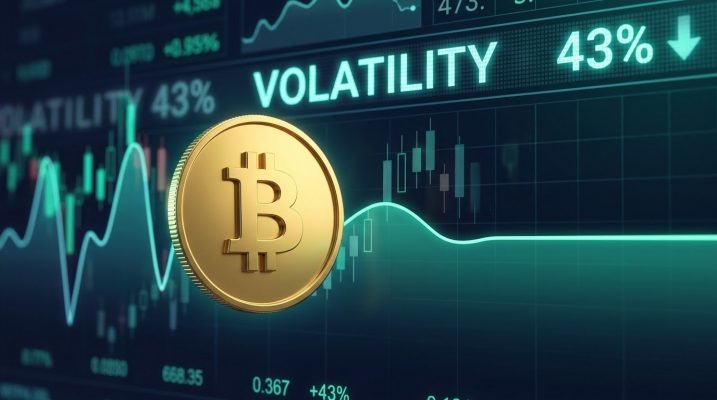
According to a report published by analyst Frank Chaparro, Bitcoin’s realized annual volatility has dropped to 43%. By comparison, the cryptocurrency’s 10-year average stands at 64%, while volatility reached an eye-catching 81% just five years ago.
The most remarkable finding, however, is not the absolute number but how Bitcoin compares with traditional financial markets. As of October 6, 2026, Bitcoin was less volatile than approximately 19% of the companies in the S&P 500. Digital gold has become more stable than Coinbase stock and trails giants like Amazon by only a relatively small margin.
The Evolution of an Asset: From the Wild West to Institutional Maturity
The decline in volatility from 81% five years ago to 43% today is not a statistical anomaly. It reflects a fundamental shift in Bitcoin’s market structure.
1. The Rise of Institutional Capital
Between 2020 and 2022, Bitcoin’s price was driven largely by retail investors and highly leveraged speculators. Market sentiment was fueled by emotion—FOMO during rallies and panic selling during downturns.
Today, the landscape looks very different. According to multiple market research firms, institutional investors—including pension funds, university endowments, and insurance companies—now control a significant share of Bitcoin’s available supply through spot Bitcoin ETFs. These investors rely on algorithmic trading, long-term investment strategies, and disciplined risk management rather than emotion. As a result, large pools of institutional liquidity help absorb sharp price swings.
2. The Impact of Spot Bitcoin ETFs
The launch and regulatory approval of spot Bitcoin ETFs from BlackRock, Fidelity, Grayscale, and other major asset managers have created a buffer between the cryptocurrency market and retail sentiment. Investors can now gain exposure to Bitcoin through traditional brokerage accounts without managing wallets or private keys. This has reduced operational risks for newcomers while making capital inflows into Bitcoin more predictable and less emotionally driven.
3. A More Mature Derivatives Market
Bitcoin’s futures and options markets have become significantly deeper over the past five years. Professional market makers increasingly use derivatives to hedge risk rather than liquidating spot holdings during periods of volatility. Instead of triggering cascading selloffs, institutional investors can offset market exposure through options strategies, smoothing price movements and reducing the likelihood of extreme “black swan” events.
Bitcoin vs. Wall Street: Surprising Numbers No One Expected
Grayscale’s data challenges the perception that cryptocurrencies are automatically the riskiest assets in an investment portfolio. Comparing realized annual volatility—measured as the standard deviation of returns—produces the following results.
| Asset | Realized Annual Volatility | Asset Class |
|---|---|---|
| Bitcoin (BTC) | 43% | Digital Asset |
| Amazon (AMZN) | 31% | Technology & E-commerce |
| JPMorgan (JPM) | 20% | Banking |
| Coinbase (COIN) | 70% | Cryptocurrency Exchange |
| SanDisk (SNDK) | 110% | Semiconductors |
What These Comparisons Tell Us
- Bitcoin vs. Amazon (43% vs. 31%): The gap has narrowed to a minimum. Investing in the world’s largest online retailer is now only about 12 percentage points less volatile than investing in Bitcoin. For an asset once viewed as purely speculative, this represents a remarkable transformation.
- Bitcoin vs. Coinbase (43% vs. 70%): Ironically, the company that earns revenue from cryptocurrency trading is nearly twice as volatile as Bitcoin itself. Coinbase shares are influenced not only by Bitcoin’s price but also by regulatory developments, competitive pressures, and company-specific operational risks.
- Bitcoin vs. SanDisk (43% vs. 110%): Memory-chip manufacturers have traditionally experienced high volatility because of cyclical demand. Against that backdrop, Bitcoin increasingly resembles a relatively conservative long-term investment.
- Bitcoin vs. JPMorgan (43% vs. 20%): America’s largest bank remains considerably more stable thanks to its deposit base and established financial position. Even so, Bitcoin’s volatility—roughly double JPMorgan’s—no longer represents the enormous gap seen during the 2017 bull market.
The fact that Bitcoin is now less volatile than 19% of the companies in the S&P 500 shows that it is no longer an outlier. The index includes numerous smaller-cap companies, biotechnology firms, and energy businesses whose shares fluctuate far more dramatically than BTC.
Why Does Volatility Matter for Bitcoin’s Price?
For long-term investors, lower volatility is generally a positive development because it allows for larger portfolio allocations. According to Modern Portfolio Theory (MPT), an asset that maintains strong returns while reducing volatility improves a portfolio’s overall risk-adjusted performance, often measured by the Sharpe ratio.
- Broader Acceptance in Conservative Portfolios: Asset managers that previously avoided Bitcoin because of its 80% drawdowns can now justify allocating capital to an asset with volatility approaching that of major technology companies.
- Lower Borrowing Costs: As volatility declines, crypto lending platforms and centralized exchanges can potentially offer lower collateralized lending rates, since the risk of forced liquidations decreases.
- Improved Investor Psychology: Investors are generally less likely to panic when daily price movements average 2–3% instead of 15%, making it easier to hold your positions during market corrections.
Historical Context: The Growth Paradox
Young, rapidly expanding asset classes are typically characterized by high volatility, which gradually declines as markets mature. Bitcoin presents a unique case. Despite growing into a multi-trillion-dollar asset class, it has continued to generate attractive returns while becoming significantly less volatile.
This trend reflects increasing market depth. The amount of liquidity required to move Bitcoin’s price by 5% today is measured in billions of dollars, whereas only a few hundred million dollars could produce similar price swings in 2017.
Looking Ahead
Bitcoin’s decline in volatility to 43% does not mark the end of its evolution—it represents another milestone in its integration into the global financial system.
Critics may argue that Bitcoin is sacrificing explosive upside in exchange for stability. But that tradeoff may ultimately be the price of legitimacy. An asset that increasingly behaves like a large-cap technology stock is far more likely to earn a permanent place in pension funds, insurance portfolios, and other pools of conservative institutional capital.
Grayscale’s data suggests that Bitcoin has evolved beyond being merely a speculative bet on emerging technology. It has matured into a macroeconomic asset competing for portfolio allocations alongside companies such as Amazon and JPMorgan—and, based on current statistics, it is proving to be a compelling contender.

Our Bitcoin mixer publishes a weekly roundup
of interesting news from the world of cryptocurrencies.
Visit our blog: Mixer.money