
- Security and the Transition Period
- Building the Architecture of a Legal Crypto Market
- Taxes, Risks, and a Gateway to Asia
- International Cooperation: The EAEU as a Crypto Hub
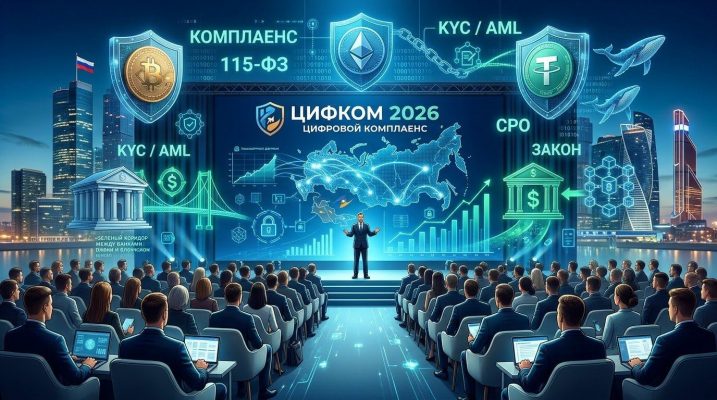
On November 12, 2026, Moscow became the center of a discussion that could shape the future of digital assets across Eurasia for decades to come. While many Western countries continue searching for ways to restrict or ban cryptocurrencies, Russia has chosen a path of deep integration. The results of the CIFCOM 2026 (Digital Compliance) conference, which brought together more than 600 participants from multiple countries, suggest that the era of the “Wild East” in Russia’s crypto industry has officially come to an end. A new phase is beginning—one defined by strict compliance, transparent crypto exchange services, and institutional capital.
The event highlighted an unprecedented level of cooperation between government authorities and private businesses. Striking the right balance between investor protection, financial transparency, and conditions that foster digital innovation is no longer a theoretical objective. At CIFCOM 2026, participants presented concrete roadmaps for achieving those goals.
Security and the Transition Period
Security and the Transition Period
One of the defining characteristics of CIFCOM 2026 was the caliber of its speakers. Regulators who viewed cryptocurrencies with skepticism just five years ago shared the stage with industry pioneers who built the market in a legal vacuum.
Alexander Shoitov on Information Sovereignty
Alexander Shoitov, Deputy Minister of Digital Development of the Russian Federation, set the tone for the conference by focusing on cybersecurity and information sovereignty. His remarks sent a clear message: Russia is not merely permitting cryptocurrency—it intends to protect the industry’s infrastructure at the national level.
Industry-specific security requirements: Shoitov emphasized that cybersecurity standards for crypto exchanges and exchange services cannot simply replicate those used in the banking sector. The fast-moving nature of Web3 requires security frameworks that are both flexible and rigorous.
Protecting critical infrastructure: Against the backdrop of growing geopolitical tensions, safeguarding cryptocurrency exchanges and digital asset custody infrastructure from external attacks has become a matter of national security. The government is prepared to provide methodological support, provided that businesses maintain full transparency in their data storage and operational practices.
Anton Tkachev on Regulatory Reform
State Duma Deputy Anton Tkachev, one of the key speakers during the regulation panel, addressed one of the industry’s most sensitive issues—the legalization of previously accumulated crypto assets.
Tkachev discussed the future operating model for cryptocurrency exchange services and, more importantly, introduced the concept of a transitional period for crypto asset holders.
In practice, this amounts to a form of capital amnesty. To bring the market out of the shadows, lawmakers are considering a framework that would allow large cryptocurrency holders—often referred to as “whales”—to legalize their portfolios through authorized banks and licensed exchange services without facing criminal liability for past transactions. Many of these investors had previously feared account freezes under Federal Law No. 115-FZ on anti-money laundering. The proposal could provide a strong incentive for capital to return to the Russian financial system.
Building the Architecture of a Legal Crypto Market
While government officials outlined the strategic direction, lawyers and entrepreneurs focused on the building blocks of the new regulatory framework. One of the conference’s centerpiece presentations came from Andrey Tugarin, founder of the law firm GMT Legal.
The End of the “Offline Exchange Office” Era
Tugarin provided a detailed overview of the new legislation expected to take effect in the near future. Its primary target is the unregulated peer-to-peer (P2P) crypto market.
Licensing and compliance standards: Cryptocurrency exchange services will no longer be allowed to operate in a regulatory gray area. Legal operation will require more than simply registering a legal entity. Businesses will have to comply with strict Know Your Customer (KYC) and Anti-Money Laundering (AML) requirements.
Institutionalization through self-regulatory organizations (SROs): One of the conference’s most significant proposals was mandatory membership in self-regulatory organizations for all cryptocurrency exchange services.
This reflects a familiar Russian regulatory model: the government establishes the legal framework while the industry is responsible for policing itself through SROs. These organizations would assume collective responsibility for their members, maintain internal blacklists of fraudulent operators, and establish professional and ethical standards. For businesses, this means additional membership costs. For the market as a whole, it promises significantly greater trust from banks and institutional partners.
Building the Banking Bridge
Representatives of Russia’s banking sector appeared far more confident at CIFCOM 2026 than they had at previous industry events. Whereas banks once closed customer accounts at the slightest indication of USDT-related activity, discussions have now shifted toward creating regulatory “green corridors.”
The new legal framework provides banks with much-needed regulatory certainty. If a cryptocurrency exchange service is licensed and belongs to an SRO, financial institutions gain a clear understanding of how to process its transactions while remaining compliant with Central Bank requirements. This could finally pave the way for legal payment acquiring services for crypto businesses—a longstanding challenge for Russian entrepreneurs.
Taxes, Risks, and a Gateway to Asia
No discussion of cryptocurrency regulation is complete without addressing taxation. At CIFCOM 2026, tax policy debates were notably pragmatic. Industry representatives acknowledged that profits from digital asset transactions would inevitably be taxed but argued in favor of a differentiated approach.
Mining: Participants called for cryptocurrency mining to be formally recognized as an industrial activity, allowing miners to qualify for preferential electricity pricing.
Investment: Speakers advocated a clear distinction between speculative trading income and long-term cryptocurrency holdings (HODLing), ensuring that tax policy does not discourage long-term investors.
International Cooperation: The EAEU as a Crypto Hub
One of the conference’s most productive discussions focused on cooperation between Russia and neighboring countries. Representatives from Kazakhstan, Kyrgyzstan, and Belarus participated in sessions dedicated to cross-border collaboration.
A clear trend emerged: while Europe and the United States continue building what many participants described as a “crypto Iron Curtain” around Russian digital assets, EAEU member states are working to establish a unified regulatory and security framework.
Kazakhstan: Shared its experience regulating cryptocurrency mining after developing a much stricter regulatory model in response to its domestic energy crisis.
Belarus: Discussed extending and modernizing its landmark Decree No. 8 to reflect the realities of deeper economic integration with Russia.
Kyrgyzstan: Positioned itself as a potential regional hub for cross-border stablecoin settlements.
Conference participants agreed that Russia’s strong IT sector and large domestic market position it to become a regulatory trendsetter across the Commonwealth of Independent States (CIS). Countries that align their legislation with Russian digital compliance standards could eventually gain access to the liquidity of the Moscow Exchange and the broader Russian banking system.
The final CIFCOM 2026 resolution carried a clear message: “The door to the regulated market is open. The rules are clear. Those who fail to adapt will remain in the jurisdiction of Telegram bots and risk losing everything.” Russia is building its own model of digital financial sovereignty, and within that ecosystem, the rules of the game will increasingly be shaped by Moscow, self-regulatory organizations, and a new generation of legal professionals.
