
- A wallet with an absolute protection from centralization
- Simplicity is the key to success
- The technical solution
Eco Inc. has secured funding in the amount 95 million US dollars from investors, including the venture capital firm a16z. Recently, the company launched a decentralized wallet called Beam, described by Eco Inc.’s CEO Andy Bromberg as a non-custodial payment system.
A wallet with an absolute protection from centralization
As the new wallet is non-custodial, no banks, exchanges, or other centralized parties have access to the funds of its users. This is an appealing option for customers, especially after the collapse of FTX. Not being linked to the user’s identity, Beam is the perfect choice for anyone who seeks financial privacy.
Simplicity is the key to success
Andy Bromberg explains that many self-custodial wallets require their customers to possess certain technical knowledge, making them difficult to use. Beam aims to make decentralized wallets simple and intuitive so that even newbies without any technical background could get started within minutes.
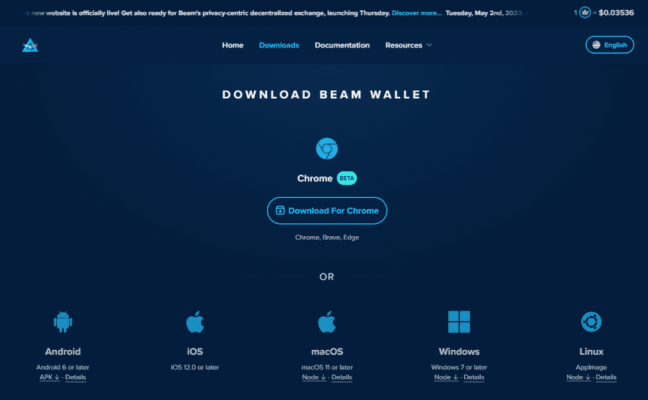
To use a Beam wallet, a new user needs to visit the wallet’s website, where a QR code linked to its address is automatically generated. After that, one can transfer USDC stablecoins from their other wallets or use Moonpay, the popular service for converting fiat money into cryptocurrencies. To transfer crypto to other users, one can share a wallet URL containing the cryptocurrencies. No further setting up is required.
Although these options may seem rather simple compared to the wide range of features offered by Web 2.0 payment apps, according to Andy Bromberg, “it’s so much harder to do things decentralized.”
The CEO added that the app will be available throughout the world at once. In this way, the new wallet differs from traditional financial products that, according to Bromberg, “need to be launched country by country because you have to be touching the banking rails in every country.”
The wallet has a limited set of features and supports only certain tokens and interactions. However, according to the developers, this is the key to security and reliability. While so far Beam is targeting only peer-to-peer payment scenarios, in the future its developers hope for it to become the global Visa.
The technical solution
“I think literally until the last few months, it wasn’t possible to build something that felt as seamless and easy as cash. And now it is with account abstraction, roll-up development and new blockchains, that we’ve built this really compelling, really easy wallet,” Andy Bromberg commented.
Account abstraction allows adding new functionalities to wallets such as social recovery. This eliminates the need for a 16-word seed phrase to recover lost crypto and makes using the self-custodial wallets that much easier. Account abstraction is possible thanks to a new Ethereum standard, ERC-4337, which has facilitated the appearance of a new class of programmable “smart contract wallets.”
Functioning as a smart contract, Beam has its access keys kept over three places — the user’s Twitter account, password, and browser. Any two of these keys can be used to reconstruct the original key.
Beam is also replacing complicated wallet addresses with ENS domain names, Ethereum-based decentralized identifications. Beam users can create their own ENS names by paying with the native Eco tokens.
Layer 2 solutions help solve another major problem associated with using crypto. They help reduce gas fees and increase a network’s throughput by processing transactions off-chain and then sending them to the main network in batches.
