
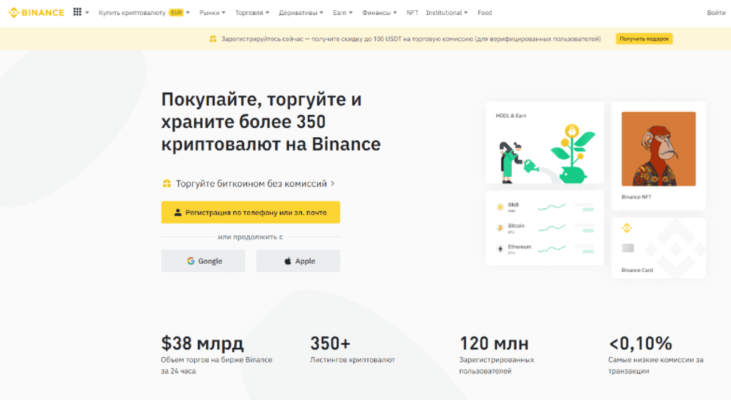
- Binance marketing
- Word-of-mouth marketing in crypto
- Sphere of influence
- В win-win relationship
- Future risks
Binance affiliates enjoy high rewards for inviting new customers. The referral program allows almost any person to make a fortune. The only requirement is to have enough followers on various platforms and convince new customers to register on the exchange. The revenue of affiliates is made up of the fees from every transaction of the customers they invite.
Binance marketing
Neither the crypto winter nor the regulatory crackdown has undermined the prospects for Binance, the world’s largest crypto exchange. What is the secret to its success? Part of it is the marketing based on its affiliate program. As a result, people from all across the world have played a significant role in Binance’s development strategy.
Binance encourages influencers to engage their followers via affiliate codes by giving them a percentage of every transaction that their followers make during the period of using the exchange. According to the insiders, Binance’s affiliate division concentrates on recruiting influencers with followers under 35 years old from developing countries.
According to crypto advocates, such networks provide new investment opportunities to underserved groups who have traditionally been overlooked by financial institutions. The profits of those at the top of the structure can be enormous: according to a 2019 blog post on the Binance website, the top affiliate earned 10.4 million US dollars in just two years.
Fortune spoke with people in Argentina, Dubai, South Africa, and the Philippines — these countries are hotspots for cryptocurrency because of the mix of poor regulation, unstable economies, and poverty. Binance’s affiliates in these countries have said that they earn between 1,000 and 10,000 US dollars a month from Binance. In fact, Africa is considered one of the world’s fastest-growing crypto markets by Chainalysis, as reported by the International Monetary Fund.
Word-of-mouth marketing in crypto
While Binance is the world’s largest exchange, other platforms also engage influencers, with noticeable marketing campaigns on social media conducted by Coinbase, Bybit, KuCoin, and many others. Some influencers even work with several platforms at once. “I’ve seen people get thousands of people in referral links, and they make a significant amount of money — like $50,000 a year — just from having a link,” says Rex Tabb, a DeFi and crypto proponent who worked as a marketing manager for Binance between May 2021 and July 2022.
Sphere of influence
It is noteworthy that despite the Binance’s secretive nature, its Affiliate Program has functioned openly since the company’s founding in 2017. The website provides a detailed description of the generous rewards and required qualifications. However, the founder Changpeng Zhao, known as CZ, rarely speaks about the program.

Binance provides the most effective referral programs compared with other exchanges, according to Joseph Edwards, head of research at Enigma Securities, who says, “Binance was behind FTX in spending on the likes of sports sponsorships, but it was far more active in these retail-focused referral plans.” Edwards considers the programs to be a major source of Binance’s development in 2020 and 2021 as well as a large part of its expenses.
According to a Binance representative, 26,000 people use its affiliate program, and influencers attract about 2 million users a year to its base audience of 120 million.
Binance says that only around 50 influencers earn 1 million US dollars a year or more. Considering the number of members, the program is likely to be the source of at least 1 billion US dollars in revenue.
The program participants receive rewards in the amount of 41% on spot trades and 30% on futures. To maintain the 41% fee, an influencer must attract at least five customers every 90 days who in total should generate at least the equivalent of 50 Bitcoin or about 1.4 million US dollars in new trades. On spot, the reward increases to 50% if an affiliate invites 10 customers over 90 days who provide 14 million US dollars in transaction volume (this corresponds to around 14,000 US dollars in Binance revenue). To attract customers, the influencers can split their BNB (Binance token) discounts with the customers they invite. This stimulates cost-conscious traders from developing countries, the exchange’s largest retail market.
Binance outperforms everyone else when it comes to rewards. For example, Kraken pays only 20% of the commission attracted by influencers. Although Coinbase pays 50%, it does so only within the first three months. At the same time, a Binance affiliate who has invited a new customer will continue to earn a commission as long as such a customer uses the exchange.
A win-win relationship
The Binance affiliate program not only provides an opportunity to make a fortune but also provides a community with local and global hierarchies. According to Archie Lim, a Binance influencer from Manila who has worked with the exchange since 2020, Binance organizes meetings for him and other local affiliates once or twice a month. He describes such meetings, “of course, there’s food, there are giveaway contests, they introduce new products, new features; it’s community meetup networking.” Lim says he was earning 10,000 US dollars a month during the crypto summer, but the income has decreased to less than 1,000 US dollars amid crypto winter. Nevertheless, according to him, it is still a lot of money in the Philippines “because things are very cheap here.”
Of course, not everyone is getting rich. David Gan, Founder and General Partner at OP Crypto, a venture capital fund that invests in the most promising blockchain entrepreneurs, says that only “1% to 2%” of the crypto affiliate marketers “actually make money,” due to the fact that “most people don’t know what they’re doing.” Rex Tabb adds that, in general, the exchange’s affiliate program is “not very lucrative.”
Peter Howson, the author of “Let Them Eat Crypto” and assistant professor of geography and environmental sciences at Northumbria University, says that it is the exchanges that benefit most from the referral programs. “When there’s a 30% to 70% unemployment rate, and then you’re saying that this is your only chance of ever getting a paid job — is to come on board and work for free until we go bust — that’s quite questionable,” he comments. He thinks that such firms as Binance are not only misleading potential clients, but also their affiliate partners who are doing all the work, including recruitment and customer service in exchange for payments in Binance’s BNB token, and “exclusive access” to executives like Zhao.
Future risks
Currently, there is no doubt about the legality of affiliate programs. In fact, competitors including Coinbase and Kraken also have well-established affiliate platforms. However, a bigger program is also associated with more significant potential liability risks. The first one is the risk of fraud.
The second one is the future of crypto in general. It will largely be determined by crypto classification and regulation. The courts have not decided yet whether cryptocurrencies should continue to be regulated as a commodity or classified as a security. Recently, the U.S. Securities and Exchange Commission (SEC) has filed claims that are based on the idea that cryptocurrencies are securities and should be subject to the respective stricter regulations.
In the middle of March, the Moskowitz Law Firm and Boies Schiller Flexner brought a 1-billion-dollar class action suit, on behalf of customers who bought FTT, against nine paid influencers and celebrities who promoted the failed coin.
“We filed the complaint on behalf of plaintiffs who bought crypto that the Binance influencers touted,” said Adam Moskowitz, managing and founding partner. He claims that crypto should be considered a security. He is filing a suit that “states clearly that if influencers promote the coins and have a personal financial incentive to do so, and the coins are unregistered securities, the influencers can be found liable for all losses suffered by people who bought those coins.” He adds, “the law wanted the burden to be on the promoters, not the victims. It doesn’t matter whether the victims were swayed by the ads or not.”
The penalty for “aiding and abetting” the sale of unregistered securities is known as “rescissory damages.” The influencers can be made liable for the total amount of the unregistered security purchases, or total victim losses. The penalties could apply to the affiliates who invited new customers to buy the coins. According to Moskowitz, the requirement would extend not only to affiliates at Binance’s relatively small U.S. division but also to affiliates working for the global exchange. “Internal evidence recently uncovered confirms that it was Binance’s main objective to target and conquer the U.S. investor market. The suit will apply not just to U.S. citizens and residents who were victims but even to non-U.S. citizens,” says Moskowitz.
It is far from certain that the court in Florida will classify crypto as a security — a decision that will determine the success of the suit. However, Moskowitz believes that the multiple similar cases brought by the SEC increase his chances of success.
The outcome is unpredictable. But if the plaintiffs win, this could strike a mortal blow to the affiliate programs of Binance and other crypto platforms.
