
- The U.S. increases scrutiny
- The crypto industry is moving eastward
- Companies are attracted by clear regulation
Between September 4 and 10, the sixth annual Korea Blockchain Week Impact conference took place in Seoul where the future of crypto in Asia was discussed. The conference was attended by representatives of 263 blockchain companies and more than 6,000 participants willing to learn about the ups and downs of the crypto industry over the last year.
Most discussions explored the differences between U.S. and Asian regulation. The United States have always been considered the largest crypto market, while various jurisdictions in Asia, such as South Korea and Japan, are creating friendlier conditions for both crypto developers and investors.
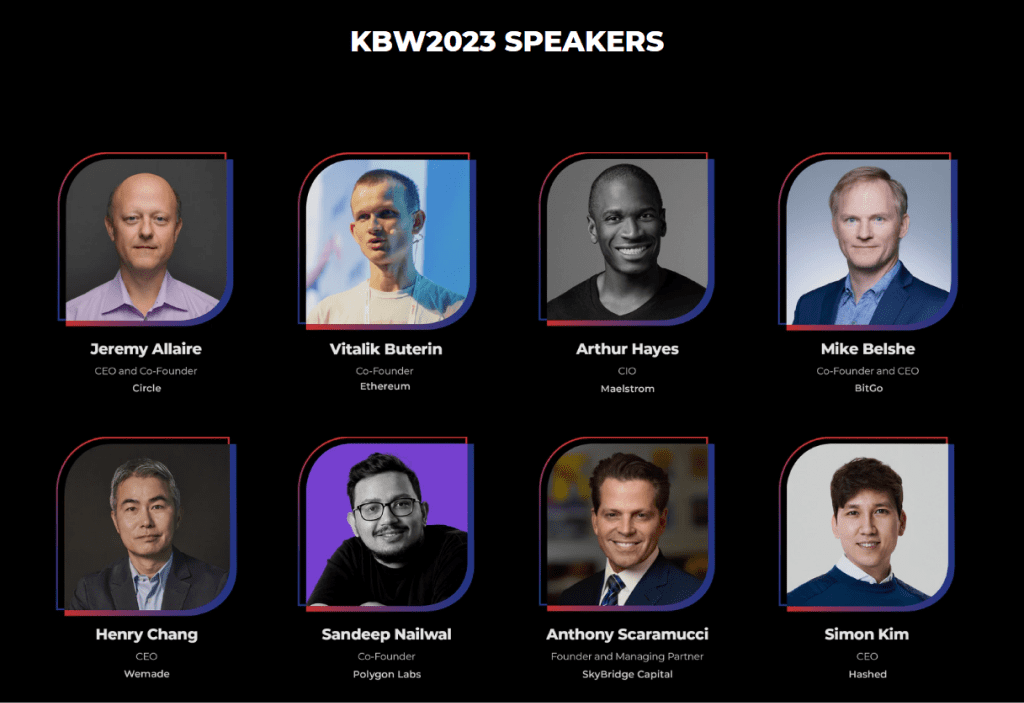
Crypto in Asia – the speakers at Korea Blockchain Week Impact 2023
Caroline D. Pham, the commissioner at the U.S. Commodity Futures Trading Commission (CFTC), thinks that a unified approach should be developed for decision-makers, regulatory authorities, and the private sector that would encourage crypto innovation. She believes that this would ensure the successful development of crypto in Asia.
“I think it’s funny that in the United States we have been so used to some of the tremendous successes that we’ve had in the tech sector that we take it for granted. It’s like everything [in Asia] is 10 years ahead of where we are in the U.S.,” Pham commented.
According to her, this is not only due to technical skill or knowledge but “because there’s an openness to technology and to changing things [in Asia].”
The U.S. increases scrutiny
The Securities and Exchange Commission (SEC) has been watching the industry closely this year claiming that most currencies except for Bitcoin should be considered securities. Based on this principle, the SEC has sued many companies dealing with digital assets, including the Ripple Labs software company, the Coinbase Global crypto exchange, and Paxos Trust Co., the owner and issuer of BUSD.
Carole House, who recently served as the Director of Cybersecurity and Secure Digital Innovation for the National Security Council at the White House, spoke about regulation in the U.S. and Asia. She said that the delays in developing crypto regulations may prevent industry growth. She added that if the regulation is too strict, it could put an end to blockchain innovation in the United States.
The crypto industry is moving eastward
While some participants did not agree on the regulatory issues in the U.S., most of them said that Asia is moving forward and achieving great results in this sphere, and that crypto is in higher demand in Asia than in the U.S.
“I really do think that the Asia-Pacific has been a powerhouse driver,” Carole House added. She has also emphasized that Japan has contributed to the international standard for fighting crypto money laundering with its regulatory framework.
Sam Seo of Klaytn Foundation, a service-centric blockchain platform developed by South Korean internet giant Kakao, believes that crypto-related firms will be moving to Asia because of the region’s favorable conditions.
For example, the Gemini exchange founded by the Winklevoss brothers, announced this June that it was increasing the number of personnel in Singapore which would serve as its hub for expansion in the Asia-Pacific region. Seo has also mentioned Klaytn’s partnership with Tokeny, a tokenization platform from Luxembourg.
“[Tokeny has] been operating their business for quite a long time, but they were mostly focused in the U.S. market or the Europe market. They are now looking at the Asia market,” he commented. Seo considers this to be the “beginning of a bigger trend.”
Dominic Jang, head of business development at Oasys, the Singapore blockchain for games, said that the crypto industry is moving eastward, and it is very noticeable in the Web3 gaming sector.
Companies are attracted by clear regulation
According to Ryo Matsubara, director of Oasys, clear regulation contributes greatly to attracting companies to Asia. As an example, he mentioned the Japanese regulatory framework. After the high-profile hacking attacks on the Mt.Gox and Coincheck exchanges in 2014 and 2018, Japan defined strict criteria for crypto.
“Under Japanese rules, crypto is crypto, not a security. So making the [clear] definition of crypto is very important,” Matusbara explained.
In July, the Financial Services Commission, the South Korean government’s top financial regulator, spoke about a bill that would amend securities regulations to accommodate security token offerings.
Although it has not been approved by legislative authorities, some of the major financial institutions already consider expanding into the digital asset industry. On August 30, the country’s financial leaders Woori Bank, Samsung Securities, and SK Securities formed an alliance to cooperate in the sphere of security token development. Therefore, crypto might soon be fully legalized in Asia.
Hong Kong has also successfully implemented crypto licensing in early 2023, playing the role of China’s digital asset regulatory sandbox.
In Southeast Asia, Singapore and Thailand toughened their rules of crypto user protection in July. In Singapore, crypto companies are required to hold customer assets in third-party trusts, while Thailand has banned crypto lending and staking services. Although the restrictions are getting tougher, the new regulations are considered the pre-requisites of crypto growth.
According to Sam Seo, whether Asia will be able to outperform the U.S. and become the world’s crypto center depends on who will replace Gary Gensler as Chairman of the SEC. If the U.S. continues to crack down on crypto, talented Americans might move to Asia and Europe, seeking more favorable conditions.
Sam Seo believes that blockchain innovation will ensure the successful development of the Asian region. He says that although U.S. financial markets are strong, Asia is far more populous and can become the international leader in Web3 if it is able to harness the power of blockchain.
