
- How Has the Landscape Changed?
- What Has Changed for the Major Players?
- What Are the Prospects for New Entrants?
- Integration with Large Enterprises
- The Role of Governments And Innovation
- The Most Popular Blockchain Ecosystems in 2025
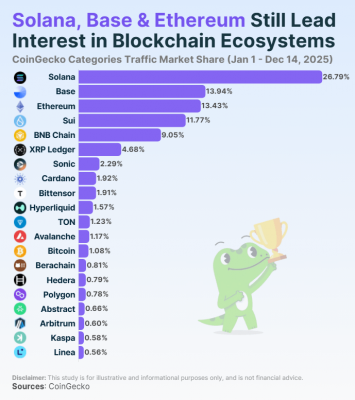
In 2025, Solana once again found itself at the top of the cryptocurrency world, capturing a significant share of overall interest in blockchain technologies. This achievement, however, did not come easily and was accompanied by major structural changes across the industry.
Over the past year, the global crypto community showed heightened interest in several major market players, including Base, Ethereum, Sui, and BNB Chain. These networks significantly strengthened their positions, capturing additional audience share that had previously been concentrated around Solana.
The most notable shift was a reduction in Solana’s market share by approximately 12 percentage points. Despite this substantial decline, Solana managed to retain its leadership position, remaining ahead of its largest competitors.
That said, growing interest in alternative cryptocurrencies had a negative impact on Solana’s overall standing. It lost its former popularity among the top five most discussed cryptocurrencies, giving way to projects associated with artificial intelligence technologies and the U.S. economy.
How Has the Landscape Changed?
The primary reason behind Solana’s reduced influence was a decline in trading volumes, driven by waning enthusiasm for meme-coin speculation. Despite efforts to restore investor confidence through the introduction of innovative products—such as ETF initiatives supported by the U.S. Securities and Exchange Commission (SEC)—the results proved underwhelming.
This downturn was particularly painful for Layer-1 (L1) blockchains. Their combined market share fell from 38.79% in 2024 to 26.79% in 2025, signaling a gradual shift in user interest toward Layer-2 (L2) solutions.
A key driver of this transition has been the emergence of powerful platforms such as Base, Arbitrum, and Optimism, which offer high-speed transactions along with attractive conditions for developers and investors.
What Has Changed for the Major Players?
Base and Ethereum remain core pillars of the industry, although both experienced certain declines in relative influence. Base, developed by Coinbase, dropped to second place with a mindshare of 13.94%, losing roughly three percentage points compared to the previous year.
This decline is largely explained by structural changes within the industry, particularly the rapid expansion of Layer-2 blockchains that offer improved performance and lower transaction fees. Nevertheless, Base continues to demonstrate resilience and maintains a strong level of investor trust.
Ethereum, by contrast, managed to slightly increase its share, reaching 13.43% and securing third place in the ranking. This modest growth reflects positive developments within the Ethereum ecosystem, including active network upgrades and more stable investment conditions.
At the same time, Ethereum faces ongoing scalability challenges caused by the rapid growth of Layer-2 transaction volumes. Today, the majority of on-chain activity is handled by specialized platforms such as Base, Arbitrum, and Optimism, which significantly reduce the load on Ethereum’s main chain.
According to research by 21Shares, a significant portion of existing Layer-2 projects may disappear in the coming years. Many smaller initiatives have failed to attract sufficient active users and transaction volumes, effectively turning into so-called “dead chains.”
What Are the Prospects for New Entrants?
Among newer entrants, Sui and BNB Chain demonstrated the strongest progress, attracting substantial investment inflows and expanding their user bases.
Sui, developed by Meta, achieved remarkable popularity, tripling its market share to 11.77%. This rapid growth highlighted the project’s potential, allowing it to close the gap with Ethereum in terms of overall interest.
BNB Chain also posted solid gains, securing fifth place with a 9.05% market share. This growth was largely driven by the successful launch of the Binance Alpha platform, which significantly increased on-chain asset trading volumes.
Additional momentum came from the active involvement of Binance CEO Changpeng Zhao (CZ) and the strong performance of the BNB token itself, which demonstrated price stability and positive value dynamics.
Integration with Large Enterprises
Solana has been able to maintain its strong position thanks to active integration with major financial institutions and technology companies. For example, Coinbase—one of the world’s largest cryptocurrency exchanges—introduced functionality for direct Solana token purchases and sales via its mobile app, significantly lowering the barrier to entry for retail users.
In addition, the crypto giant announced plans to acquire Vector, a company that develops a Solana-based trading marketplace. The deal is expected to close by the end of the year and could mark a new phase of growth for the Solana ecosystem.
The Role of Governments And Innovation
One of the most notable recent initiatives was Bhutan’s involvement in launching a gold-backed digital token. The system, introduced by the Kingdom’s government under the name TER, operates exclusively on the Solana blockchain and is distributed through the country’s largest national bank, DK Bank.
This initiative highlights the growing willingness of governments to explore blockchain technologies and apply them to modernize national financial systems. Similar experiments are underway in other countries, reinforcing Solana’s reputation as a reliable and technologically mature platform for public-sector use cases.
The Most Popular Blockchain Ecosystems in 2025
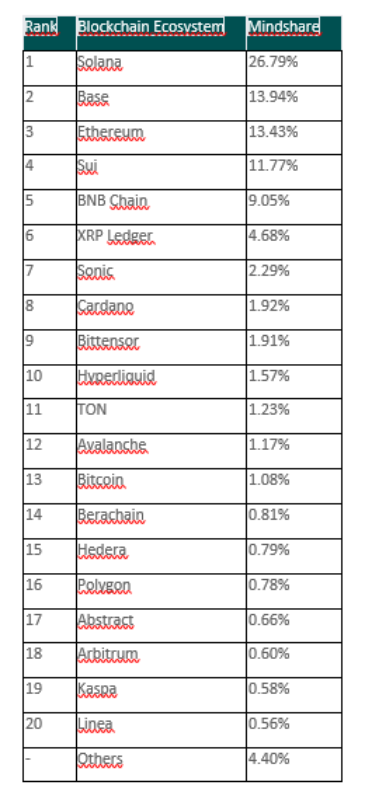
In 2025, there were a total of 62 blockchain ecosystems with a non-zero share of market attention. The top 20 ecosystems accounted for 95.60% of global interest in specific blockchain networks.
Conclusions
The 2025 market overview clearly illustrates a deep realignment of priorities within the digital asset space. New entrants are emerging as serious competitors, setting new standards for user engagement and developer experience, while established ecosystems adapt to a rapidly evolving blockchain landscape.
