
- From Tokenized Gold to Bitcoin
- The New Law: Five Licenses and Strict Limits
- The Battle for Crypto Custody
- Moscow Exchange Opens the Gates
- What’s Next for the Market?
Russia’s financial sector is on the verge of a major transformation. What was considered a risky experiment—or a legal gray area reserved for crypto enthusiasts—just a few years ago is now becoming a core part of the strategy of the country’s largest financial institutions.
Alfa-Bank, Russia’s largest private bank, has officially announced its plans to obtain a regulated digital asset custody license. Similar ambitions have since been confirmed by state-owned banking giant Sberbank and T-Bank. This coordinated move by traditional banks into the cryptocurrency sector comes ahead of a landmark event: the new Russian cryptocurrency law taking effect on September 1, 2026.
From Tokenized Gold to Bitcoin
Alfa-Bank’s announcement came as little surprise to the market. It reflects years of preparation and extensive involvement in Russia’s Digital Financial Assets (DFA) market. While many financial institutions remained on the sidelines, Alfa-Bank and Sberbank had already established themselves as approved issuers on Russian tokenization platforms.
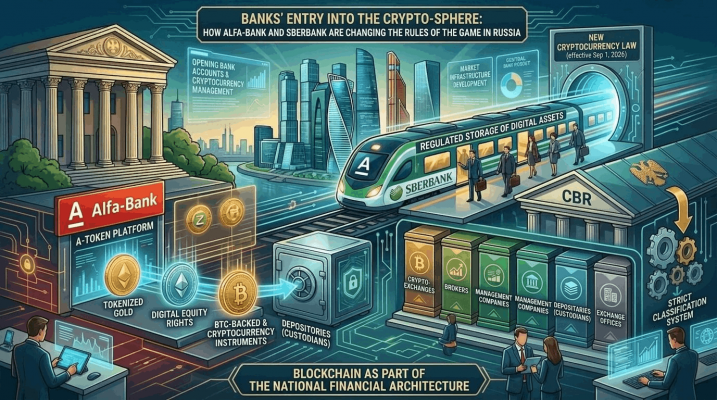
In practice, the necessary infrastructure was built long before comprehensive crypto legislation arrived. Through its A-Token platform, Alfa-Bank has already launched products backed by real-world assets, including:
• Tokenized gold;
• Digital rights representing shares;
• Instruments backed by major cryptocurrencies, including Bitcoin (BTC).
By transaction volume in Digital Financial Assets, Alfa-Bank has become the dominant player, accounting for nearly half of Russia’s entire DFA market. The bank has demonstrated its ability to operate blockchain infrastructure within Russia’s existing legal framework using hybrid financial models. That experience is now being expanded in preparation for the upcoming regulatory changes.
The New Law: Five Licenses and Strict Limits
Russia’s new cryptocurrency law is expected to introduce one of the world’s most comprehensive and tightly regulated legal frameworks for digital assets. The key date is September 1, 2026, when mandatory licensing for all cryptocurrency-related activities officially begins.
The Central Bank of Russia will classify market participants into five licensed categories:
• Cryptocurrency exchanges;
• Brokers;
• Asset management companies;
• Custodians (digital asset depositories);
• Exchange offices.
All licensed entities will operate under the direct supervision of the regulator. The legislation also introduces significant restrictions for retail investors. Non-qualified investors will be allowed to trade digital assets only after passing a mandatory knowledge test, and their annual investment limit will be capped at approximately 300,000 rubles (around $3,800).
Market participants will have until July 1, 2027, to complete registration and obtain the appropriate licenses. After that deadline, conducting cryptocurrency-related business without authorization from the Central Bank will expose companies to severe administrative penalties and, in some cases, criminal liability.
The Battle for Crypto Custody
Custody services—the secure storage of clients’ private keys—will become one of the cornerstones of Russia’s new digital asset ecosystem. This is where competition among the country’s largest banks is expected to be most intense.
Alfa-Bank aims to become a full-service digital asset provider. Beyond custody, the bank plans to launch blockchain-based investment products for both domestic clients and international investors. This suggests that the bank intends to position the Russian regulatory framework as a hub for cross-border settlements amid ongoing sanctions.
Sberbank, traditionally the government’s flagship institution for financial innovation, is moving quickly as well. The bank plans to launch a fully integrated cryptocurrency wallet and digital asset custody platform by December 2026. These services will be incorporated into the familiar Sberbank Online and SberInvestments ecosystems. According to bank representatives, the entire digital asset custody infrastructure is expected to be operational by December 1, 2026.
Other major financial institutions are joining the race. VTB, Russia’s second-largest bank, and T-Bank have also confirmed plans to establish their own digital asset custody businesses immediately after the new legislation comes into force. Together, these institutions are poised to form an oligopoly that will likely capture the majority of institutional cryptocurrency assets in Russia.
Moscow Exchange Opens the Gates
The scale of the transformation is further underscored by the country’s leading exchange. The Moscow Exchange (MOEX) has announced plans to launch cryptocurrency-related products by the end of 2026. This marks an important shift, moving cryptocurrencies from the realm of speculative assets toward becoming recognized exchange-traded financial instruments.
Why Is This Happening Now?
Several factors are driving this strategic shift in Russia’s approach to digital assets.
Sanctions pressure. Traditional cross-border payment channels have become restricted or unreliable. The government increasingly views regulated cryptocurrency infrastructure as a practical tool for facilitating international trade under sanctions.
Competition for capital. Russian individuals hold substantial wealth in USDT, BTC, and other cryptocurrencies outside the traditional banking system. Banks recognize that unless they provide a secure and fully regulated custody solution—a “white-label” or compliant crypto wallet—those funds are unlikely to return to the financial system through deposits and lending.
Demand for security. The cryptocurrency market has matured. Investors have grown wary of the risks associated with centralized offshore exchanges following high-profile failures such as FTX. A custody solution licensed by the Central Bank offers a level of legal protection and institutional trust that offshore platforms cannot provide.
What’s Next for the Market?
The new legislation marks the end of the era of anonymous crypto exchangers and large P2P transactions conducted through messaging apps. The era of regulatory compliance has arrived.
For everyday users, the implications are mixed. On one hand, consumers will gain stronger legal protections. If digital assets are stolen from a bank-operated crypto wallet, clients will have legal avenues to pursue recovery through the courts. On the other hand, users will sacrifice much of the flexibility that has traditionally defined the cryptocurrency market. The 300,000-ruble annual investment cap will effectively prevent active retail traders from using regulated banking infrastructure unless they qualify as accredited investors, pushing many back toward gray-market platforms.
The broader significance, however, extends beyond individual investors. After years of uncertainty over the legal status of cryptocurrencies, Russia has chosen strict regulation rather than prohibition. Leading this transition are the country’s most conservative and influential financial institutions. Blockchain technology is no longer viewed as an experimental niche—it has become an integral part of Russia’s evolving financial architecture.
