
- What Is Mining Difficulty and Why Does It Matter?
- How It Works in Practice
- A Brief History: The Evolution of Mining Difficulty
- What Does the Latest Increase Mean?
On May 29, 2026, the Bitcoin network experienced a notable—though widely anticipated—event: mining difficulty increased by 1.72%. Reaching 138.96 trillion (T), the metric climbed to its highest level since early April. At first glance, this may seem like just another technical statistic, but behind it lies one of the fundamental mechanisms that keeps the world’s first cryptocurrency stable and predictable. To understand what is happening on the network, it is worth taking a closer look at what mining difficulty is, how it is adjusted, and why rising difficulty is generally considered a sign of a healthy network.
What Is Mining Difficulty and Why Does It Matter?
At the core of the Bitcoin network is the Proof-of-Work (PoW) consensus mechanism. Miners around the world use specialized hardware, known as ASIC miners, to solve complex mathematical problems. Their task is to find a specific number, called a nonce, which, when combined with block data and processed through a hashing function, produces a result that meets certain requirements—for example, a hash that begins with a specified number of zeros.
Mining difficulty is a dynamic network parameter that determines how hard it is to find this valid hash. The higher the difficulty, the more hashing attempts a miner’s hardware must perform before it has a chance to discover a new block, add it to the blockchain, and receive the associated reward.
The primary purpose of this mechanism is to control Bitcoin issuance. When creating Bitcoin, Satoshi Nakamoto embedded a strict issuance schedule into the protocol. Every 2,016 blocks—approximately once every two weeks—the network automatically recalculates mining difficulty. This adjustment ensures that the average block production time remains close to 10 minutes.
• If the hash rate increases: When new and more powerful mining equipment joins the network, blocks are found faster—perhaps every 8–9 minutes instead of 10. The network detects this acceleration and raises mining difficulty during the next adjustment to restore the average block time.
• If the hash rate decreases: When miners disconnect due to low profitability, power outages, or other factors, blocks take longer to find—perhaps 11–12 minutes. In response, the network lowers difficulty, allowing the remaining miners to maintain the target block production rate.
In this sense, mining difficulty acts as a self-regulating “brake” or “accelerator” for the entire network. Even if the collective computing power of all miners worldwide were to increase a millionfold overnight, new bitcoins would not be issued any faster. The issuance schedule would remain predictable and continue exactly as designed until approximately 2140.
How It Works in Practice
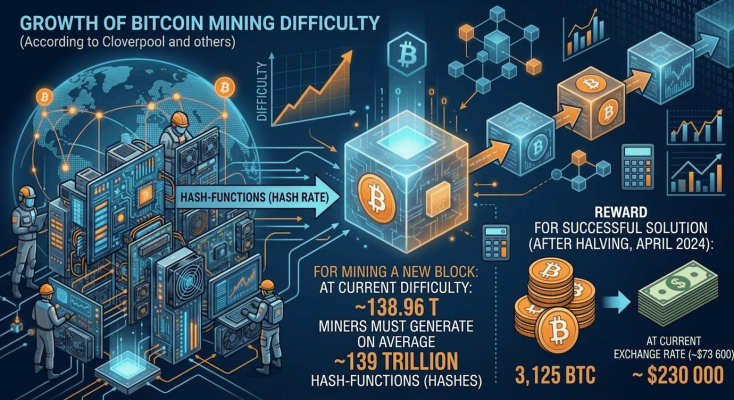
According to analytics platforms such as CloverPool, at the current difficulty level of 138.96 T, miners must perform approximately 139 trillion hash calculations on average to discover a valid block. For successfully solving this computational challenge, the network currently awards 3.125 BTC per block, following the most recent halving in April 2024. With Bitcoin trading at roughly $73,600, that reward is worth approximately $230,000.
The next difficulty adjustment will occur in about two weeks. Whether difficulty rises or falls will depend entirely on the global hash rate—the combined computational power of all devices mining Bitcoin.
1. Current Hash Rate
As of late May, the global Bitcoin hash rate remained relatively stable. The 24-hour average stood at approximately 1.03 EH/s (exahashes per second), while the seven-day average was around 1.02 EH/s.
2. Distribution of Mining Power
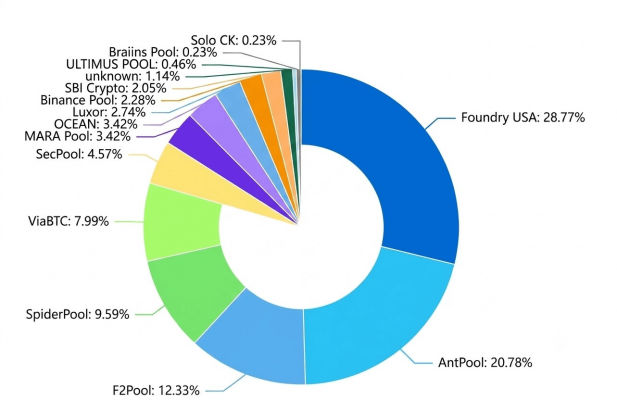
Large mining pools continue to play a dominant role in securing the network. The leading pool remains Foundry USA with a 28.77% share of the total hash rate. It is followed by AntPool (20.78%), F2Pool (12.33%), SpiderPool (9.59%), and ViaBTC (approximately 8%).
To evaluate mining profitability, analysts often use the hashprice metric, measured in dollars per petahash per second per day ($/PH/s/day). This indicator shows how much revenue miners generate daily for each unit of computing power. Currently, hashprice stands at approximately $34.1 per PH/s/day. For comparison, it peaked near $39 just one month ago. A declining hashprice generally indicates that mining profitability per unit of computing power is decreasing, either because mining difficulty is rising or because Bitcoin’s market price has fallen.
A Brief History: The Evolution of Mining Difficulty
To appreciate the scale of today’s figures, it helps to look at how mining difficulty has evolved since Bitcoin’s launch.
| Year | Difficulty | Comment |
|---|---|---|
| 2009 | 1 | In Bitcoin’s earliest days, Satoshi Nakamoto mined coins using an ordinary laptop. Difficulty was set at one. |
| 2010–2012 | From 1 to ~3 million | The era of CPU mining gave way to GPU mining. Difficulty grew exponentially as Bitcoin gained popularity. |
| 2013–2016 | From ~4 million to ~350 billion | The introduction of ASIC miners revolutionized the industry. Network computing power expanded at an unprecedented pace. |
| 2017–2018 | From ~500 billion to ~7 trillion | Bitcoin’s surge toward $20,000 attracted massive investment into mining, causing difficulty to increase more than tenfold. |
| 2019–2021 | From ~7 trillion to ~25 trillion | China’s mining ban triggered the “Great Migration” of miners, followed by a temporary collapse in hash rate and difficulty in mid-2021. However, the industry quickly recovered as miners relocated to new hubs such as the United States, Kazakhstan, and Russia. |
| 2024–2026 | ~140 trillion | Current levels reflect the enormous growth in global mining capacity over recent years. |
Two developments are particularly noteworthy:
1. The Halving Cycle
Every four years, Bitcoin’s block reward is cut in half—from 50 BTC to 25 BTC, then to 12.5 BTC, 6.25 BTC, and now 3.125 BTC. Despite this steady reduction in mining rewards, difficulty has continued to rise or remain elevated due to technological progress and the introduction of increasingly energy-efficient ASIC chips.
2. The 2021 China Mining Ban
When China banned cryptocurrency mining, the global hash rate fell by more than 50% within a matter of weeks. This led to one of the largest downward difficulty adjustments in Bitcoin’s history.
Yet the network demonstrated remarkable resilience. Within less than six months, the hash rate had not only recovered to previous levels but significantly surpassed them as mining operations relocated to other countries.
What Does the Latest Increase Mean?
The 1.72% increase in mining difficulty is a direct result of a stable or slightly growing global hash rate. It signals several important trends:
• The network remains healthy: Miners continue investing in equipment and electricity, reflecting confidence in Bitcoin’s long-term future.
• Competition is intensifying: Bitcoin mining is becoming increasingly competitive. Smaller operators face growing challenges when competing against large-scale data centers with access to low-cost power.
• Security is strengthening: The higher the hash rate and mining difficulty, the more expensive it becomes to carry out a 51% attack. Current levels make Bitcoin one of the most secure computing networks in the world.
For the average user, rising mining difficulty simply means the system is functioning exactly as its creator intended. Bitcoin continues to self-regulate, adapt to changing conditions, and move steadily toward its ultimate supply cap of 21 million coins.
