
- The Architecture of Invisibility: A Bulletin Board Instead of a Vault
- Anatomy of a Private Payment
- The Price of Privacy
- ZEC Holders Panic While Bitcoin Takes the Long View
- A Specification, Not a Product
Bitcoin has always been a public ledger. Since its creation by Satoshi Nakamoto, every transaction—from the purchase of two pizzas for 10,000 BTC to transfers sent to cryptocurrency exchanges—has remained permanently visible for the entire world to see. If you know a wallet address, you can trace the complete financial history associated with it.
Today, privacy in the cryptocurrency industry largely relies on either cryptocurrency mixers or switching to dedicated privacy coins such as Monero and Zcash. However, researchers Klara Shikelman, Mikhail Komarov, and Alexey Moskvin of New York have proposed a radically different approach. On Thursday, they published the white paper for Shielded Bitcoin, outlining a way to enable private transactions directly on Bitcoin’s Layer 1 (L1) without modifying a single line of Bitcoin’s code.
The Architecture of Invisibility: A Bulletin Board Instead of a Vault
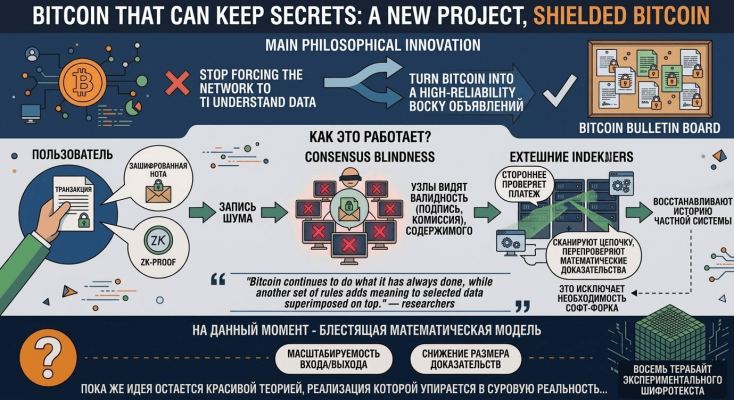
The core philosophical innovation behind Shielded Bitcoin is simple: stop requiring the Bitcoin network to understand transaction data. Instead, Bitcoin becomes an extremely reliable public bulletin board.
How does it work?
A traditional blockchain validates every piece of transaction data: whether you have sufficient funds, whether the signature is valid, and whether the transaction fee is adequate. Shielded Bitcoin introduces a different model:
Recording encrypted data: A user broadcasts a transaction containing encrypted ciphertext (an encrypted “note”) together with a zero-knowledge proof (ZK proof).
Consensus remains blind: Bitcoin nodes verify that the transaction satisfies Bitcoin’s consensus rules—the signature is valid, and the fee has been paid—but they have no idea what the encrypted note contains. To them, it is nothing more than a collection of random bytes.
External indexers: Dedicated software performs the actual verification of Shielded Bitcoin transactions. These indexers scan the blockchain, locate Shielded Bitcoin records, verify the underlying cryptographic proofs, and reconstruct the history of the private payment system.
“Bitcoin continues doing what it has always done, while a separate set of rules assigns meaning to selected data layered on top of it,” the researchers explain.
This design eliminates the need for a soft fork—a backward-compatible protocol upgrade. Bitcoin doesn’t even need to know that the overlay exists; it simply guarantees that the recorded data remains immutable.
Anatomy of a Private Payment
Within the private system, the underlying logic resembles Zcash’s architecture, but implemented as a metaprotocol.
Notes: Instead of storing balances at addresses, funds exist as encrypted records.
Nullifiers: To prevent double spending, each note publishes a unique serial number when it is spent. Indexers ensure that no nullifier is ever used twice.
Groth16 proofs: Zero-knowledge cryptography proves that the total value of the inputs equals the total value of the outputs without revealing the actual amounts.
When Alice pays Bob, she encrypts the payment so that only Bob can decrypt it using his viewing key. Public blockchain data reveals only that a shielded transfer occurred, along with the timestamp, the number of notes involved, and the transaction fee. Transaction amounts, sender and recipient addresses, and the links between past and future transactions all remain hidden.
Absolute anonymity, however, is not guaranteed. If a user repeatedly pays transaction fees from the same Bitcoin address, blockchain analysts may still correlate those private transactions. Furthermore, the smaller the anonymity set, the easier it becomes to identify participants through graph analysis.
The Price of Privacy
Privacy comes at a computational cost. A typical Shielded Bitcoin transaction occupies roughly 700 vbytes. By comparison, a standard Bitcoin transaction is usually around 100–200 vbytes.
In an interview with Laura Shin, Mikhail Komarov said that a fourfold increase in transaction size is “not catastrophic.” However, during periods of heavy mempool congestion, the larger transaction size translates directly into significantly higher fees. This creates an interesting paradox: a private transaction costs more than a regular Bitcoin payment, meaning that choosing the expensive privacy protocol itself reveals some information about the user.
The Biggest Challenge: Moving Funds In and Out
The published white paper explains how funds move within the private pool, but leaves the most difficult question unanswered: how do bitcoins enter and exit the system?
A second paper will describe that mechanism, based on research known as Bitcoin PIPEs v2. The proposed approach relies on a cryptographic lock:
– You send ordinary BTC to a special Pay-to-Script-Hash (P2SH) script on the Bitcoin network.
– The funds become locked.
– A specific zero-knowledge proof unlocks an equivalent amount inside Shielded Bitcoin.
When funds are withdrawn, the process runs in reverse, producing a standard Schnorr transaction visible to the entire Bitcoin network.
This bridge is where the greatest risks lie. The boundary between Bitcoin’s transparent blockchain and the private system provides an ideal point for blockchain analysis. Observers could potentially correlate deposit timing with the creation of new shielded notes, weakening users’ privacy.
In addition, the witness encryption technology required to build this bridge is still in its infancy. Komarov noted that over the past year the amount of data required has been reduced from an astonishing 300 terabytes to a more manageable 8 terabytes.
“It’s still a highly experimental technology,” the researcher explained.
ZEC Holders Panic While Bitcoin Takes the Long View
The publication of the white paper sparked intense debate across social media, exposing a long-standing rivalry between different cryptocurrency communities.
A Threat to Zcash
Cypherpunk LLC described the project as a major technological step forward while reassuring its investors that Shielded Bitcoin is not yet a direct competitor to Zcash. Their reasoning includes several important points:
Bitcoin has no native consensus mechanism for managing this metadata, meaning a faulty indexer could temporarily split the overlay network.
There are currently no lightweight (SPV) clients capable of verifying private transactions.
Layer 1 transaction fees make micropayments impractical.
Zcash has been operating for nearly a decade, secures a shielded pool worth more than $7 billion, and has already proven itself in production.
Developers React
Developers were considerably less diplomatic.
Joe Burnett of Blockware Intelligence provocatively wrote: “Zcash to zero.”
Daniel Buchner of Proof added a sarcastic remark: “The number of privacy-coin enthusiasts… experiencing panic attacks is approaching decibel levels that raise concerns about hearing damage.”
Meanwhile, Sam Callahan of OranjeBTC urged the community to remain focused on Bitcoin’s core strengths: “Bitcoin doesn’t need to win every functionality race. Privacy, speed, and additional features can all improve over time. Its competitive advantage is decentralization, security, and sound monetary policy.”
A Specification, Not a Product
At this stage, Shielded Bitcoin is an elegant cryptographic specification rather than a production-ready wallet.
If the researchers succeed in solving the scalability challenges surrounding deposits and withdrawals while significantly reducing proof sizes, the project could mark a historic milestone for Bitcoin. It would allow the network to permanently record transactions while remaining completely unaware of who sent funds, who received them, and how much was transferred.
For now, however, Shielded Bitcoin remains a compelling theoretical framework whose practical implementation still depends on overcoming the very real challenge of managing eight terabytes of experimental encrypted data.
