
- BIP-110 and the War on “Spamcoin”
- A Technical Knockout: How the ASIC Industry Was Left Behind
- The Market’s Verdict: A 900-Fold Gap
- How Industry Titans Responded
- Why Hard Forks No Longer Work
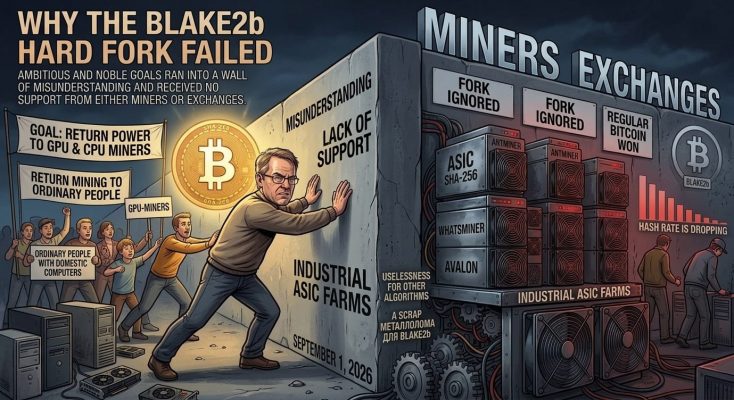
On September 1, 2026, the cryptocurrency industry witnessed an event that was supposed to make history. Luke Dashjr, one of the oldest and most conservative maintainers of the Bitcoin Core codebase, launched a hard fork of the Bitcoin mainnet called BLAKE2b.
The goal was ambitious: eliminate what he calls “spam” from the network, return Bitcoin mining to ordinary users with home computers, and break the monopoly of industrial ASIC mining farms. Instead, the market responded with near-total indifference. The new chain failed to gain meaningful support from either miners or exchanges, and its native token debuted at a price nearly one thousand times lower than Bitcoin itself.
BIP-110 and the War on “Spamcoin”
To understand why Dashjr took such a radical step, it’s important to look at his BIP-110 proposal. Over the past few years, the Bitcoin ecosystem has seen explosive growth in Runes, Ordinals, and BRC-20 tokens. These protocols allow images and arbitrary data to be recorded directly on the blockchain, leading to mempool congestion and significantly higher transaction fees for everyday users.
Dashjr and his supporters see this as a disaster. In their view, Bitcoin’s main chain has effectively become a “Spamcoin,” where financial transactions have been pushed into the background. BIP-110 proposed either imposing strict limits on block capacity or changing the consensus rules so that non-financial data could no longer fit into the blockchain.
When the Bitcoin community rejected these restrictions for inclusion in the main codebase, Dashjr took more drastic action:
1. A new mining algorithm: SHA-256 was replaced with BLAKE2b.
2. A new chain: Dashjr’s team declared their blockchain to be the true continuation of Satoshi Nakamoto’s vision, arguing that the original BTC ticker now belonged to a “fake” project.
A Technical Knockout: How the ASIC Industry Was Left Behind
The fork’s biggest strategic mistake was its choice of a new consensus algorithm. Modern Bitcoin mining depends on Application-Specific Integrated Circuits (ASICs)—specialized chips designed to perform one task exceptionally well: calculating SHA-256 hashes. They are extraordinarily efficient for Bitcoin mining but virtually useless for anything else.
Switching to BLAKE2b instantly rendered Antminer, Whatsminer, and Avalon hardware—representing tens of billions of dollars in investment—effectively obsolete.
• The idea: Return mining power to GPU miners and CPU miners using ordinary personal computers.
• The reality: Industrial mining companies simply ignored the fork. They had no incentive to purchase entirely new hardware for a coin with uncertain prospects.
As a result, the new network’s hash rate declined almost immediately after launch. Miners cast their votes in the clearest way possible—by shutting down their machines. Even the few mining pools that initially supported the initiative, such as OCEAN, faced internal backlash. A similar attempt to deploy BIP-110 in August lasted only two blocks before pool participants demanded new leadership, accusing management of redirecting their hash power to the new chain without obtaining explicit consent.
The Market’s Verdict: A 900-Fold Gap
Financial markets delivered an even harsher judgment than the technical community. Major exchanges, including Binance, Coinbase, and OKX, refused to even consider listing the new cryptocurrency. Only a small testing exchange offered support, assigning the temporary ticker BTCB2.
The order book clearly reflected the lack of genuine market interest:
• Bitcoin (BTC): Approximately $76,900. The network continued operating normally, and traders largely ignored the news of the chain split.
• Highest bid for BTCB2: No more than $82.
• Lowest asking price for BTCB2: $190.
This resulted in a staggering 131.7% bid-ask spread. By comparison, highly liquid cryptocurrencies typically have spreads below 0.1%. Such an enormous gap indicates a market with almost no real buyers or sellers—only a handful of enthusiasts hoping to find counterparties. Dashjr’s version of the “true Bitcoin” ultimately traded at roughly 1/900th the value of the “Spamcoin” he had hoped to eliminate.
How Industry Titans Responded
For most industry veterans, the fork’s failure came as no surprise. Adam Back, CEO of Blockstream and one of the most influential figures in modern cryptography, summed it up in a single post on X:
“Live by the fork, die by the fork.”
The remark quickly spread throughout the crypto community. It echoed Bitcoin’s history of surviving multiple attempts to rewrite its rules, including Bitcoin Cash and Bitcoin SV. Each time, the market voted with capital in favor of the chain supported by the largest community of users, miners, developers, and infrastructure providers.
Former Ripple CTO David Schwartz had already dismissed Dashjr’s claims back in August, calling the arguments made by the Bitcoin Knots project—Dashjr’s alternative Bitcoin node implementation—”nonsense.” The market appears to agree. Decentralization means accepting the will of the majority, not allowing a single developer—even one who has contributed to Bitcoin since its early days—to dictate the future of the network.
Why Hard Forks No Longer Work
History has seen successful hard forks before. Ethereum’s transition to Proof-of-Stake through The Merge is a prime example, despite widespread predictions that it would fail.
However, the differences are substantial:
• Consensus: Vitalik Buterin secured the support of more than 90% of Ethereum developers and validators. Dashjr positioned himself against the overwhelming majority of Bitcoin mining pools.
• Economics: Ethereum’s transition addressed concerns about inflation and energy consumption. Dashjr’s fork, by contrast, threatened the economic interests of mining hardware owners without presenting a compelling long-term growth strategy.
• Leadership: Ethereum’s transition was backed by an extensive ecosystem of foundations, companies, and institutional participants. Dashjr was supported primarily by a small circle of ideological followers.
Bitcoin once again demonstrated its resilience. The attempt to seize the Bitcoin brand by changing the mining algorithm failed because a cryptocurrency is not defined solely by its code—it is ultimately a social contract. If the overwhelming majority of users choose to call the network that processes Ordinals and other non-financial data “Bitcoin,” then, at this stage of the ecosystem’s evolution, that is the Bitcoin the market has collectively chosen.
Conclusion
The BLAKE2b hard fork will likely be remembered as a powerful reminder that even the strongest technical arguments cannot overcome the network effect. Bitcoin’s main chain continued operating without interruption. Transaction fees stabilized as second-layer solutions such as the Lightning Network continued to mature. Meanwhile, Luke Dashjr was left maintaining an almost empty blockchain—the very chain he declared to be the only legitimate Bitcoin.
