
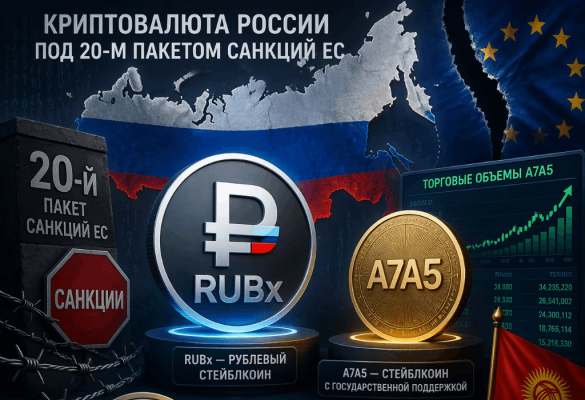
In recent years, cryptocurrencies have become an important tool for international transactions, especially under strict financial sanctions. In 2025, the European Union (EU) adopted its 20th sanctions package against Russia—the most extensive in the past two years. As part of this package, a full sectoral ban was introduced on working with Russian services involved in crypto-asset operations.
Reasons for the Sanctions
Growing Reliance on Cryptocurrencies
According to a European Council press release, Russia is increasingly relying on cryptocurrencies to conduct international transactions due to sweeping sanctions on its financial sector. This trend was one of the main reasons the EU decided to tighten restrictions on Russian crypto services. In particular, the sanctions targeted a Kyrgyz organization managing an exchange that handles significant volumes of the state-backed stablecoin A7A5.
Ban on RUBx Transactions
As part of the 20th sanctions package, the EU also imposed a ban on transactions involving RUBx, a ruble-denominated stablecoin launched by Rostec in July 2025 on the Tron blockchain. This decision highlights the EU’s intent to limit Russia’s ability to use cryptocurrencies to circumvent sanctions.
Historical Context
Previous Sanctions
The EU first introduced restrictive measures targeting crypto services in 2022 as part of its eighth sanctions package, which prohibited Russians from using crypto wallets. In 2024, the 14th package expanded these measures further, banning cooperation with companies located outside Russia that settle payments in cryptocurrencies with Russian residents for dual-use goods.
Sanctions by the US and the UK
In 2025, the United States and the United Kingdom also imposed sanctions on Russian and Kyrgyz crypto companies. The list included platforms such as Garantex, Exved, Grinex, and INDITEX, as well as Bishkek-registered Old Vector, a company linked to a group of legal entities operating under the A7 brand and associated with the A7A5 stablecoin. These actions underscore a broader global trend toward tighter oversight of cryptocurrency operations connected to Russia.
Impact on Russia’s Financial Sector
With the introduction of new sanctions, Russia will need to adapt to evolving conditions. This is expected to result in stricter domestic regulation of cryptocurrencies and increased oversight of crypto-asset transactions. The Bank of Russia has already announced a financial market development strategy for 2026–2028, which will likely take these new realities into account.
Given these constraints, Russian companies and individuals may begin seeking alternative methods for conducting international transactions. This could drive increased interest in decentralized finance (DeFi) tools and other cryptocurrencies that fall outside the scope of current sanctions.
