
Digital Storm: How Critical PHP and eMudhra Vulnerabilities Put the Entire Crypto Industry at Risk
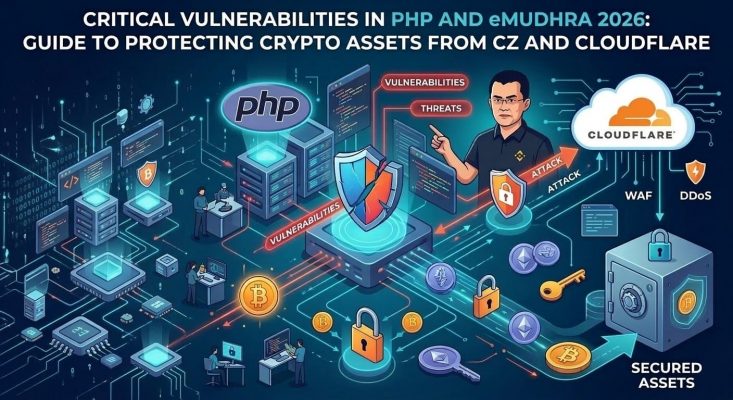
Code Red Alert: Changpeng Zhao’s Warning
The Backbone of the Internet: A PHP Vulnerability Affecting 70% of the Web
Alarming Numbers: Cloudflare Reports “Millions” of Exploitation Attempts
Small Business at Risk: BTCPay Server and WordPress Plugins
The Second Front: Weak eMudhra Keys and the HTTPS Threat
A Survival Guide: How to Protect Your Crypto Assets
The cryptocurrency market has grown accustomed to operating in a state of constant turbulence, but that turbulence is usually driven by price volatility or regulatory pressure. This week, however, the threat emerged from an unexpected source—the very foundation of the internet. Two critical vulnerabilities, one affecting the PHP programming language and another involving the digital certificate infrastructure of India’s eMudhra certificate authority, prompted some of the industry’s biggest players to go on high alert.
Binance co-founder Changpeng Zhao (CZ), who is typically known for his calm and measured demeanor, issued a rare and unusually stark warning to millions of users.
“Call me paranoid, but be extremely cautious when visiting ANY website over the next few days, as some web administrators don’t always apply security patches promptly,” Zhao warned, adding that compromised websites could become “vectors for credential theft or attacks on users’ devices.”
Binance itself quickly announced that it had “implemented proactive security measures before the official patch was released and completed all necessary remediation efforts.” However, CZ’s message was clear: this is a global threat that extends far beyond cryptocurrency exchanges—it affects every click you make in your web browser.
The Backbone of the Internet: A Critical PHP Vulnerability Affects 70% of the Web
The root cause of the current security scare lies in the PHP programming language. According to analytics firm W3Techs, PHP powers about 70% of websites with known server-side technology. That includes WordPress, millions of online stores and discussion forums, and—most critically—the back-end infrastructure of countless cryptocurrency services.
On October 17 and again on October 21, security researchers disclosed critical Remote Code Execution (RCE) vulnerabilities in PHP. Their impact is alarmingly straightforward: they let an attacker run arbitrary code on a vulnerable server without a username or password. In practice, this can give a hacker complete control over the compromised system.
Europe’s cybersecurity agency, CERT-EU, has sounded the alarm, while the U.S. National Security Agency (NSA) issued guidance that reads like something out of a disaster movie:
“If immediate patching is not possible, organizations are advised to disconnect the affected system from the network until the vulnerability has been fully mitigated.”
The challenge lies in the decentralized nature of the internet itself. The PHP development team released security patches on October 21, but “PHP doesn’t update automatically”. Every one of the millions of system administrators worldwide must manually apply the fixes. Until a patch is installed, any server managed by a slow or inattentive administrator remains an open gateway for cyberattacks and data theft.
Alarming Numbers: Cloudflare Reports “Millions” of Exploitation Attempts
Attackers didn’t wait for system administrators to finish their morning coffee. Cloudflare’s infrastructure, which handles a significant share of global internet traffic, recorded an explosive surge in exploitation attempts.
“Ten hours before the public disclosure, @Cloudflare had already detected thousands of attempts to exploit this vulnerability. Within 45 minutes of the announcement, that number had climbed into the tens of thousands. Two hours later, it reached the hundreds of thousands—and now we’re seeing millions,” said Cloudflare CEO Matthew Prince.
This wave of attacks confirms the industry’s worst fears: the exploits had been prepared well in advance. Cybersecurity experts emphasize that the date a vulnerability is publicly disclosed is rarely the date attackers begin exploiting it. Amazon, for example, identified attempts to exploit the PHP2Shell vulnerability dating back to October 17.
“Security professionals should not assume that the public disclosure date of a vulnerability is the earliest date it was exploited,” warned CJ Moses, Chief Information Security Officer at Amazon Integrated Security.
So far, industry leaders including Coinbase, Bitget Wallet, PancakeSwap, and Kaia Chain have publicly stated that they either do not rely on PHP for critical infrastructure or have already remediated the affected systems.
“We’re also working closely with our third-party vendors to provide an additional layer of assurance,” Coinbase Chief Security Officer Jeff Lunglhofer wrote on X.
However, the absence of reports about successful breaches does not necessarily mean that no compromises have occurred. Large cryptocurrency companies employ security teams consisting of hundreds of specialists, but the broader crypto ecosystem is made up of thousands of much smaller businesses and service providers.
Small Business at Risk: BTCPay Server and WordPress Plugins
The primary targets of this attack are not major platforms like Binance or Coinbase, but small businesses. Thousands of merchants around the world accept Bitcoin and other cryptocurrencies through independent payment gateways. And that is where the hidden danger lies.
The popular payment processor BTCPay Server is considered one of the most secure solutions available because it is open source and does not store users’ private keys. However, BTCPay Server itself does not run on PHP. The vulnerability lies within the surrounding ecosystem: its integration plugin for WooCommerce stores (built on WordPress) relies on PHP.
If the owner of a small souvenir shop accepting BTC has not updated their WordPress installation, the website can become an ideal entry point for attackers. A malicious actor could inject a script that replaces the wallet address during the payment process. A customer might send 0.1 BTC believing they are paying the merchant, while the funds are actually transferred directly to a hacker.
Nicolas Dorier, founder of BTCPay Server and someone known for his straightforward communication style, responded to the situation with dark humor that reflected developers’ growing frustration:
“I’m going to leave software development and become a carpenter. It’s safer. Call me again when everything is fixed.”
The Second Front: Weak eMudhra Keys and the HTTPS Threat
While the industry was dealing with the PHP vulnerability, researchers uncovered a second critical weakness. This time, the flaw affected the internet’s trust infrastructure itself—digital certificates. India’s certificate authority eMudhra, which issues SSL/TLS certificates (the familiar padlock icons displayed in browser address bars), made a critical security mistake.
Investigators discovered that the private keys used for eight intermediate certificates issued by the authority were “extremely weak.” This could allow an attacker with sufficient computing power to forge a digital certificate for virtually any website.
For ordinary users, this means that a website that appears to be a legitimate cryptocurrency exchange—with the correct address and a security padlock in the browser—could actually be a fake copy created by a hacker. Browsers such as Chrome and Firefox have already begun urgently blocking these certificates. However, specialized software—including trading bots, custom applications, or hardware wallets that maintain their own lists of trusted endpoints—may not automatically implement these protections.
Olaoluwa Osuntokun, CTO of Lightning Labs, immediately issued a warning to users:
Olaoluwa Osuntokun, CTO of Lightning Labs, urged users of the company’s Bitcoin and Lightning Network software to update their applications immediately after the eMudhra vulnerability was discovered.
A Survival Guide: How to Protect Your Crypto Assets
The average user cannot update the PHP server running their favorite forum or cryptocurrency exchange. However, they can significantly reduce the risk of losing funds by following strict security hygiene practices.
1. Bookmarks are your best friends. Never access exchanges or wallets through links from Telegram, Discord, email messages, or search engines. Attackers are already buying ads for searches like “Binance login” that redirect users to phishing websites. Use only trusted bookmarks saved in your browser.
2. Ignore “urgent updates.” If a website suddenly asks you to update your wallet or enter your seed phrase for “verification” because of a supposedly discovered vulnerability, it is almost certainly an attack. Legitimate services never ask users for their seed phrases.
3. Double-check wallet addresses (anti-phishing protection). This is the most important step given the risk posed by certificate vulnerabilities. If you copy a transaction address from a website, a compromised PHP script could replace it in your clipboard or alter it directly on the page.
- A hardware wallet (such as Ledger or Trezor) displays the actual destination address before signing a transaction. Always verify the address on your device’s screen.
- Confirm receiving addresses through a second channel. If someone sends you an address in a chat, compare at least the first and last four characters with the address displayed in your exchange or wallet application.
4. Keep everything updated. Make sure your browsers, operating systems, and mobile wallets are running the latest versions. Newer releases already include updated lists of revoked eMudhra certificates.
Conclusion
This week was a wake-up call for crypto enthusiasts. It reminded us that blockchain decentralization ends where centralized web interfaces begin. We may truly own our Bitcoin, but to move it, we still have to rely on a PHP-based tech stack secured by digital certificates issued by centralized authorities.
Changpeng Zhao’s advice is more relevant than ever. In the coming days, paranoia is not a sign of irrational fear—it is a necessary professional skill for surviving in the digital world.

Our Bitcoin mixer publishes a weekly roundup
of interesting news from the world of cryptocurrencies.
Visit our blog: Mixer.money