
- The BIP-110 Deadlock and the Birth of a Flexible Alternative
- Technical Details: From the Dust Limit to Block Weight
- Market Sentiment and the Risk of Fragmentation
- The Philosophy of Early Bitcoin
- Why Fighting Spam Became Bitcoin’s Biggest Debate of 2026
A quiet technological revolution is unfolding within the Bitcoin ecosystem. While the community continues to debate BIP-110—a proposal designed to curb “spam transactions” through strict protocol-level restrictions that require majority miner approval—an alternative solution has quietly emerged.
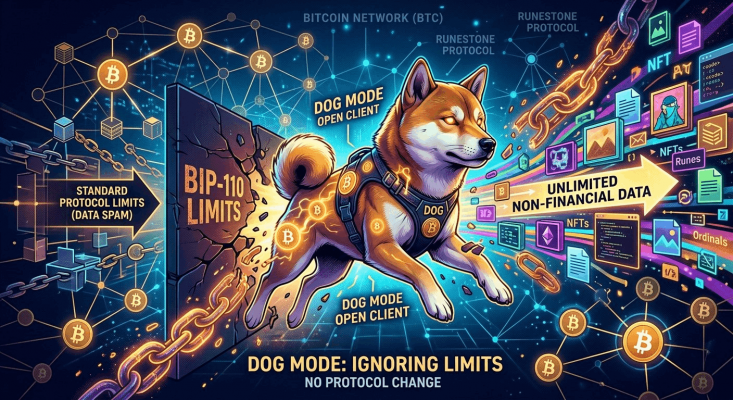
Leonidas, co-founder of the Bitcoin protocol Runestone, has launched DOG Mode, an open-source Bitcoin client that allows network nodes to ignore relay limits on non-financial data without modifying Bitcoin’s core consensus rules.
The BIP-110 Deadlock and the Birth of a Flexible Alternative
BIP-110 (Bitcoin Improvement Proposal) was introduced to limit non-standard transactions to 256 bytes in an effort to reduce blockchain spam generated by protocols such as Ordinals and Runes. However, the proposal has reached a dead end. Activating it would require a consensus change backed by a majority of the network’s hash rate. As of mid-July, support stands at barely 2%, making adoption effectively impossible.
Against this backdrop, Leonidas proposed a fundamentally different approach. Rather than attempting to rewrite the rules for the entire network, DOG Mode gives every node operator a choice:
1. Continue using the standard Bitcoin Core policy rules.
2. Install DOG Mode and begin relaying transactions containing data that can occupy nearly an entire block.
As community analysts have noted:
“DOG Mode’s developers emphasize that their software is not intended to become a mandatory standard. Any node operator can voluntarily install it and begin relaying larger transactions without waiting for network-wide consensus.”
This is a textbook example of how a decentralized network can overcome governance deadlocks through voluntary market adoption instead of protocol-level voting.
Technical Details: From the Dust Limit to Block Weight
To appreciate the scale of the changes, it’s important to understand Bitcoin Core’s default relay policies. These policies protect nodes from being overwhelmed by low-value or abusive transactions.
Examples include:
• Minimum relay fee: Transactions must pay a minimum fee rate in satoshis per byte. Transactions paying too little are treated as spam and are not relayed.
• Dust limit: Outputs worth only one satoshi are generally rejected because the cost of spending them exceeds their value. This prevents the UTXO set from being flooded with economically worthless outputs.
• Transaction size limits: Standard relay rules restrict the size of an individual transaction (typically to around 400,000 weight units) so that a single transaction cannot consume a significant portion of a block.
Raising the Transaction Weight Limit
DOG Mode increases the maximum standard transaction size from 400,000 weight units to an extraordinary 3,900,000 weight units. Since a Bitcoin block is limited to 4 million weight units, the standard Bitcoin Core client relays transactions that occupy only about one-tenth of a block. DOG Mode, by contrast, can relay transactions large enough to consume almost an entire block.
Lowering the Dust Limit to One Satoshi
The second major change concerns the dust limit. Normally, Bitcoin nodes refuse to relay transactions whose outputs are too small to spend economically, since the transaction fee required to spend them would exceed their value. This protects the UTXO set from being cluttered with microscopic outputs.
Leonidas lowered this threshold to one satoshi (0.00000001 BTC). According to the developer, the goal is to unlock roughly $25 million worth of dormant “dust” currently trapped in old wallets. These are tiny leftover balances from previous transactions that have remained economically impractical to move. By reducing the dust threshold, those funds once again become spendable.
Market Sentiment and the Risk of Fragmentation
According to CoinNess, market sentiment surrounding DOG Mode remains neutral. Investors currently view the software as an experiment whose long-term impact is still uncertain.
Relay Policy vs. Consensus Rules
It’s important to distinguish between consensus rules, which determine whether blocks are valid, and relay policies, which determine which transactions nodes forward to one another. DOG Mode changes only the latter. If enough nodes adopt the client, the topology of transaction propagation across the network could change significantly:
• Large data-heavy transactions would reach miners running DOG Mode more quickly.
• Users relying on standard Bitcoin Core nodes could experience slower propagation of complex transactions if the network becomes divided.
Potential Benefits
For developers building meta-protocols such as Runes, DOG Mode could be a significant improvement. Broader relay support would make inclusion of complex transactions in blocks more predictable. Meanwhile, miners seeking to maximize fee revenue would have an incentive to connect to DOG Mode nodes in order to see the complete flow of transactions entering the mempool.
The Risk of a Fragmented Mempool
The greatest concern is inconsistent network behavior. If some nodes enforce one set of relay policies while others follow different ones, the network could develop a fragmented mempool. In that scenario, a transaction that enters a segment dominated by standard nodes might remain unconfirmed for hours before eventually reaching a mining pool connected to DOG Mode nodes.
The Philosophy of Early Bitcoin
The conflict between BIP-110 and DOG Mode is about far more than technology—it reflects two competing visions of Bitcoin.
BIP-110 represents a more paternalistic philosophy: developers and miners decide which types of data are beneficial for the network and prohibit everything else at the protocol level.
DOG Mode takes the opposite approach, returning to Bitcoin’s original philosophy. In Bitcoin’s early years, multiple clients—including BitcoinJ, libbitcoin, and others—coexisted, each offering different policies and configuration options. Only later, with the dominance of Bitcoin Core, did network behavior become largely standardized.
DOG Mode reminds the community that Bitcoin was originally designed as a voluntary network where every participant could configure their own node according to their own priorities.
Historically, disputes of this kind tend to affect infrastructure before they influence price. Miners and node operators choose sides first. Spot markets usually react only after it becomes clear which approach wins the battle over transaction propagation.
Why Fighting Spam Became Bitcoin’s Biggest Debate of 2026
DOG Mode did not emerge in isolation. It is a direct response to the rapid growth of Ordinals and Runes, which have dramatically increased the amount of non-financial data stored on the Bitcoin blockchain.
By early 2026, network activity had reached record levels, with daily transaction counts exceeding 760,000. This created a paradox. Supporters of keeping Bitcoin focused on payments wanted to implement BIP-110, but they ran into resistance from miners themselves. The reason was straightforward: fees generated by images, inscriptions, and token transactions had become an increasingly lucrative source of mining revenue.
When BIP-110 failed to gain sufficient support because of the lack of miner backing, advocates of Bitcoin-based meta-protocols shifted strategies. Instead of changing consensus rules, they began leveraging relay policy as an alternative path forward. DOG Mode has become the tool of those who want to continue expanding Bitcoin’s meta-protocol ecosystem by taking advantage of the flexibility built into the network’s transaction relay rules.
Whether DOG Mode will achieve widespread adoption remains uncertain. However, its very existence demonstrates an important characteristic of Bitcoin: even when consensus cannot be reached, the community often finds alternative ways to overcome governance deadlocks without resorting to disruptive hard forks. Whether a voluntary client like DOG Mode can ultimately compete with attempts to impose stricter protocol-level restrictions may determine what Bitcoin becomes over the next decade—a network dedicated exclusively to financial transactions or an open, censorship-resistant data layer with global significance.
