
- From Scaling to Specialization: The Original L2 Concept
- The Current State of the L2 Sector
- Ethereum Foundation’s New Strategy: Clear Role Separation
- Key Recommendations for L2 Developers
- Ethereum’s Technical Roadmap: Upgrades and AI Integration
The Ethereum Foundation (EF), the organization behind the world’s second-largest cryptocurrency by market capitalization, has released a strategic vision for the ecosystem’s future — one that places Layer-2 (L2) networks at the center of Ethereum’s long-term development.
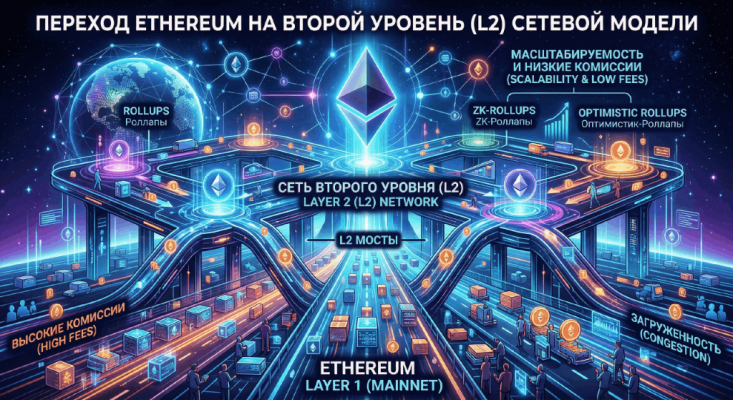
Roughly five years after the first L2 solutions launched, Ethereum developers have redefined both their mission and their role within the network architecture. While L2 networks were originally designed to reduce congestion on the main chain and lower transaction costs, their role has now expanded significantly. Today, L2s are evolving into experimentation platforms for innovation, specialized applications, and new economic models.
From Scaling to Specialization: The Original L2 Concept
In 2020, amid the explosive growth of decentralized finance (DeFi) and NFTs, Ethereum’s mainnet began experiencing serious scalability issues. Transaction delays increased, and gas fees surged, making the blockchain difficult for mainstream users to access. This marked the beginning of rapid Layer-2 development.
The original L2 concept focused on three core objectives:
1. Moving part of the transaction load from the mainnet (Layer-1) to secondary networks (Layer-2) to reduce congestion
2. Delivering faster and cheaper transactions for end users
3. Preserving security and decentralization by periodically anchoring data to Ethereum mainnet
However, the situation evolved following major Ethereum upgrades — including the transition to Proof-of-Stake, sharding-related scaling developments, and other improvements.
In early February 2025, Ethereum co-founder Vitalik Buterin stated that the idea of L2 networks competing with Layer-1 on speed and cost had become outdated. Instead, he emphasized that L2s should focus on unique features and specialization.
The Current State of the L2 Sector
Despite the shift in strategy, the Layer-2 sector remains one of the most dynamic segments of the crypto market. According to CoinGecko data as of late March 2026:
• More than 130 projects now have their own L2 tokens
• Combined market capitalization exceeds $7 billion
• Daily trading volume across L2 tokens surpasses $500 million
Among the largest players:
• Mantle (MNT) — affiliated with crypto exchange Bybit
• Polygon (POL)
• Arbitrum (ARB)
• Stacks (STX)
• Optimism (OP)
These projects are not only improving scalability but also introducing unique mechanisms — aligning with Ethereum Foundation’s updated strategy.
Ethereum Foundation’s New Strategy: Clear Role Separation
In a strategic document published in late March 2026, Ethereum developers clearly defined responsibilities between Layer-1 and Layer-2 networks:
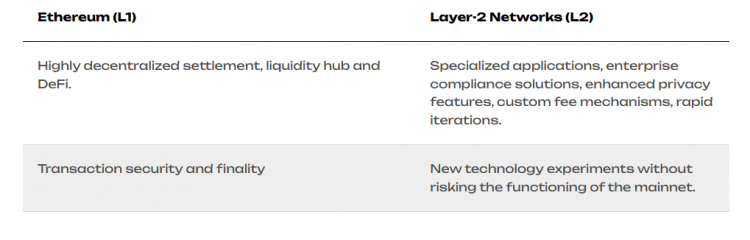
According to the Ethereum Foundation, this model benefits both sides:
• L2 networks gain access to Ethereum’s liquidity, users, and security without spending billions building their own infrastructure
• Ethereum strengthens its network effects, attracts new users, and increases demand for ETH
Key Recommendations for L2 Developers
The Ethereum Foundation outlined three main recommendations for teams building Layer-2 solutions:
1. Stop competing with Ethereum on speed and cost
Instead, focus on unique functionality and specialization.
2. Improve security transparency
Developers should clearly disclose the level of decentralization and security mechanisms used in their networks.
3. Enable frictionless asset movement
Implement mechanisms that allow liquidity to move freely between Layer-1 and Layer-2 without complex and risky bridges.
Ethereum’s Technical Roadmap: Upgrades and AI Integration
The new development strategy builds on previously announced plans. In early 2026, the Ethereum Foundation introduced two major protocol upgrades:
• Glamsterdam — focused on scaling and reducing transaction fees
• Hegota — aimed at further infrastructure improvements
Lead researcher Justin Drake also presented a roadmap extending through 2029.
Additionally, in early 2026, the Ethereum Foundation increased its activity in the artificial intelligence sector. Vitalik Buterin published a new vision for the synergy between AI, blockchain, and cryptography, outlining key development vectors for the Ethereum ecosystem.
