
- ECB Chooses Independence: Betting on Its Own Standards
- How It Will Work: Three Pillars of Europe’s Payment System
- The Current Reality: Europe Under the Hood
- The Battle for the Future: Skeptics vs. Supporters
- What Does This Mean for the World?
The world of digital finance is undergoing another shift. The European Central Bank (ECB) has taken a decisive step toward financial independence by signing agreements with three leading European payment standardization bodies. This move could mark a turning point for Europe’s economy—and for the global digital currency landscape.
ECB Chooses Independence: Betting on Its Own Standards
This week, the regulator officially announced partnerships with ECPC, Nexo Standards, and the Berlin Group. The goal is to implement their open technical standards for processing payments within the future digital euro framework.
“When you make a payment—whether in an online store, by card, or with your phone—you’re always relying on non-European infrastructure. Visa, Mastercard, PayPal, Alipay—where are they from? Either the U.S. or China. The entire infrastructure that powers payments is non-European,” said ECB President Christine Lagarde.
This is more than a technical upgrade. It’s a strategic move aimed at reclaiming control over European payments from American and Chinese giants.
How It Will Work: Three Pillars of Europe’s Payment System
To build a unified and independent ecosystem, the ECB has assigned roles to three key players, each responsible for a segment of the payment chain:
1. ECPC (C-PAy Contactless Extension): Provides “tap-to-pay” technology via NFC. This is the standard that enables contactless payments with a phone or card. ECPC protocols are already successfully used in national systems like Germany’s Girocard and France’s Carte Bancaire.
2. Nexo Standards: Acts as the “bridge” between merchants and banking systems. It standardizes communication between point-of-sale terminals, ATMs, and the backend infrastructure of payment providers.
3. Berlin Group: Focuses on “alias-based payments.” This enables transfers via phone numbers or merchant apps, as well as balance checks.
“Using widely adopted European standards will simplify digital euro acceptance and ensure a consistent user experience across the eurozone,” the ECB said in its press release.
The Current Reality: Europe Under the Hood
Today, Europe’s payments market is heavily dependent on the United States. Roughly two-thirds of all card transactions in the eurozone are processed through international schemes controlled by U.S. companies.
The standards behind these cards are defined by EMVCo, a California-based consortium governed by companies such as American Express, Discover, JCB, Mastercard, UnionPay, and Visa. These standards come with associated fees.
The ECB is proposing a fundamentally different model: free access for all market participants. The goal is to reduce costs for businesses and make payments more accessible for consumers.
The Battle for the Future: Skeptics vs. Supporters
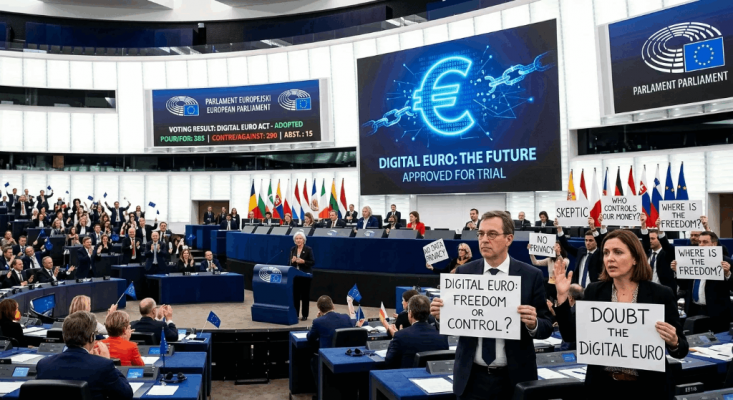
The ECB’s decision is just one step in a longer journey. The digital euro project has not yet been fully approved, and heated debates are underway in the European Parliament:
Supporters: The European Commission and EU member state governments back the initiative, viewing it as a cornerstone of digital sovereignty.
Skeptics: Major European banks and payment providers worry that a state-issued digital euro could crowd out private initiatives (such as the Wero project) without delivering meaningful benefits to the market.
If the European Parliament votes in favor this summer, the legislation will move into negotiations with EU member states. Final approval is expected by late 2026 or early 2027.
What Does This Mean for the World?
If Europe successfully delivers on this project, the digital euro could become the world’s first large-scale state-backed digital currency built on a fully independent infrastructure. That would set a precedent and potentially trigger a chain reaction, prompting other countries to develop their own payment standards to reduce reliance on geopolitical players.
For users, this could mean greater security, lower fees, and standardized payments across the eurozone—wherever you are, the payment experience would work the same way. For crypto enthusiasts, it signals that governments are taking the digital economy seriously and are ready to compete with private fintech solutions on their own turf—technology and user experience.
Europe is placing its bet on openness and autonomy. Now, all that remains is the final decision from lawmakers.
