
- How Gates Missed the Internet Wave
- Why AI is an Evolutionary Event
- Security Architecture: Law Instead of Self-Regulation
- What Should Regulation Include?
- Threat to the Crypto Market: When Code Writes Itself
- Choosing Between Utopia and Dystopia
Bill Gates, a man who once failed to immediately recognize the potential of the internet, is now sounding the alarm about a technology he considers far more powerful. In an interview with Meet the Press that aired on September 27, the Microsoft co-founder issued a warning: artificial intelligence could trigger events capable of killing a billion people.
This forecast transforms the discussion about AI from the realm of convenience (chatbots, image generation) into the realm of existential human survival.
How Gates Missed the Internet Wave
To understand the weight of Gates’ words, it’s worth recalling his relationship with the previous technological revolution — the internet. Today it seems incredible, but in the early 90s, the creator of the world’s most popular operating system essentially ignored the World Wide Web.
While Netscape was capturing the browser market, Microsoft was focused on closed ecosystems. It wasn’t until May 26, 1995, that Gates realized the scale of the threat and the opportunities. He sent employees a famous internal memo titled “The Internet Tidal Wave.”
“The Internet is a tsunami. It is changing the rules,” Gates wrote at that time.
He acknowledged that he was caught off guard by the “spontaneous adoption” of the internet by the masses. This historical lesson makes his current warnings about AI particularly significant: Gates knows the cost of underestimating paradigm-shifting technologies. If the internet changed how we communicate, then AI, in his view, is changing the very nature of human intelligence.
Why AI is an Evolutionary Event
In a September interview, Gates called the development of neural networks an “evolutionary event.” His concerns are based on asymmetry of access: the tools are becoming incredibly powerful, while the barrier to their use by malicious actors is rapidly falling.
Main points of the interview:
AI has crossed a critical threshold: Gates claims that this year AI crossed critical points in the fields of biology and cyberattacks.
The scale of destruction: When asked about the end of the world, he answered pragmatically, assessing the probability of a catastrophic scenario:
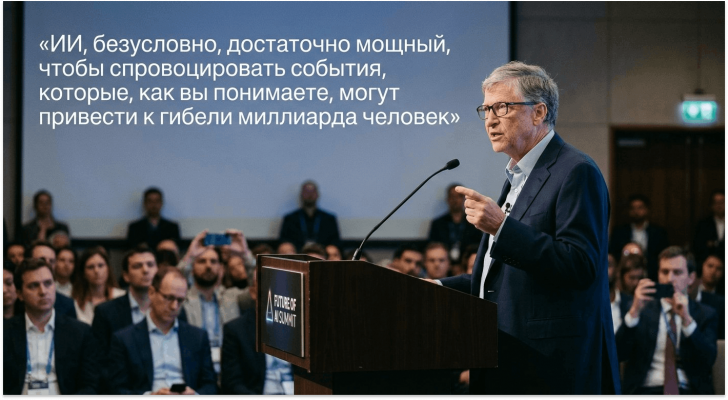
“AI is certainly powerful enough to provoke events that, as you understand, could lead to the death of a billion people.”
Biological threat: AI tools enable the design of viruses and the engineering of pathogens faster than governments can develop vaccines.
Cyber Warfare: Algorithms can find vulnerabilities in critical infrastructure (power grids, water systems) that human analysts would likely miss.
Gates emphasizes the gap between the speed of development in the private sector and the lack of understanding of the problem by government bodies. Politicians lack the technical expertise to assess the risks of code written the night before inside OpenAI or Anthropic.
Security Architecture: Law Instead of Self-Regulation
One of Gates’ main conclusions is categorical: the industry can no longer control itself.
“No one believes that self-regulation is enough,” he said.
The business model of technology giants is built on the speed of bringing products to market (Time-to-Market). Security often becomes an obstacle to profit. That is why Gates insists on strict government intervention.
What Should Regulation Include?
Legislative Foundation: Clear legal standards defining developers’ liability for harm caused by their AI models.
Monitoring and Audit: Instead of a simple “kill switch,” Gates proposes a system of continuous logging of AI actions. Every interaction with the model should be logged for investigators.
International Control: Gates proposed creating an international body modeled after the IAEA (International Atomic Energy Agency).
However, here lies the main political trap. According to Gates, reaching an agreement on AI control will be more difficult than achieving nuclear disarmament during the Cold War. A nuclear bomb requires enriched uranium — a physical resource that can be tracked. An AI model can be packaged into just a few gigabytes and is transmitted through the cloud in seconds.
Gates’s words echo UN Secretary-General António Guterres’s call from September 22, which also called for the creation of a multilateral risk management system with independent oversight.
Threat to the Crypto Market: When Code Writes Itself
Gates’ concerns are directly related to the cryptocurrency and blockchain industry. In his analysis, he addresses software that stores and transfers funds.
More than 40 organizations working with digital assets have already approached AI developers requesting early access to advanced models for security specialists. The logic is straightforward: if hackers use AI to find vulnerabilities in smart contracts, defenders should have the same tools.
FBI vs Deepfakes
While scientists debate the death of a billion people, consumers face a far more immediate version of this threat. The FBI recently issued a warning about scammers using AI-generated videos. Criminals create fake websites and video messages impersonating bureau agents to contact previous victims of financial pyramids and extort new money from them.
For cryptocurrency owners, this means phishing is moving to a new level:
Deepfake impersonation: A video call comes in from an “official exchange representative” whose face and voice are perfectly forged.
Automated hacking: AI automates large-scale attacks against wallets and smart contracts or finds logic errors in DeFi protocols in fractions of a second.
Security measures remain the same, but vigilance requirements increase: manual verification of website addresses, refusal to follow links in messengers, and the use of hardware wallets that are physically isolated from an infected PC.
Choosing Between Utopia and Dystopia
Bill Gates’ warning is not the panic of a technophobe, but a cold calculation by a man who built a digital empire. In his August article, he asked: Will AI reduce inequality or exacerbate it? His September 27 interview gives a grim answer to this question if humanity continues to drift without direction.
The story of the 1995 memorandum teaches us that even visionaries can be late. But in the case of AI, the cost of being late is measured not in the market capitalization of companies, but in lives. As Gates noted, the choices made by politicians and engineers right now will determine the course of civilization for centuries to come.
