
- Who Was Targeted?
- The A7 Network: A $90 Billion Digital Payment Machine
- Why Kyrgyzstan and Canada?
- A Global Chain of Sanctions
- FinCEN’s Proposal and the Future of Stablecoins
- Historical Context
October 8, 2026, became a black Tuesday for a wide range of cryptocurrency services operating across the former Soviet Union. The UK’s Foreign, Commonwealth & Development Office (FCDO) delivered a targeted but significant blow to the financial infrastructure supporting these businesses by imposing sanctions on 38 entities. The list included not only the usual oil tankers and industrial facilities, but also three cryptocurrency exchanges and two payment platforms that London believes have become key gateways for cross-border capital flows.
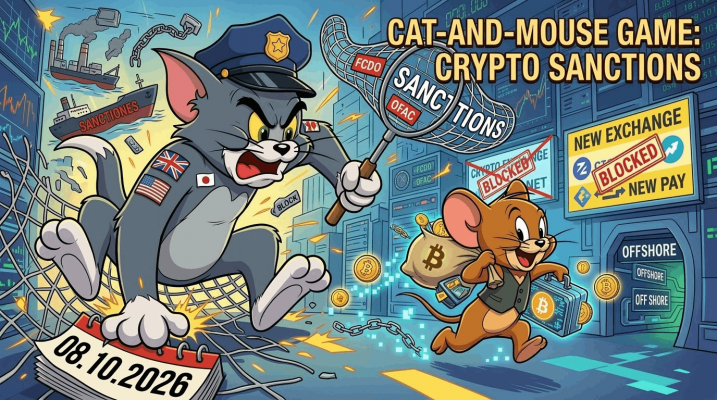
The move is part of a global game of regulatory cat-and-mouse, where authorities blacklist wallet addresses and companies while businesses rapidly reappear under new names in more crypto-friendly jurisdictions.
Who Was Targeted?
The UK’s October 8 sanctions targeted several critical links connecting fiat currencies with digital assets outside the traditional SWIFT banking system.
Sanctioned entities:
Xeltox Enterprises Ltd.: Registered in Canada. British authorities concluded that this corporate entity operates two well-known cryptocurrency brands—Cryptomus and Heleket. Their inclusion under a single designation suggests that their corporate structures are closely intertwined and function as a unified operational network.
TokenSpot, Tsunami Payments, Processing KG, and Planeta: Platforms primarily based in Kyrgyzstan. Particular attention has been directed toward Processing KG. In the UK’s sanctions documentation, the Kyrgyz Ministry of Finance is explicitly identified as the company’s parent organization, while Ulan Arymbaevich Bukabaev is listed as its director.
For UK residents, these sanctions immediately freeze any assets belonging to the designated companies. They are also prohibited from providing funds, services, or entering into any economic relationship with the sanctioned entities.
The A7 Network: A $90 Billion Digital Payment Machine
The centerpiece of the British investigation is the A7 network. Rather than a single cryptocurrency exchange, A7 is an entire cross-border payments ecosystem that has expanded dramatically over the past year.
The Scale of the Network
According to statements made by A7 itself and cited by British officials, more than $90 billion passed through its infrastructure during 2025. For comparison, that is roughly equivalent to the annual GDP of countries such as Slovenia or Serbia.
Its primary settlement instrument is A7A5, a ruble-pegged stablecoin issued by Old Vector LLC. Notably, Old Vector was sanctioned by the U.S. Treasury in August 2025, yet the network continued operating despite those restrictions.
TokenSpot as Grinex’s Front End
Blockchain analytics firm TRM Labs provided the most detailed assessment of the network’s internal relationships. According to its findings, TokenSpot effectively functions as a front-end platform for the Grinex exchange.
Key figures: TokenSpot transferred more than $950 million to accounts associated with Grinex, Garantex, and directly to the A7 network.
The technical evidence cited by TRM Labs points to a shared wallet infrastructure. In practice, this suggests that the wallet management keys for TokenSpot and Grinex are controlled by the same operators, making transfers between them little more than internal fund movements designed to obscure transaction trails.
It is worth recalling that Grinex emerged as the successor to the Russian exchange Garantex after U.S. authorities shut down Garantex in March 2025. Operation Economic Outcast, launched by the United States on October 1, specifically targeted the dismantling of this broader financial architecture.
The Evolution of Sanctions: From Wallet Addresses to Entire Networks: In the past, regulators such as the U.S. Office of Foreign Assets Control (OFAC) or the UK’s Office of Financial Sanctions Implementation (OFSI) primarily sanctioned individual cryptocurrency wallet addresses. That strategy has now evolved.
The A7 ecosystem has demonstrated remarkable resilience. Whenever one payment gateway is blocked, transaction flows are quickly redirected through another, forcing regulators to shift their focus from isolated wallets to entire payment infrastructures.
Why Kyrgyzstan and Canada?
The choice of jurisdictions for registering sanctions-evasion platforms is far from accidental.
Canada (Xeltox): Registering Cryptomus and Heleket through a Canadian company appears to provide greater business legitimacy and easier access to banking services and liquidity by leveraging Canada’s reputation as a well-regulated financial jurisdiction.
Kyrgyzstan (TokenSpot and Processing KG): These platforms are based in a jurisdiction with an evolving regulatory framework for virtual assets, where oversight remains less developed than in the United States or the European Union. The UK’s decision to identify the Kyrgyz Ministry of Finance as Processing KG’s parent organization represents an unusually serious allegation, one that potentially damages the reputation of an entire government institution.
A Global Chain of Sanctions
The UK’s October 8 sanctions are only one link in a broader international enforcement campaign.
May 26: The UK sanctions HTX (formerly Huobi), Exmo, Bitpapa, and Rapira.
October 1: The United States designates the A7 network as a “significant transnational criminal organization.”
October 2: Japan freezes the assets of Garantex Europe OU, despite the original exchange having effectively ceased operations in March.
Taken together, these coordinated actions demonstrate that regulators have moved beyond targeting individual exchanges and are now focused on dismantling entire cross-border payment networks.
The Shadow Fleet and Oil: Crypto as the Financial Engine of the Real Economy
The sanctions against cryptocurrency platforms are not an isolated campaign against digital assets. They form part of a much broader effort to reduce revenue generated through sanctioned exports.
The same October 8 sanctions package also targeted:
Zarubezhneft and INK Capital, bringing more than 90% of the targeted oil production capacity under sanctions.
The shadow tanker fleet, with another 12 vessels added to the blacklist, bringing the total number of tankers allegedly used to circumvent oil price caps to more than 600.
The connection is straightforward. Selling oil outside the Western financial system requires alternative payment mechanisms. The A7 network and the A7A5 stablecoin provide precisely that infrastructure.
An oil exporter can receive payment in rubles, convert those funds into A7A5 through intermediaries, and then use the stablecoin to purchase equipment, pay logistics providers, or settle other international obligations without relying on Western banking channels.
FinCEN’s Proposal and the Future of Stablecoins
The regulatory campaign is continuing to escalate. On October 1, alongside Operation Economic Outcast, the U.S. Financial Crimes Enforcement Network (FinCEN) published a proposal that would prohibit certain categories of transactions involving A7’s network of intermediary agents.
If adopted, the measure would prevent financial institutions worldwide from processing transfers routed through intermediaries connected to the A7 ecosystem. That could effectively turn A7A5 into a toxic asset that even cryptocurrency exchanges with relatively permissive compliance standards may refuse to support.
Historical Context
The current campaign echoes the U.S. government’s efforts against the Silk Road marketplace between 2013 and 2017. Back then, shutting down one darknet marketplace simply led to the emergence of many new ones. The difference today is that regulators are no longer dealing primarily with criminal marketplaces operated by anonymous hackers. Instead, they are confronting large-scale financial networks that allegedly facilitate state-linked and quasi-state cross-border transactions.
The UK’s October 8 sanctions acknowledge a new reality: cryptocurrency has become a fully fledged geopolitical financial tool. As long as there is demand for sanctions-evasion mechanisms—and as long as stablecoins can be issued from jurisdictions willing to accommodate them—the global cat-and-mouse game between regulators and crypto payment networks is likely to continue, producing increasingly sophisticated financial structures.
