
- The Scale of the Transformation: From the Shadows to the Banking System
- Regulatory Barriers: A Glass Ceiling for Investors
- Infrastructure: Who Will Receive a License?
- Why Sber’s Conservative Outlook Makes Sense
- The Birth of a Hybrid Market
Russia’s financial sector is undergoing a tectonic shift. The era of back-alley exchange services and anonymous P2P transactions is gradually giving way to a regulated cryptocurrency market integrated into the country’s banking system.
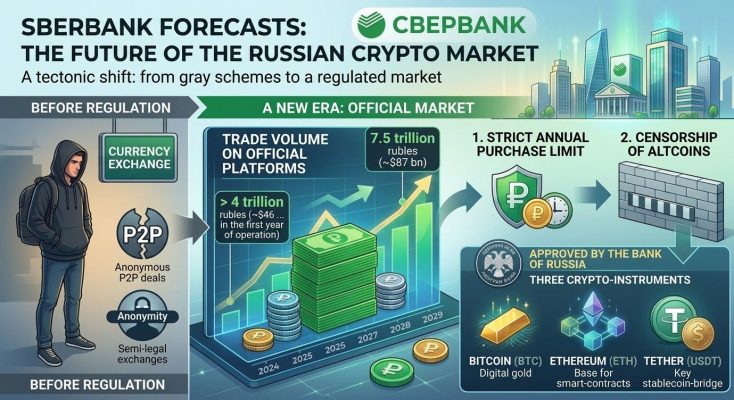
According to analysts at Sberbank, the volume of legal cryptocurrency trading on officially licensed Russian platforms could exceed $46 billion (approximately RUB 4 trillion) during the market’s first year of operation. Yet behind these impressive figures lies the harsh reality of strict regulatory constraints, leaving a significant portion of crypto activity in the gray market.
The Scale of the Transformation: From the Shadows to the Banking System
The estimates presented by Anatoly Popov, Deputy Chairman of Sberbank’s Management Board, are based on an in-depth analysis of current capital flows. According to data from Russia’s Ministry of Finance cited by Popov, Russians already conduct approximately RUB 50 billion worth of cryptocurrency transactions every day. On an annual basis, that amounts to roughly RUB 18 trillion—a figure comparable to the country’s federal budget.
However, analysts at SberCIB Investment Research take a much more conservative view. They believe that only a relatively small share of this volume will migrate into the regulated sector immediately after the new legislation comes into force.
“SberCIB Investment Research analysts provide a fairly conservative estimate: during the first year after legalization, approximately 20% of this volume—or RUB 3.5–4 trillion annually—will be traded on licensed exchanges,” Anatoly Popov told TASS.
By 2029, Sberbank expects investors to gradually transition to the regulated market, with annual trading volumes reaching RUB 7.5 trillion (approximately $87 billion). The bank does not expect this growth to be linear. Instead, it will largely depend on how flexible Russian regulations prove to be in competing with international cryptocurrency exchanges.
Regulatory Barriers: A Glass Ceiling for Investors
The primary reason behind these cautious projections is the stringent restrictions imposed by the Bank of Russia to protect retail investors. Regulators remain concerned about the volatility of digital assets and aim to prevent widespread financial losses should crypto prices experience a sharp decline.
Investment Limits for Individuals
The new legislation establishes strict annual limits on cryptocurrency purchases.
Retail (non-qualified) investors: They may invest no more than RUB 300,000 (approximately $3,800) per year through a single licensed intermediary. Investors must also pass a knowledge test demonstrating their understanding of cryptocurrency-related risks before making purchases.
Qualified investors: Although the requirements for obtaining qualified investor status have recently been relaxed, their investment capacity remains significantly constrained. Annual investments are capped at RUB 3 million (approximately $38,000).
These limits are insignificant compared to the capital typically deployed by larger investors. Someone seeking to establish a $100,000 or $500,000 position simply cannot do so through a Russian bank without splitting funds across numerous intermediaries—a cumbersome process that makes the regulated market unattractive for institutional participants.
A Narrow List of Approved Assets
Another major limitation is the extremely restricted list of cryptocurrencies available for trading. The Bank of Russia currently permits trading in only three digital assets:
Bitcoin (BTC) — digital gold.
Ethereum (ETH) — the leading smart contract platform.
Tether (USDT) — the dominant fiat-pegged stablecoin.
Every other major cryptocurrency—from Solana and XRP to high-risk memecoins—remains outside the legal framework.
This creates a paradox. Investors may choose a Sber-backed exchange for its regulatory protection and security, only to discover that many of the assets they want to buy are unavailable. As a result, capital inevitably flows back to unregulated international exchanges that offer a much broader selection of cryptocurrencies.
Infrastructure: Who Will Receive a License?
Legalization also requires the creation of an entirely new class of market participants. Under the Bank of Russia’s regulatory framework, which is scheduled to take full effect in autumn 2026, only licensed cryptocurrency exchanges, brokers, and custodians will be authorized to provide trading services.
At present, state-owned Sberbank and private-sector Alfa-Bank are among the approved issuers of tokenized financial assets. Both institutions already operate in the tokenization space, including through Alfa-Bank’s A-Token platform. Their next challenge will be adapting their infrastructure to support spot trading in cryptocurrencies themselves.
A key milestone will be July 1, 2027, when the transition period officially ends. By that date, every company wishing to operate legally must complete the licensing process. Afterward, conducting cryptocurrency transactions through unlicensed organizations could expose both platforms and their clients to administrative—and potentially criminal—liability.
Why Sber’s Conservative Outlook Makes Sense
Anatoly Popov’s expectation that most cryptocurrency trading volume will remain outside regulated exchanges is supported by several compelling factors.
Tax considerations: Trading through licensed platforms means complete transparency of investment income. Many Russian crypto holders accumulated their assets years ago and may prefer to remain outside the regulated system rather than explain the origin of their funds to tax authorities.
Sanctions and blockchain choice: Restricting trading to just three cryptocurrencies also limits access to DeFi ecosystems built on networks such as TRON and BNB Chain, both of which are widely used for cross-border settlements under sanctions-related constraints.
Competition between jurisdictions: Neighboring countries with friendlier regulatory regimes may offer businesses more attractive conditions. If obtaining a Russian license involves extensive compliance obligations while investment limits remain low, companies may simply choose to relocate elsewhere.
The Birth of a Hybrid Market
Russia is no longer trying to ban cryptocurrencies—it is trying to regulate and integrate them into the financial system. The $46 billion projection represents an acknowledgment that total control over crypto activity is no longer realistic. Policymakers recognize that a substantial amount of citizens’ wealth has already moved into digital assets. Their objective now is to build a secure gateway that channels at least part of this capital back into the regulated economy.
According to analysts, this shift presents a significant opportunity for the banking sector. Banks stand to generate substantial fee income from trillions of rubles in trading volume that previously bypassed the traditional financial system. Ultimately, however, the success of the reform will depend on the regulator’s next steps. Unless investment limits are raised and the list of approved digital assets is expanded, Russia’s licensed cryptocurrency exchanges risk becoming expensive museums—places where investors can trade only BTC, ETH, and USDT while the rest of the global crypto market continues to innovate and move forward.
