
- A Canceled Vote and a Surprise Announcement
- The Story of Gram’s Battle for Survival
- The Birth of The Open Network and Life After Telegram
- What Does This Rebrand Mean?
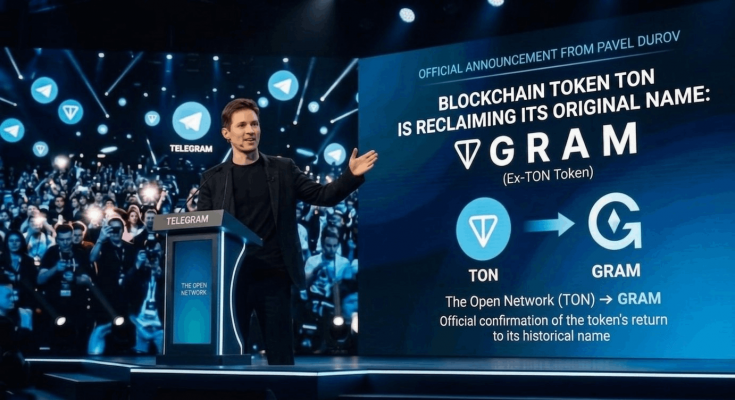
In the cryptocurrency industry, where rebranding is often used to distance a project from a troubled past or revive interest in a stagnant ecosystem, Pavel Durov’s latest move stands apart. This is not an attempt to escape history—it is a triumphant return to it. The Telegram founder has officially confirmed what many in the crypto community had been quietly discussing: the native token of The Open Network (TON) blockchain is reclaiming its original name—Gram.
A Canceled Vote and a Surprise Announcement
Events unfolded rapidly. Shortly before the official announcement, a proposal was launched on TON Vote—the network’s decentralized governance platform—to change the token ticker from TON to GRAM. However, the vote was removed just minutes before Pavel Durov published a statement on his official Telegram channel.
The move sparked a wave of speculation, but the outcome remained unchanged: the decision had already been made. In his announcement, Durov highlighted several key points:
• Only the token’s name and ticker are changing. The blockchain itself will continue to operate under the name The Open Network (TON).
• No action is required from users. Wallet balances, addresses, NFT collections, and positions in DeFi protocols will remain unchanged.
• Any offers to assist with token swaps or migrations are scams.
Durov described the move as a “return to the roots” and “the beginning of a new chapter,” emphasizing the continuity of the project’s original vision.
The Story of Gram’s Battle for Survival
To understand the significance of this development, it is necessary to go back more than eight years. In 2018, the Telegram Open Network (TON) was one of the most ambitious projects in the cryptocurrency industry. Led by Pavel and Nikolai Durov, Telegram conducted one of the largest ICOs in history, raising approximately $1.7 billion from private investors.
At the center of the ecosystem was the Gram token. It was envisioned as a global currency for instant payments across Telegram’s massive user base.
However, those plans did not materialize as quickly as expected. The U.S. Securities and Exchange Commission (SEC) stepped in, filing a lawsuit against Telegram and arguing that the sale of Gram constituted an unregistered securities offering. The lengthy legal battle drained company resources, and in May 2020, following an unfavorable court ruling, Telegram announced it would cease active involvement in the TON project. The company returned funds to investors and paid a financial penalty.
At the time, it seemed that Gram’s story had ended before it had truly begun. But the project soon found new custodians.
The Birth of The Open Network and Life After Telegram
Telegram’s withdrawal did not mark the end of the project. An independent community of developers picked up where the company left off. Using the open-source code released by the Durov team, they continued developing the network on their own. This effort gave rise to The Open Network (TON)—a fully decentralized project no longer dependent on a single company.
The network’s native token became known as Toncoin (TON). Despite the separation from its original creator, the ecosystem continued to grow rapidly. Developers implemented sharding technology to improve scalability, built infrastructure for decentralized applications across DeFi and GameFi, and integrated wallets directly into Telegram through bots and mini-apps. Toncoin eventually entered the top 20 cryptocurrencies by market capitalization, which currently exceeds $5.5 billion, proving the long-term viability of the original concept.
Yet the name Toncoin always carried the mark of compromise. The true original name—the one described in the first white paper and embedded in the project’s DNA—was Gram.
What Does This Rebrand Mean?
This is more than a simple name change. It is a powerful symbolic gesture with several layers of significance.
1. A Symbol of Victory
The rebrand signals that the project survived intense regulatory pressure and emerged stronger and more independent than before. What Telegram was unable to launch as a centralized initiative ultimately became reality through decentralization.
2. The Completion of a Cycle
The project has returned to its original concept. The circle is complete. An idea born within Telegram endured years of challenges, achieved independence, and is now returning home as an integral part of the messenger’s ecosystem.
3. The Fourth Step of MTONGA
Durov noted that this rebranding is only one stage of the Make TON Great Again (MTONGA) initiative. This sends a clear signal to both the market and the community that additional integration and development efforts are still ahead. Deeper ties between Telegram and the TON blockchain can be expected in the future.
Ultimately, Toncoin is becoming Gram again not because the old brand failed, but because the time has come to restore historical continuity and reconnect the project’s past with its future. For the most successful blockchain initiative to emerge from the post-Soviet region, this marks the beginning of a new era—one in which the technology has finally caught up with the bold vision first outlined in 2018.
