
- The Anatomy of a Giant: From $100 Million to $96 Billion
- The “Backup Airfield” Phenomenon: Grinex and the A7A5 Token
- How the Migration Worked
- Why Sanctions Function More Like a Gate Than a Wall
- The Evolution of Evasion: From Rotating Wallets to Sector-Wide Bans
- Lessons for the Industry
There is an unwritten rule in the cryptocurrency industry: protocols live forever, while centralized services survive only until the first law enforcement raid. The story of the Russian cryptocurrency exchange Garantex is more than the rise and fall of a single company. It is a textbook example of how the crypto industry adapts to government pressure, turning sanctions from a fatal blow into little more than another operating expense.
This week, Japan’s Ministry of Foreign Affairs officially added Garantex Europe OU to its asset-freeze list. Tokyo joined the United States, the United Kingdom, and the European Union in closing its doors to a platform that, according to the U.S. Treasury, processed more than $96 billion in transactions, a significant portion of which authorities believe was tied to ransomware activity and sanctions evasion.
There is, however, one fundamental problem with this story: by the time Japan pulled the trigger, Garantex was already gone. The bullets were aimed at a ghost while the real money had already slipped out through an emergency exit called Grinex.
The Anatomy of a Giant: From $100 Million to $96 Billion
Founded in late 2019 and registered in Estonia, Garantex quickly became one of the primary gateways between the Russian ruble and cryptocurrencies.
Timeline of the Crackdown
April 2022: The U.S. Office of Foreign Assets Control (OFAC) imposed its first sanctions against Garantex, citing its links to the Hydra darknet marketplace and the laundering of more than $100 million.
February 2025: The European Union introduced its 16th sanctions package, making Garantex the first Russian cryptocurrency exchange to appear on the EU sanctions list.
March 2025: The U.S. Secret Service (USSS), working alongside European partners, launched a coordinated enforcement operation. Authorities seized the exchange’s domains, confiscated servers located in Germany and Finland, and froze $26 million in fiat assets.
Management Arrests: Technical director Aleksei Besciokov was arrested in India, while arrest warrants were issued for co-founder Aleksandr Mira Serda.
On paper, the operation looked like a complete takedown. Blockchain analytics firms Elliptic and TRM Labs, however, continued monitoring on-chain activity. Their findings showed that after the first sanctions were imposed in 2022, Garantex did not shrink—it accelerated, processing another $60 billion in transactions.
The “Backup Airfield” Phenomenon: Grinex and the A7A5 Token
Perhaps the most remarkable detail in the entire story is the registration date of Garantex’s successor. According to the U.S. Treasury, Grinex was incorporated in Kyrgyzstan in December 2024.
That means Garantex’s operators were preparing for the coming crackdown at least three months before law enforcement agents arrived at their data centers.
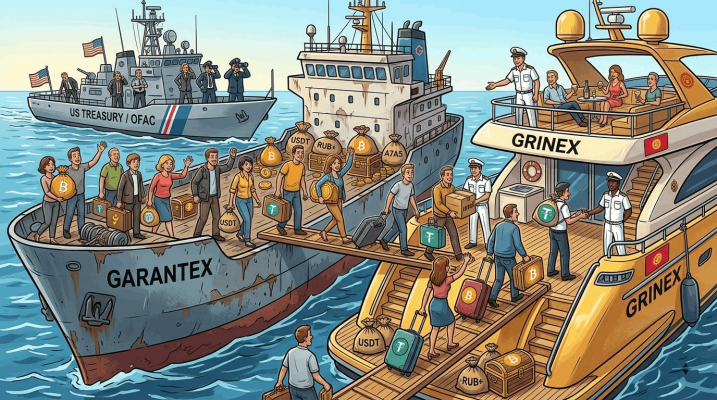
Rather than trying to save a sinking ship, they simply moved the passengers onto a yacht already moored alongside it.
How the Migration Worked
When Tether, the issuer of USDT, froze Garantex’s wallets in March 2025, effectively cutting the exchange off from its primary liquidity, a contingency plan immediately went into effect.
Debt Tokenization:Customers whose funds became trapped on Garantex received a new asset in their accounts: A7A5, a ruble-backed stablecoin issued by the Kyrgyz company Old Vector.
A New Storefront: Users soon discovered that their previously “frozen” balances had become fully tradable on a new exchange—Grinex.
A Near-Identical Interface: The UK’s Office of Financial Sanctions Implementation (OFSI) later noted that the two exchanges shared nearly identical user interfaces. Customers were even instructed to recover access to their funds through Grinex’s support service.
By May 2025, more than $1.2 billion in USDT had already flowed through Grinex. By August 2025, the U.S. Treasury had seen enough. OFAC expanded its sanctions to include Grinex, Old Vector, and another successor platform, Exved.
Why Sanctions Function More Like a Gate Than a Wall
Japan’s latest action on October 2, 2026, is significant from a legal perspective but largely ineffective as a means of intercepting capital flows. Adding Garantex Europe OU to Japan’s sanctions list (Entry No. 402) means Japanese banks and businesses are now prohibited from processing payments involving that legal entity without special authorization.
The Limits of Bureaucracy
An 18-Month Delay: Japan froze the assets of a company whose servers and domains had already been seized more than a year and a half earlier. It is, in effect, shooting at a building long after everyone has left.
Jurisdictional Blind Spots: Japan’s sanctions list does not include Grinex or Old Vector. Transactions involving A7A5 and operations conducted through Kyrgyzstan remain outside Tokyo’s jurisdiction.
No Recovery Mechanism: Sanctions can freeze whatever assets remain inside a country’s financial system, but they cannot retrieve billions of dollars that have already moved across blockchains into other jurisdictions.
Japan placed Garantex on the same sanctions list as Russian defense manufacturers and 35 vessels belonging to the so-called “shadow fleet” transporting Russian oil. The move demonstrates political resolve—but cryptocurrencies do not recognize national borders.
The Evolution of Evasion: From Rotating Wallets to Sector-Wide Bans
The Garantex case exposed a major weakness in traditional address-based sanctions.
According to blockchain analysts, after the first sanctions in 2022, the exchange adapted simply by rotating its wallet addresses on a daily basis. By the time blacklists were published, many of the listed addresses were already obsolete.
Regulators eventually adjusted their strategy. Previously, sanctions targeted specific entities such as Garantex, Binance, or Bitzlato. After observing the Garantex → Grinex → A7A5 migration model, however, the European Union shifted toward broader sectoral restrictions in its 20th sanctions package.
Rather than adding each new exchange to the sanctions list individually, the EU moved to prohibit dealings with any crypto-asset service provider (CASP) established in Russia or Belarus. The package also targets ruble-backed stablecoins—including RUBx and A7A5—as an entire asset class.
It is a game of cat and mouse played at the level of nation-states.
Governments close one door. The industry opens a window.
Governments seal the window. The industry builds a basement.
Lessons for the Industry
The Garantex case illustrates how decentralized finance (DeFi) and stablecoins have become powerful tools for maintaining financial continuity under pressure.
Speed Versus the State: Grinex’s registration three months before the enforcement raid suggests that crypto businesses can sometimes anticipate regulatory action more effectively than governments can execute it.
Stablecoins as Strategic Infrastructure: Tether’s ability to freeze $28 million demonstrated the centralized control that still exists within USDT.
The rapid emergence of A7A5, however, demonstrated just as clearly how quickly the market can create alternatives.
The Illusion of Control: Authorities can seize a .com domain.
They cannot seize a smart contract deployed on Ethereum or confiscate a blockchain address itself.
While Japan, the United States, and the European Union celebrate what appears to be a victory over Garantex, many of the operational mechanisms built by its founders continue to function under new names.
The A7A5 token continues to circulate through non-custodial wallets, while Exved has assumed part of the role in facilitating cross-border transactions. The sanctions shut down a brand. They did not stop the movement of capital. In the world of cryptocurrencies, a legal entity’s name matters far less than control of a private key.
