
- From Peak to Decline: The Numbers Are Shocking
- Where Did the Money Go? The Battle for Traders’ Attention
- The Bigger Picture: Market Capitalization Is Melting Away
- The Dark Side of the Hype
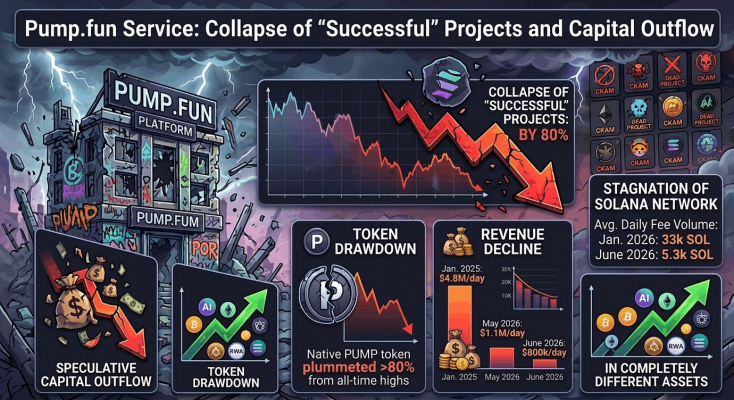
The cryptocurrency market runs on cycles of hype, but the decline of Pump.fun has been one of the fastest downturns in recent memory. What only recently seemed like an endless profit engine on the Solana blockchain is now showing signs of a deep crisis. Analysts are sounding the alarm: the number of “successful” projects has collapsed by 80%, while speculative capital is flowing into entirely different asset classes.
From Peak to Decline: The Numbers Are Shocking
Pump.fun—a platform that allowed anyone to launch a memecoin in just a few clicks—was long considered one of the key growth drivers of the Solana ecosystem. Since September 2025, however, the situation has changed dramatically:
• Token slump: The platform’s native token, PUMP, has fallen more than 80% from its all-time highs.
• Revenue decline: Daily platform revenue dropped from $4.8 million at the beginning of 2025 to just $800,000 by June (down from $1.1 million in May 2026).
• Network stagnation: Falling activity on the platform has affected the entire Solana network. Average daily fees collected by the network declined from 33,000 SOL in January to just 5,300 SOL in June.
The paradox is that the number of newly issued tokens remains high—more than 33,000 per day—but hardly anyone is buying them anymore. Investor interest has faded.
The key indicator is whether a token makes it onto a decentralized exchange (DEX). New coins initially trade within Pump.fun, and only a small percentage successfully “graduate” to external DEXs. That metric has deteriorated dramatically: the average weekly share of successful tokens has fallen to just 0.26%. In other words, the platform has lost 80% of its effectiveness over the past three months.
| Metric | January 2025 / Peak | June 2026 |
|---|---|---|
| Pump.fun revenue (daily) | $4.8 million | $800,000 |
| Solana network fees (daily) | 33,000 SOL | 5,300 SOL |
| Share of tokens reaching DEXs | ~1.3% | 0.26% |
Where Did the Money Go? The Battle for Traders’ Attention
Why have investors turned away from memecoins? According to industry experts, the answer lies beyond the crypto market itself. Major players such as Wintermute and analysts at Binance point to a broader reallocation of capital.
Speculative traders have shifted their attention from high-risk digital assets to traditional markets. Trading interest is now concentrated in technology stocks, artificial intelligence-related sectors, and commodities such as oil. The weakness in Bitcoin and altcoins is largely attributed to this liquidity outflow.
The Pump.fun team has attempted to counter the downturn. In February, the platform introduced a cashback mechanism for traders, and more recently launched a $3 million project support fund. So far, however, these measures have failed to reverse the negative trend.
The Bigger Picture: Market Capitalization Is Melting Away
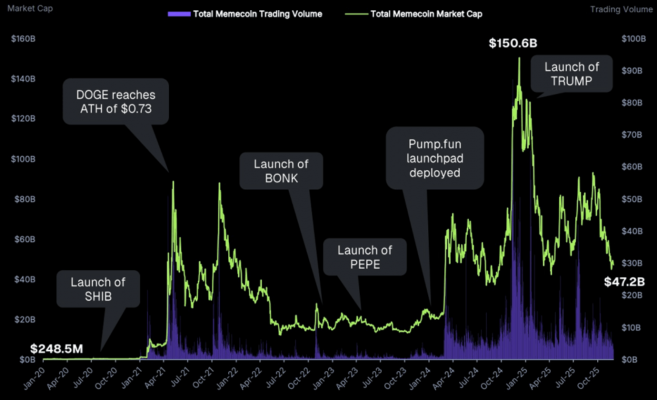
The issue extends far beyond a single platform. According to CoinMarketCap data, the total memecoin market capitalization has shrunk by nearly $4 billion over the past month. Compared with its early-May peak, the sector has lost approximately $8 billion, falling to $30.2 billion by mid-June. For comparison, the market approached $80 billion at its 2025 peak.
CoinGecko’s 2025 State of Memecoins report supports the conclusion that another “memecoin season” has come to an end. That cycle peaked in early 2025 and coincided with the controversial launches of the TRUMP and LIBRA tokens, both of which were accompanied by scandals and aggressive marketing campaigns involving prominent political figures.
Despite the launch of thousands of new tokens, most of the sector’s market capitalization remains concentrated in long-established leaders such as Dogecoin (DOGE), Shiba Inu (SHIB), and Pepe (PEPE). The chart below illustrates historical trading volumes (shown in purple), total memecoin market capitalization (green line), and several key milestones for the sector: the launch of SHIB, Dogecoin’s all-time high, the launches of BONK and PEPE, the launch of Pump.fun—which triggered a sharp rise in market capitalization—and the launch of TRUMP, after which the market entered a prolonged decline.
The Dark Side of the Hype
CoinGecko also highlights the risks associated with the memecoin sector. The report includes a dedicated section on fraudulent schemes that continue to thrive in this niche:
• Rug Pulls: Developers suddenly withdraw all liquidity from a pool, causing the token’s price to collapse to near zero.
• Sniping: Bots instantly buy large quantities of newly launched tokens and later sell them to retail investors at inflated prices.
• Bundling: A group of related wallets purchases tokens simultaneously to create the illusion of strong demand.
• Fake Clones and Honeypots: Fraudsters launch copies of popular coins or deploy smart contracts that prevent buyers from selling their tokens.
The Pump.fun story serves as a clear reminder that once the phase of unchecked optimism ends, the market quickly filters out the noise and leaves only fundamentally strong projects behind. For Solana, this represents a serious challenge and may require a reassessment of the ecosystem’s long-term growth strategy.
