
- Anatomy of the Scheme: A Discount That Cost Hundreds of Millions
- At What Stage Was the $50 Million Lost?
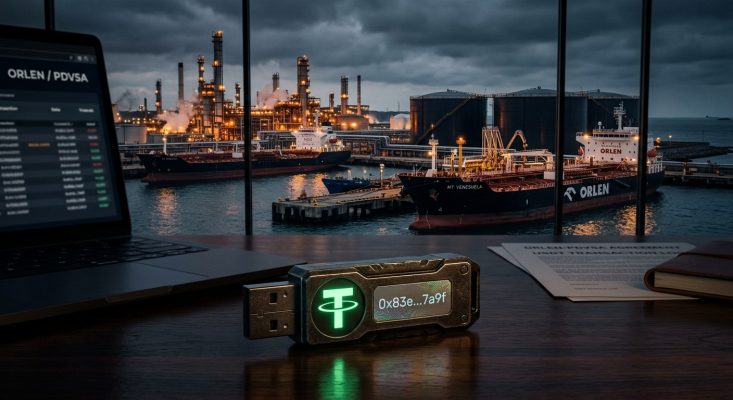
- Handing Over the Keys on USB Drives
- Collapse: One Tanker Instead of Six
- Political Fallout in Poland
- Lessons for the Industry
The history of corporate cryptocurrency transactions rarely produces stories worthy of a spy thriller. Yet an investigation by the Financial Times has shed light on one of the largest and most disastrous deals at the intersection of the traditional energy sector and digital assets.
The case centers on an attempt by the Polish state-owned energy company Orlen to circumvent international sanctions and banking restrictions to purchase discounted Venezuelan crude oil. The operation ultimately resulted in losses approaching half a billion dollars, the arrests of senior executives, and a political crisis in Warsaw. At the heart of the transaction was the stablecoin Tether (USDT). At the same time, access to hundreds of millions of dollars’ worth of digital assets was transferred using nothing more sophisticated than ordinary USB flash drives.
Anatomy of the Scheme: A Discount That Cost Hundreds of Millions
On paper, the plan appeared straightforward. In late 2023, the U.S. government temporarily eased sanctions on Venezuela’s energy sector, opening a window to purchase discounted Merey 16 heavy crude from the state-owned oil company PDVSA.
However, one major obstacle remained: the blocked banking system. Because of sanctions, PDVSA had effectively been cut off from the SWIFT network and demanded advance payment not in U.S. dollars—which were difficult or impossible to transfer—but in cryptocurrency.
Key Players
Samer Awad — then head of Orlen Trading Switzerland (OTS), Orlen’s Swiss trading subsidiary.
Kam Ho “Alex” Chieh — the 25-year-old founder of Dubai-based trading firm Hannon International, which acted as the intermediary.
The two sides met in Abu Dhabi in late November 2023 and signed a contract to deliver 6 million barrels of oil. To launch the deal, OTS transferred an unsecured advance payment of $230 million to Hannon International. Although the official contract made no mention of cryptocurrency, digital assets were always intended to power the transaction behind the scenes.
At What Stage Was the $50 Million Lost?
Hannon International’s role was to convert fiat U.S. dollars into USDT through over-the-counter channels operating in Dubai and across the Middle East. This is where the first cracks began to appear. Converting such large sums outside regulated exchanges typically involves substantial fees and significant settlement risks.
Blockchain analysis and court documents indicate that a significant portion of the money disappeared before it ever reached Venezuela.
First transfer — $80 million: The intermediary charged a $400,000 fee for processing the payment. Result: exactly 80 million USDT was delivered.
Second transfer — $135 million: A major anomaly occurred during the transfer to another counterparty. Result: only 85 million USDT arrived. The remaining $50 million effectively vanished during the conversion process between intermediaries.
At this point, the transaction had already become highly problematic, yet Orlen’s management chose to continue.
Handing Over the Keys on USB Drives
Unlike traditional bank transfers, cryptocurrency cannot simply be mailed or wired. Control over digital assets is transferred through private keys or seed phrases. Under strict secrecy, representatives of the intermediaries traveled to Caracas.
Between January and March 2024, physical exchanges of storage devices took place in restaurants and hotel rooms.
January 5, 2024: A USB drive containing access credentials to a wallet holding 60 million USDT was handed over.
January 28, 2024: A second USB drive containing the keys to 50 million USDT changed hands.
February–March 2024: Several additional transfers totaling approximately 22 million USDT followed.
This illustrates a classic example of cryptocurrency being used to bypass financial sanctions. Decentralized digital assets enabled capital to move outside the oversight of global banking compliance systems and directly into the hands of representatives of a sanctioned regime. At the same time, that very mechanism eliminated virtually all practical control over the funds once the assets had been transferred.
Collapse: One Tanker Instead of Six
Communication with the Venezuelan brokers suddenly stopped. According to investigators, local intermediaries either misappropriated the tokens and transferred them to entities associated with Nicolás Maduro or lost control of the funds to rival factions operating within PDVSA itself.
The outcome was disastrous.
Instead of the planned shipment of 6 million barrels, only one tanker was loaded.
Delivered volume: approximately 500,000 barrels of fuel oil
Estimated value of the cargo: $28.8 million
In March 2024, Orlen officially terminated the contract after concluding that the remaining millions of dollars in USDT had effectively disappeared.
Political Fallout in Poland
Once the scale of the losses became public, the scandal quickly evolved into far more than a failed commercial transaction. For Poland—where state-owned corporations play a central role in the economy—estimated losses of $378 million to $424 million, including shipping costs and legal expenses, became a major political issue.
Prime Minister Donald Tusk described the operation as “a disgrace before the entire world” and used the scandal to criticize the previous Law and Justice (PiS) government, questioning how state funds could legally have been transferred abroad for conversion into USDT in the United Arab Emirates.
The controversy further damaged public confidence in the cryptocurrency industry in Poland, which had already been shaken by the collapse of the Zondacrypto exchange earlier that year.
Legal Consequences
Polish prosecutors have opened criminal investigations into former OTS executives.
Three former senior managers face prison sentences of up to 25 years on charges including misuse of public funds and abuse of authority.
Meanwhile, Orlen’s new management has launched international arbitration proceedings in Dubai, seeking to recover at least the original $230 million advance payment from Hannon International.
Hannon International’s defense is straightforward. The company argues that it fulfilled its contractual obligations by purchasing the required USDT and transferring wallet access exactly as instructed by the Polish side. According to its position, responsibility lies with the Venezuelan counterparties, who allegedly received the funds but failed to deliver the contracted oil.
Lessons for the Industry
The Orlen case highlights the limits of cryptocurrency as a tool in geopolitical and sanctions-related transactions. Stablecoins can move capital almost instantly across borders, but they also eliminate many of the protections available in traditional finance, including chargeback mechanisms, banking safeguards, and established legal avenues for recovering funds.
Entrusting access to tens of millions of dollars to something as simple as a supermarket USB flash drive demonstrates how the human element can become the weakest link in even the most technologically advanced financial systems. As long as traditional corporations attempt to operate in the legal gray areas of international sanctions using crypto and decentralized finance, they face a harsh reality: once digital assets have been stolen or misappropriated, there is often no bank to call, no payment to reverse, and little evidence beyond a blockchain address and the record of a smart contract.
