
- What’s the Vulnerability?
- Avihu Levy’s Signature Grinding Technique
- The Formatting Challenge and MARA’s Slipstream
- Why the Quantum Threat Matters Now
- What’s Next?
While the crypto community remains focused on ETFs and Bitcoin halvings, the industry is facing a threat far greater than the next bear market: the emergence of a practical quantum computer. Such a machine could break Bitcoin’s ECDSA (Elliptic Curve Digital Signature Algorithm) in a matter of minutes, potentially compromising millions of wallets.
On August 26, 2026, StarkWare, best known for its Ethereum scaling technology based on ZK-rollups, announced a major breakthrough. The company successfully executed the first-ever quantum-resistant transaction on the Bitcoin mainnet—without requiring any changes to the Bitcoin protocol itself.
What’s the Vulnerability?
To understand why this achievement matters, it’s important to examine how a quantum attack could work. Many Bitcoin users believe their public key remains hidden until they spend their coins. That is only partially true.
When you send bitcoin, your transaction first enters the mempool—the waiting area where transactions sit before miners include them in a block. During this period, the transaction is broadcast across the network.
At that moment, critical cryptographic information becomes publicly visible. A sufficiently powerful quantum computer could intercept the transaction directly from the mempool, derive the private key using Shor’s algorithm, and immediately create a competing transaction with a higher fee. If miners include the attacker’s transaction first, the funds would be redirected to the attacker’s address before the legitimate transaction is confirmed.
Avihu Levy’s Signature Grinding Technique
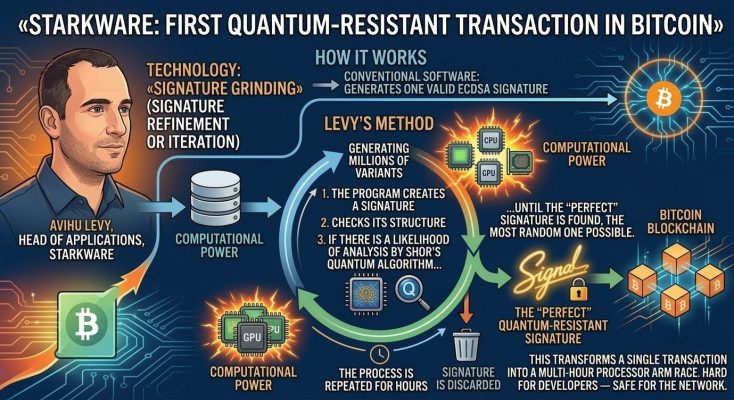
Avihu Levy, Head of Applications at StarkWare, developed an elegant—albeit extremely computationally expensive—approach to mitigating this risk. The technique is known as Signature Grinding.
How does it work?
Conventional wallet software generates a single valid ECDSA signature and broadcasts it to the network. However, among the enormous number of mathematically valid signatures, some reveal more information about the public key than others.
Levy’s approach rejects the first valid signature. Instead, StarkWare’s infrastructure generates millions of candidate signatures:
1. It creates a valid signature.
2. It analyzes the signature’s mathematical structure.
3. If the signature has even the slightest chance of exposing information that Shor’s algorithm could exploit, it is discarded.
The process continues for hours until the system finds an “ideal” signature that appears as random as possible and minimizes the amount of information exposed about the public key.
As a result, creating a single transaction becomes a computational marathon. In effect, the developers deliberately make transaction generation far more resource-intensive in exchange for greater security.
The Formatting Challenge and MARA’s Slipstream
The biggest obstacle to deploying this technique is Bitcoin’s conservative network policy. Standard Bitcoin nodes simply reject transactions that use non-standard formats. To them, a “ground” signature appears malformed, so the transaction is excluded from the mempool.
To make the experiment possible, StarkWare bypassed the public mempool entirely. Instead, the transaction was delivered directly to a miner through MARA’s Slipstream service. The mining pool agreed to include the unconventional transaction in a block, effectively recognizing it as valid.
The transaction has since become part of the public blockchain. Its transaction ID is:
305a24ffea912b9cf428f29ebf952321c96dab5bab284fc0d0801562f5abab07
Why the Quantum Threat Matters Now
For years, quantum resistance was viewed as a problem for the distant future. However, recent reports from ARK Invest and statements from Google researchers suggest the timeline may be accelerating.
Researchers generally describe quantum risk as progressing through five stages. The industry is now approaching Stage 2, where quantum computers may begin breaking weaker cryptographic systems. Stage 3—the point at which Bitcoin keys could potentially be cracked within hours—is still widely expected to arrive sometime in the mid-2030s. Even so, many developers believe preparations should begin long before that milestone.
StarkWare CEO Eli Ben-Sasson compared today’s crypto industry to passengers aboard the Titanic who can already see the iceberg but continue celebrating:
“Avihu’s breakthrough matters because it provides the psychological confidence that an asset needs… He has shown that lifeboats exist. But that’s not a reason to relax. It’s a reason to build more of them—and to start building them now.”
Levy himself emphasizes that Signature Grinding is only a temporary workaround rather than a permanent solution. He advocates for a future Bitcoin soft fork that would introduce true post-quantum cryptography—such as lattice-based signature schemes—directly into the protocol.
What’s Next?
StarkWare’s experiment demonstrated two important points:
• Quantum-resistant transactions are already possible on today’s Bitcoin network without a hard fork.
• Their computational cost is so high that widespread adoption is impractical until the protocol itself is optimized.
The demonstration is also likely to accelerate development across the industry. Earlier, TRON began testing a quantum-resistant wallet on its Nile testnet using cryptographic standards developed by the U.S. National Institute of Standards and Technology (NIST).
The race to secure Satoshi Nakamoto’s network has entered a new phase. The question is no longer whether Bitcoin can be protected against quantum computing—it is who will deliver a practical, scalable, and cost-effective solution first.
