
- Five Pillars of Regulation: Who Will Remain in the Market
- Investors: Who Can Buy Crypto—and How Much?
- The Biggest Question: Restrictions at Home, Freedom Abroad
- Implementation Timeline: When Will the New Rules Take Effect?
- Expert Opinion: A Compromise Instead of a Crackdown
- What Will Change for Everyday Users?
The long era of regulatory uncertainty in Russia’s cryptocurrency market has officially come to an end. In July 2026, the State Duma passed the federal law On Digital Currencies and Digital Rights in its second and third readings. The nearly 300-page legislation, scheduled to take effect on September 1, 2026, establishes a comprehensive legal framework for miners, investors, and businesses for the first time.
Rather than being a symbolic declaration, the law represents a fundamental overhaul of Russia’s financial architecture to support the digital economy. It pursues two primary objectives: protecting retail investors from fraud while providing businesses with a legal framework for conducting international trade using digital assets.
Five Pillars of Regulation: Who Will Remain in the Market
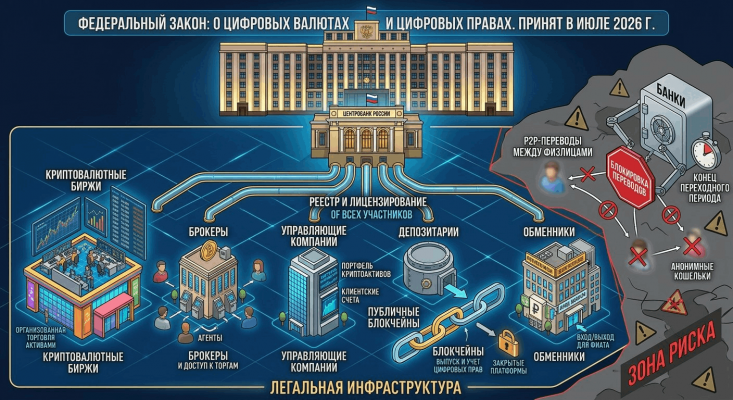
The new legislation introduces strict market segmentation. Only entities that obtain the appropriate license or are included in the Bank of Russia’s official registry will be permitted to provide cryptocurrency-related services. The law defines five categories of licensed market participants:
1. Cryptocurrency Exchanges: Platforms for organized trading of digital assets.
2. Brokers: Intermediaries providing investors with access to cryptocurrency markets.
3. Asset Management Companies: Firms that manage cryptocurrency investment portfolios on behalf of clients.
4. Digital Depositories: Institutions responsible for recording ownership rights to digital assets. One of the law’s most significant innovations allows Russian digital rights to be issued and recorded on public blockchains instead of being limited to closed platforms operated by licensed information system operators.
5. Crypto Exchange Services: Licensed providers that facilitate conversions between fiat currencies and cryptocurrencies.
Any transactions conducted outside this regulated infrastructure—such as direct peer-to-peer (P2P) transfers between individuals using anonymous wallets—will remain high-risk. Following the end of the transition period, banks will be required to block such transactions.
Investors: Who Can Buy Crypto—and How Much?
One of the most heavily debated aspects of the legislation was the investment limits for retail users. The final version divides investors into two categories while maintaining strict market access requirements.
• Retail (Non-Qualified) Investors: Retail investors will be allowed to purchase only the most liquid cryptocurrencies, primarily Bitcoin (BTC) and Ethereum (ETH). However, access will not be automatic. Before investing, individuals must pass a broker-administered suitability test demonstrating an understanding of cryptocurrency risks. Annual purchases will be capped at 300,000 rubles per intermediary.
• Qualified Investors: Individuals who meet established capital or professional experience requirements will also be required to pass a knowledge assessment. Once qualified, they will receive unrestricted access to all cryptocurrencies, tokens, and trading volumes.
This framework is designed to protect inexperienced investors from highly speculative altcoins while still allowing them to invest in the market’s largest and most established digital assets.
The Biggest Question: Restrictions at Home, Freedom Abroad
Perhaps the most important feature of the new legislation is its dual regulatory approach. Lawmakers have drawn a clear distinction between domestic cryptocurrency use and international trade.
Domestic Transactions: The Ban Remains
Cryptocurrency cannot be used to pay for goods or services inside Russia—from a cup of coffee to real estate purchases. Digital assets will continue to be treated solely as investment assets or property. The goal is to preserve the Russian ruble as the country’s only legal means of payment while preventing uncontrolled capital outflows through domestic consumer transactions.
Foreign Trade: A Green Light
For exporters and importers, however, the restrictions have been almost entirely removed. Businesses will be permitted to use cryptocurrencies for cross-border settlements without transaction limits.
Key provisions include:
Companies may conduct transactions through licensed intermediaries or, in certain cases, directly.
• All types of cryptocurrency wallets may be used.
• Russian exporters will be able to receive payments for commodities such as oil, metals, and grain in Bitcoin (BTC) or stablecoins, bypassing the SWIFT network and correspondent banking relationships with Western financial institutions.
At the same time, companies and individuals will be required to disclose cryptocurrency holdings maintained in foreign accounts to Russian tax authorities, closing a major loophole previously used to conceal taxable income.
Implementation Timeline: When Will the New Rules Take Effect?
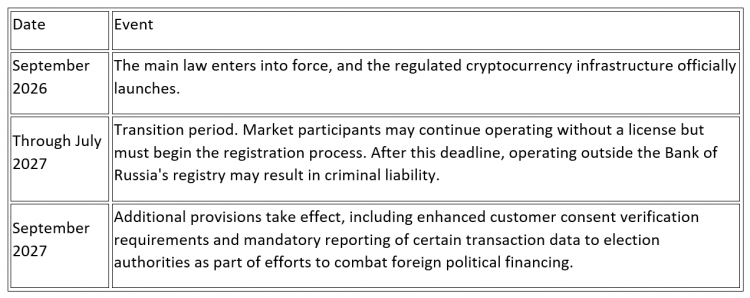
Recognizing the scale of the reform, lawmakers introduced an extended transition period to allow the industry to adapt gradually.
Additional legislation is also moving forward. In June 2026, lawmakers approved the first reading of a cryptocurrency taxation bill designed to align Russia’s Tax Code with the new regulatory framework. Another package of amendments introducing criminal penalties is currently under consideration. Organizing unauthorized cryptocurrency operations could become punishable by up to four years in prison.
Expert Opinion: A Compromise Instead of a Crackdown
According to Anatoly Aksakov, Chairman of the State Duma Committee on the Financial Market, the final version of the legislation represents a carefully negotiated compromise. He stated that lawmakers “took the views of market participants into account as much as possible,” ultimately abandoning earlier proposals for sweeping government control in favor of a more pragmatic regulatory model.
The government’s objective is clear: not to prohibit the cryptocurrency industry, but to bring it into the regulated economy. By legalizing the sector, authorities hope to move billions of dollars from the gray market into the banking system, increase transparency, and generate additional tax revenue.
What Will Change for Everyday Users?
Although most provisions will not take effect until 2027, several industry trends are already becoming apparent.
1. Informal Telegram-based exchanges will gradually disappear: Large OTC desks and exchange services are expected to establish physical offices and begin applying for Bank of Russia licenses.
2. KYC will become mandatory: The era of anonymously purchasing Bitcoin with cash is coming to an end. Any licensed cryptocurrency platform will require identity verification, including government-issued identification and proof of address.
3. Stronger consumer protections for digital assets: Holding cryptocurrency with a licensed exchange will provide users with significantly stronger legal protections than using unregulated platforms, although cybersecurity and hacking risks will naturally remain.
The adoption of the Law on Digital Currencies and Digital Rights marks the end of Russia’s largely unregulated crypto era. A new period of government oversight is beginning. While some view this as a setback for decentralization and financial freedom, many institutional investors and large businesses see it as the long-awaited foundation for a legitimate, regulated digital asset market.
