
- The “Quantum Winter” Era: How Blockchains Are Preparing for the Future
- TRON Tests the Innovative Security
- ARK Invest’s Breakdown of the Quantum Threat
- Five Stages of the Quantum Apocalypse and Three Paths to Survival
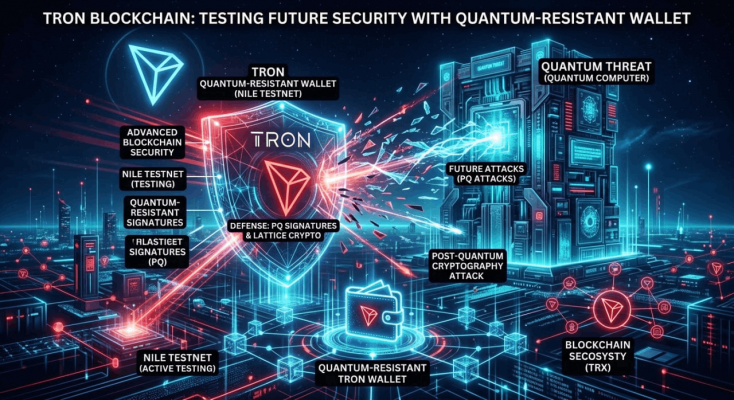
The cryptocurrency market is undergoing a fundamental transformation. Just a few years ago, volatility and returns dominated industry discussions. Today, the focus is shifting toward a far more critical question: whether blockchain technology itself can withstand the next generation of computing power. The TRON blockchain ecosystem has taken a major step toward the future of cybersecurity by launching tests of a quantum-resistant wallet designed to protect digital assets from quantum attacks.
The “Quantum Winter” Era: How Blockchains Are Preparing for the Future
For years, the threat posed by quantum computers seemed more like science fiction than reality. However, rapid advances in quantum computing have forced blockchain developers to rethink existing security standards. Traditional cryptography used by Bitcoin and most other blockchain networks relies on the mathematical difficulty of factoring large numbers or solving discrete logarithms. These problems are effectively impossible for today’s supercomputers, but a sufficiently powerful quantum computer could solve them in minutes using Shor’s algorithm.
TRON Tests the Innovative Security
To address this emerging challenge, TRON has introduced quantum-resistant digital signatures on its Nile testnet. The implementation follows standards developed by the U.S. National Institute of Standards and Technology (NIST), underscoring the project’s commitment to long-term security. The upgrade protects not only user transactions but also validator block signatures.
TRON founder Justin Sun announced the launch with his typical sense of humor:
“Now my mom will never have to worry about the safety of my digital assets.”
While lighthearted, the remark highlights a serious issue: mainstream cryptocurrency adoption will be impossible without complete confidence in the security of digital asset storage. TRON is not alone in preparing for the post-quantum era. Zcash previously announced plans to implement quantum-resistant protections before the summer, while NEAR Protocol began testing similar signature schemes on July 1.
ARK Invest’s Breakdown of the Quantum Threat
Investment firm ARK Invest conducted an in-depth analysis of Bitcoin holdings, classifying coins according to their vulnerability to quantum attacks. Their findings paint a concerning picture of what could happen once quantum computers reach sufficient computational power.
Quantum-safe assets (65.4% / approximately 13 million BTC). Modern address formats, including SegWit, protect public keys by hashing them. Until a user spends coins from such an address, the underlying public key remains hidden, making these funds effectively resistant to quantum attacks.
Vulnerable but recoverable coins (25% / approximately 5 million BTC). These are coins stored in addresses that have already been used to send transactions. Once a transaction is made, the public key becomes publicly visible, turning the address into a potential target for future quantum attacks. Owners are advised to move their funds to newly generated addresses before quantum computing becomes a practical threat.
Critical risk zone (8.6% / approximately 1.7 million BTC). The oldest Bitcoin address format, P2PK (Pay-to-Public-Key), exposes the public key directly as the address itself. These coins largely date back to the era of Satoshi Nakamoto. Based on research by Sergio Demian Lerner (the well-known Patoshi pattern) and widely accepted community estimates, approximately 1.1 million BTC believed to belong to Satoshi are stored in this format. These holdings would be among the easiest targets if hostile quantum capabilities become available.
In its February report, CoinShares reached similar conclusions, estimating that roughly 8% of all Bitcoin could theoretically be vulnerable. However, the firm also noted that the actual market impact would likely be much smaller. Analysts estimate that only about 10,200 BTC—worth more than $700 million—would realistically become available for sale after a successful quantum attack. Most lost or dormant coins would remain inaccessible due to technical characteristics of the original key implementation.
Five Stages of the Quantum Apocalypse and Three Paths to Survival
Analysts at ARK Invest and Unchained argue that the arrival of the quantum era should be viewed as a gradual process rather than a single event. They outline five stages in the evolution of quantum computing. According to this framework, the world is currently in Stage 0, where quantum computers exist but have little commercial utility. The first truly dangerous phase—Stage 3, when breaking cryptographic keys takes only hours—is not expected until the mid-2030s, based on projections from Google, IBM, and Microsoft.
Based on this timeline, researchers outline three possible future scenarios.
Optimistic scenario (“Quantum Winter”). Quantum computing encounters major physical limitations that significantly slow its progress. This gives Bitcoin developers decades to gradually implement post-quantum cryptography without disrupting the network.
Pessimistic scenario. A major breakthrough arrives unexpectedly, potentially accelerated by advances in artificial intelligence. The Bitcoin community is forced into an emergency protocol upgrade, triggering market panic, blockchain splits, and heated debates over whether and how to protect legacy coins.
Base-case scenario (the most likely outcome). Humanity has a 10- to 20-year window to prepare. Quantum computers will first find practical applications in chemistry and medicine (Stage 1) before progressing to attacks on weaker cryptographic keys (Stage 2). By the time quantum computing poses a genuine threat to blockchain security, the cryptocurrency community will likely have reached consensus on protocol upgrades, although the transition will almost certainly bring a period of elevated market volatility.
