
- Who Are Lazarus and TraderTraitor?
- Six Months in the Shadows: Preparing the Attack
- How the Hack Unfolded
- Pyongyang Responds: “Absurd Rhetoric” and a “Political Provocation”
- Why Analysts Are Convinced North Korea Was Responsible
- The Industry Aftermath: Cold War 2.0
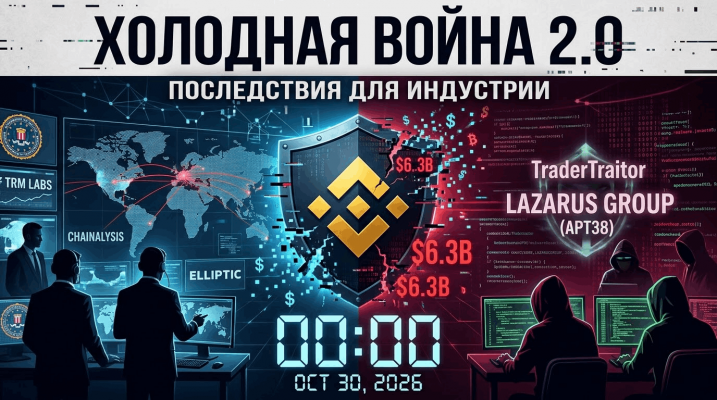
On the night of October 30, 2026, the cryptocurrency industry experienced an event that permanently changed the rules of the game. The $6.3 billion Binance hack was not only the largest theft in the history of digital assets—it became the largest robbery ever recorded, surpassing even the infamous Brink’s-Mat gold bullion heist.
The U.S. Federal Bureau of Investigation (FBI) and leading blockchain intelligence firms—including TRM Labs, Chainalysis, and Elliptic—all pointed to the same culprit. According to their investigation, the attack was carried out by TraderTraitor, a hacking group that cybersecurity researchers have long linked to the notorious Lazarus Group, also known as APT38.
Who Are Lazarus and TraderTraitor?
To understand the scale of the threat, it’s important to understand who cryptocurrency exchanges are up against. Lazarus Group is far more than a handful of hobbyist hackers operating from a basement. It is an elite cyber unit believed to operate under the direct supervision of North Korea’s intelligence apparatus.
Its cybercrime history stretches back years. The group has been linked to the 2014 Sony Pictures breach, the $81 million theft from Bangladesh Bank in 2016, and, more recently, the $1.4 billion Bybit hack in February 2025. For Kim Jong Un’s regime, which remains under some of the world’s toughest economic sanctions, cryptocurrency has become an ideal financial lifeline. Unlike traditional money, digital assets move outside the SWIFT network and cannot be blocked by conventional banking sanctions.
TraderTraitor is widely regarded as Lazarus’ specialized division focused exclusively on stealing digital assets. According to TRM Labs, the attack patterns found on Binance’s infrastructure closely resemble those seen in the Bybit, Drift, and KelpDAO breaches carried out during 2025–2026.
Six Months in the Shadows: Preparing the Attack
As Xakep.ru later reported, the Binance breach was anything but spontaneous. It was the culmination of a carefully planned, multi-stage operation that began as early as June 2026.
Initial Compromise: The attackers targeted a DevOps engineer responsible for cryptocurrency wallet infrastructure. While attempting to install a popular AI-powered coding tool, the engineer unknowingly downloaded a fake Homebrew installer.
Establishing Persistence: Once the malware gained access to the system, the attackers quietly began collecting intelligence. They mapped Binance’s internal network, analyzed employee shift schedules, and studied the company’s transaction approval procedures.
A False Sense of Security: Binance’s security team detected the malware during the summer. The compromised employee received a new laptop, and all credentials were replaced. Unfortunately, the response came too late. By then, the attackers had already created a complete digital blueprint of the infrastructure and had likely deployed backdoors that survived the hardware replacement.
How the Hack Unfolded
At 11:14 p.m. server time on October 29, 2026, TraderTraitor’s attack script was activated. Unlike many previous exchange hacks, this operation was executed with remarkable precision.
Speed: Within just 20 minutes, the attackers drained 57 different cryptocurrencies and tokens.
Primary Targets: The operation focused primarily on hot wallets, with the largest losses coming from stablecoins—approximately $1.6 billion in USDT—and Ethereum.
Attack method: Investigators found no evidence that private keys had been leaked. This strongly supports the theory that the attackers compromised Binance’s transaction-signing system after gaining access to the engineer’s service container.
To prevent the complete depletion of its reserves, Binance suspended withdrawals. At that point, stablecoin issuers intervened. Tether and Circle froze approximately $2.7–3 billion worth of assets. However, another $3–4 billion in Bitcoin and Ethereum had already entered the blockchain—where there is no “undo” button.
Pyongyang Responds: “Absurd Rhetoric” and a “Political Provocation”
While financial markets were in turmoil, North Korea’s leadership convened a meeting of the Central Committee of the Workers’ Party of Korea on November 3, 2026. Pyongyang’s response to the FBI’s accusations proved nearly as dramatic as the hack itself.
Kim Yo Jong, a senior Workers’ Party official and the sister of North Korean leader Kim Jong Un, issued an official statement carried by the Korean Central News Agency (KCNA). The message left little doubt that Pyongyang viewed the accusations as part of a broader information war.
The statement centered on several key arguments:
“Absurd rhetoric.” Kim Yo Jong described the FBI’s allegations as “a serious political provocation,” claiming that Washington exploits every major international cyber incident as an excuse to damage North Korea’s international reputation.
An attack on national dignity. According to the statement, the accusations were intended to “humiliate our dignity and national prestige” and represented “a violation of the DPRK’s sovereignty extending into a new domain.”
A systematic campaign. Pyongyang argued that the United States routinely blames North Korea for cyberattacks around the world, asserting that “last year the United States also attributed responsibility for the cyberattack on the Bybit cryptocurrency exchange to us.”
A declaration of innocence. North Korea reiterated what it called its “consistent policy position” of firmly opposing “all malicious acts in cyberspace.”
Why Analysts Are Convinced North Korea Was Responsible
Despite Pyongyang’s categorical denials, blockchain intelligence firms remain convinced that the attack originated in North Korea. Analysts from TRM Labs and Pangolin Intelligence identified several striking similarities to previous Lazarus operations.
Funding Pattern: Before launching the attack, the hackers routed small amounts of cryptocurrency through Tornado Cash. This is a well-known Lazarus tactic used to “warm up” wallets and sever links to previous transactions.
Infrastructure Preparation: The attackers had developed sophisticated withdrawal automation code and assembled a complete library of transaction signatures well before the attack. This level of preparation points to a development cycle lasting several months.
Money Laundering Strategy: Immediately after the theft, the stolen assets began flowing into Ethereum. The FBI warned that the next phase would likely involve laundering the funds through decentralized exchanges (DEXs) and cross-chain bridges before eventually cashing out through Asian over-the-counter (OTC) trading desks.
A Pangolin Intelligence analyst told CNN that the situation was “a game of cat and mouse that is only just beginning.” North Korea is not simply stealing cryptocurrency—it is building part of its economy around it. According to Chainalysis, the regime has accumulated more than $3 billion through similar cyberattacks in recent years, using the proceeds to fund its missile program and procure dual-use technologies in violation of international sanctions.
The Industry Aftermath: Cold War 2.0
The Binance hack marked a turning point. Where exchange hacks were once viewed as either the “stupidity tax” paid by careless operators or simply another operational risk, they are now increasingly seen as a geopolitical threat. Surprisingly, the market’s response remained relatively calm. As of November 2, Binance had recorded $4.72 billion in net outflows, representing roughly 3% of its assets. Investors appeared to distinguish between the security risks facing an individual exchange and the long-term value proposition of Bitcoin itself. To stem the panic, Binance introduced a customer loyalty program offering trading fee rebates and yields of up to 10%. Yet the confidence of millions of users had already been shaken by the realization that stolen customer assets could ultimately help finance a nuclear weapons program on the other side of the world.
The Binance breach was far more than another cryptocurrency theft. It represented the largest transfer of wealth ever carried out by a rogue state against the global financial system. And while Kim Yo Jong dismissed the accusations as a political provocation, the blockchain evidence tells a different story. In this new Cold War, the battlefield is no longer defined by national borders but by lines of code—and North Korean hackers have demonstrated that they are among the most formidable players on that board.
