
- Leadership Under Sanctions: Kazakhstan, Georgia, and Uzbekistan
- The “Toxicity” of Russian Assets and the Emergence of a Closed Ecosystem
- Different Goals, Different Policies
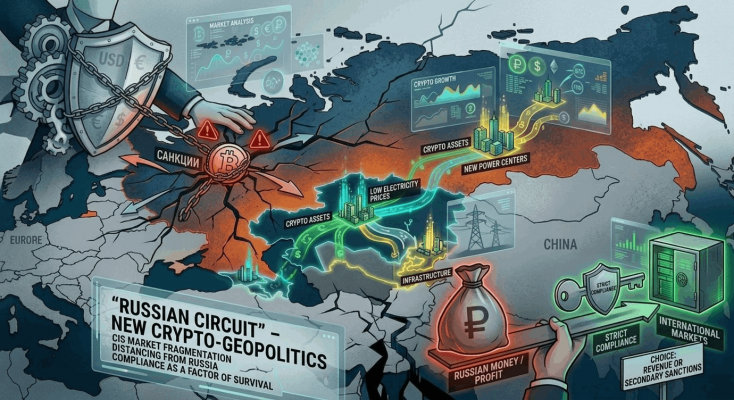
The cryptocurrency market, originally envisioned as global and decentralized, is once again confronting the realities of geopolitics. Western sanctions on Russia have not only complicated matters for local investors but have also triggered a large-scale transformation of the crypto industry across the former Soviet Union. We are witnessing a fragmentation process: the region is increasingly divided between assets directly linked to Russia and those seeking to distance themselves from Russian exposure.
Certified analyst, crypto trader, and investor Viktor Pershikov shared his perspective on how the digital asset landscape is evolving across the post-Soviet space and which countries are emerging as new centers of influence.
Leadership Under Sanctions: Kazakhstan, Georgia, and Uzbekistan
According to Pershikov, despite the broader geopolitical pressure, global crypto companies remain interested in the CIS region due to its relatively low electricity costs and developing infrastructure. However, strict compliance has become the key factor for survival. Companies increasingly face a choice between profiting from Russian capital and avoiding the risk of secondary sanctions—and more often than not, they are choosing the latter.
Within the region, a clear group of leaders has already emerged, attracting capital and businesses through regulatory predictability and lower risk profiles:
• Kazakhstan: The country stands out for its well-developed regulatory framework and high level of cryptocurrency adoption. The government has established clear rules for miners and investors, making Kazakhstan one of the region’s most attractive crypto hubs.
• Georgia: The country continues to attract market participants through its relatively favorable regulatory environment, particularly within its Free Economic Zones. These conditions have helped foster the growth of fintech startups and cryptocurrency companies.
• Uzbekistan: This country is rapidly gaining importance as a lower-risk alternative to Kyrgyzstan. While offering a comparable range of crypto services, it provides a more stable political and legal environment. A recent example is the Central Bank’s decision to allow non-resident legal entities to open accounts for purchasing crypto assets—a move clearly aimed at attracting foreign capital.
The “Toxicity” of Russian Assets and the Emergence of a Closed Ecosystem
By contrast, Pershikov believes that Belarus, Kyrgyzstan, and Russia itself occupy a more vulnerable position. Although their crypto sectors are relatively developed, significant sanctions-related pressure makes them less attractive to major international players. Kyrgyzstan, for example, maintains close crypto ties with Russian participants engaged in foreign trade activities, making it a higher-risk partner in the eyes of many international businesses.
The behavior of major crypto exchanges illustrates this trend. Bybit, which became one of the primary beneficiaries of Binance’s withdrawal from the Russian market, is now gradually reducing its exposure to Russian clients, particularly those connected to sanctioned entities. This sends a clear message: Russian-linked capital is increasingly viewed as a compliance risk.
As a result, what Pershikov describes as a “Russian domain” is beginning to take shape within the region. Assets circulating within Russia, Belarus, and closely connected jurisdictions are gradually becoming part of a more self-contained ecosystem. According to the analyst, this process is largely driven by external sanctions pressure. While these assets continue seeking access to international markets through indirect channels, other CIS countries are becoming increasingly reluctant to engage directly with funds that Western authorities classify as sanctions-related.
Different Goals, Different Policies
It is important to recognize that crypto policy across the CIS is far from uniform. While countries such as Kazakhstan and Uzbekistan view cryptocurrencies as a source of economic growth and technological innovation, Russia’s priorities are different. Russian legislation is primarily focused on meeting the requirements of the Financial Action Task Force (FATF), integrating digital assets into the existing financial system, and establishing comprehensive state oversight. This approach prioritizes security and control over private-sector development, making Russia less likely to evolve into an open international crypto hub.
As a result, the future of the cryptocurrency industry across the CIS appears increasingly divided. On one hand, jurisdictions such as Kazakhstan and Uzbekistan are likely to see continued growth in regulated crypto services and inflows of foreign capital. On the other hand, the Russian segment of the market is expected to become increasingly isolated, developing into a self-sufficient ecosystem that remains largely disconnected from the broader global economy.
