
- Timeline of the Deal and What Sparked the Controversy
- From Inquiry to Formal Demand: Escalating Pressure
- The Battle Over Stablecoins and Ethics
- Political Deadlock and a Procedural Standoff
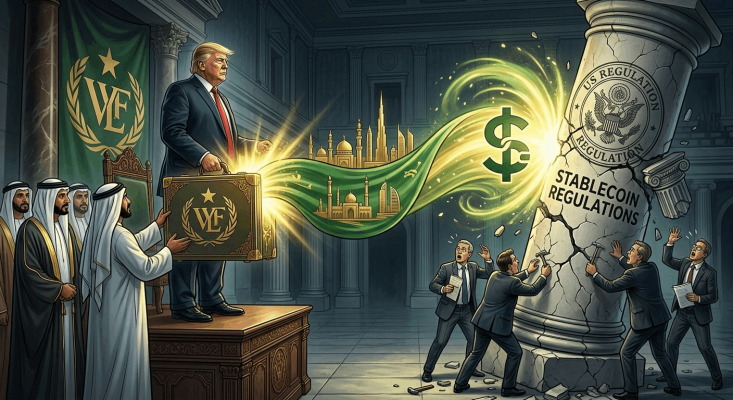
On June 23, 2026, Washington was rocked by a political firestorm that could shape the future of cryptocurrency regulation in the United States for years to come. Five influential Democratic senators—Elizabeth Warren, Richard Blumenthal, Gary Peters, Dick Durbin, and Ron Wyden—formally called for congressional hearings after the United Arab Emirates (UAE) made an unprecedented $500 million investment in Donald Trump’s cryptocurrency venture, World Liberty Financial (WLF). The senators described the deal as “unprecedented in American political history” and demanded that White House officials testify under oath about what they knew about the transaction and when they became aware of it.
This is far more than another partisan dispute. It marks the beginning of a high-stakes political battle involving billions of dollars, national security, and the future of key digital asset legislation.
Timeline of the Deal and What Sparked the Controversy
The controversy centers on a transaction completed just four days before Donald Trump’s inauguration. Representatives of Sheikh Tahnoon bin Zayed Al Nahyan, the UAE’s National Security Advisor, acquired a 49% stake in WLF. Of the total investment, $218 million was paid upfront to entities linked to the Trump family and Steve Witkoff, Trump’s chief Middle East diplomat.
Two executives from G42—an Abu Dhabi-based artificial intelligence powerhouse—joined WLF’s board of directors, effectively giving the Emirati side veto power over the project’s key strategic decisions. According to the Democrats’ letter, the investment was followed by a series of U.S. government decisions that significantly benefited the UAE:
• Arms sales: Approval of a $1.4 billion weapons deal in May 2025 despite congressional concerns over weapons shipments reaching armed groups in Sudan.
• Financial incentives: The Treasury Department launched a “Known Investor Pilot Program” designed to accelerate approval of UAE investments through the Committee on Foreign Investment in the United States (CFIUS).
• Technology: The Department of Commerce lifted Biden-era restrictions, allowing G42 to acquire 35,000 advanced Nvidia Blackwell AI chips worth more than $1 billion.
The final point is by far the most controversial. U.S. intelligence agencies had previously alleged that G42 supplied technology that helped expand China’s missile capabilities. Granting access to America’s most advanced AI chips in the wake of a massive investment in the president’s personal crypto venture represents what critics describe as a textbook conflict of interest.
From Inquiry to Formal Demand: Escalating Pressure
This is not the senators’ first attempt to scrutinize the deal. On February 13, Elizabeth Warren and Senator Andy Kim asked the Treasury Secretary to determine whether the UAE’s stake should undergo formal CFIUS review and requested a response by March 5. No response was ever provided. The June 23 letter marked a procedural escalation. What began as a request for review has now become a formal demand for public testimony under oath.
WLF spokesperson David Wachsman sought to defuse the controversy by stating that neither Trump nor Witkoff participated in the investment negotiations and that both severed ties with the company upon taking office. Democrats, however, argue that this misses the point. Under WLF’s revenue structure, a Trump-linked company is entitled to 75% of the proceeds from token sales—currently estimated at roughly $400 million. In their view, this arrangement does nothing to eliminate the underlying conflict of interest.
The Battle Over Stablecoins and Ethics
The controversy extends well beyond political optics. At stake is the future of the U.S. cryptocurrency industry itself. The U.S. Senate is currently considering two landmark pieces of digital asset legislation:
• The CLARITY market structure bill.
• A stablecoin bill currently under review by the Senate Banking Committee.
Republicans need at least 60 votes to pass either measure, meaning they must secure the support of at least seven Democratic senators. That gives Democrats significant leverage.
They have already indicated that their support will depend on stronger ethics rules and stricter safeguards against foreign influence in the cryptocurrency industry. The conflict of interest is especially pronounced because World Liberty Financial is actively promoting its own USD1 stablecoin, backed by short-term U.S. Treasury securities, while Congress is simultaneously debating the regulatory framework that would govern precisely such products.
An earlier investment by another UAE-based company, MGX, reportedly increased the market capitalization of the Trump family’s stablecoin by nearly $2 billion virtually overnight. Senators Elizabeth Warren and Maxine Waters separately urged the SEC Chair to preserve all records related to WLF and Donald Trump, describing the company’s revenue-sharing model as an “unprecedented conflict of interest.”
Senator Chris Murphy summarized the Democrats’ central argument: “The UAE investment delivered millions of dollars to Trump… just before the White House approved an unprecedented deal to sell advanced artificial intelligence chips.” Democrats argue that this sequence of events raises serious questions about foreign government money potentially influencing U.S. policy decisions.
Political Deadlock and a Procedural Standoff
So far, the Trump administration and the Republican majority have ignored calls for a formal investigation. Cryptocurrency policy remains a White House priority—as reflected in the administration’s recent executive orders on post-quantum cybersecurity—giving committee chairs little incentive to voluntarily hold hearings.
Democrats, meanwhile, face procedural limitations. They can delay or block votes on cryptocurrency legislation until their demands are addressed, but they lack the authority to unilaterally convene hearings or issue congressional subpoenas while in the minority.
The developments that could fundamentally change the situation—such as a formal CFIUS investigation or a congressional subpoena—have yet to materialize. Instead, the dispute has evolved through a steady escalation of political pressure.
For Democrats, the strategy is to build a documented record while increasing the political cost of inaction. For Republicans, the message is equally clear: without stronger ethical safeguards, there will be no Democratic votes for cryptocurrency legislation.
As a result, the future of stablecoin regulation—and, by extension, the structure of the U.S. cryptocurrency market—may now depend on whether five Democratic senators can compel their political opponents to answer difficult questions about a half-billion-dollar investment from the Middle East. With the congressional August recess rapidly approaching, the window for advancing these landmark crypto bills is closing fast, while the political crisis continues to intensify.
