
- Wealth Concentration: $200 Billion in the Hands of Five Players
- The Phenomenon of “Silent” Wallets and Permanently Lost Coins
- A Giant Faces a Crisis: Strategy Is Under Pressure
- Who’s Buying Up the Entire Supply? The Institutional Battle
- The Economics of Scarcity
Imagine an asset that doesn’t just rise in value—it literally disappears over time. Gold can be melted down, oil can be burned, but Bitcoin, once lost, can vanish forever. Against the backdrop of reports that the five largest Bitcoin holders have accumulated nearly $200 billion worth of BTC, one obvious question emerges: why isn’t this vast pool of digital wealth flowing back into the economy? Why do individuals and corporations prefer to “HODL” rather than spend? The answer lies in Bitcoin’s unique design and the psychology of its owners.
Wealth Concentration: $200 Billion in the Hands of Five Players
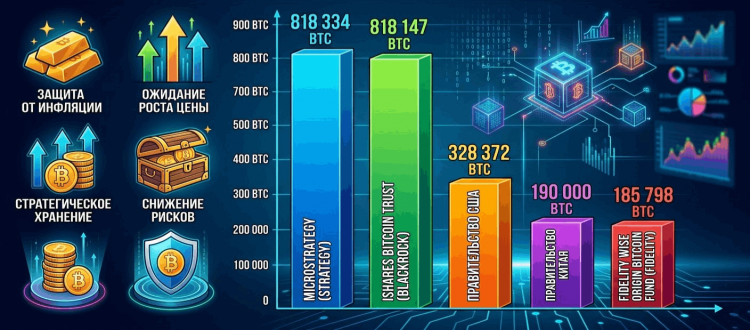
According to analytics platform Bitcointreasuries, the five largest known Bitcoin holders control more than 2.3 million BTC. At current market prices, that amounts to roughly $191 billion—over 11% of Bitcoin’s maximum supply of 21 million coins.
Who are these giants? The list reads like a showcase of institutional capital:
Strategy (formerly MicroStrategy): 818,334 BTC
BlackRock’s iShares Bitcoin Trust: 818,147 BTC
U.S. Government: 328,372 BTC
Chinese Government: 190,000 BTC
Fidelity Wise Origin Bitcoin Fund: 185,798 BTC
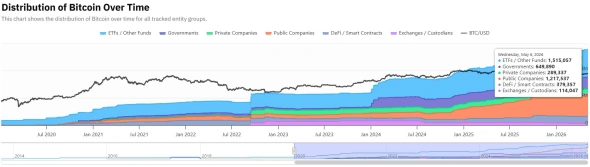
In total, more than 300 companies, funds, and governments collectively hold 4.16 million BTC worth around $340 billion. But the most fascinating part of the story isn’t found in institutional rankings—it’s hidden in the shadows of the blockchain itself.
The Phenomenon of “Silent” Wallets and Permanently Lost Coins
A massive portion of Bitcoin will never be spent again. That doesn’t necessarily mean its owners are fanatics waiting for a $1 million price target. In many cases, it means access to the coins has been lost forever.
Bitcoin is pure cryptography. There’s no customer support, no password reset button. Access to funds depends entirely on a private key or seed phrase. Losing either is the digital equivalent of throwing a chest of gold into the ocean.
How Billions Disappear
Human error: a seed phrase written on paper gets damaged or lost; the password to an encrypted wallet is forgotten; an old laptop containing the only copy of a wallet ends up in a landfill .
Technical failure: malware attacks ; formatting a drive without backing up wallet.dat; hardware failure or corrupted storage devices.
Inheritance issues: a Bitcoin owner passes away without leaving access instructions for family members.
Researchers estimate that between 2.6 million and 3.8 million BTC have been permanently lost. This creates a “compressed spring” effect: available supply keeps shrinking while demand from large buyers continues to rise.
A Giant Faces a Crisis: Strategy Is Under Pressure
A new warning signal has emerged within this wave of institutional accumulation. Strategy, the world’s largest corporate Bitcoin holder, is facing mounting financial pressure. For the first quarter of 2026, the company reported a net loss of $12.54 billion. Unrealized losses tied to the decline in the value of its digital assets reached an even more staggering $14.46 billion.
The core issue lies in Strategy’s accumulation model. The company finances Bitcoin purchases through stock issuance and debt. Its annual dividend obligations on these instruments total roughly $1.5 billion. Company founder Michael Saylor has acknowledged a scenario in which Strategy could be forced to sell part of its Bitcoin reserves to meet those obligations. That raises a critical question for the market: could the world’s largest HODLer become a forced seller?
Who’s Buying Up the Entire Supply? The Institutional Battle
Between July and November 2025, the market experienced a remarkable event. Long-term holders—wallets that had held coins for more than 155 days—sold roughly 300,000 BTC worth around $33 billion. Under normal circumstances, that level of selling pressure would have crushed the market. Instead, Bitcoin’s price remained relatively stable between $95,000 and $106,000, while volatility was cut in half.
That points to only one conclusion: a new class of buyer has emerged with the capacity to absorb virtually unlimited supply—and it isn’t retail traders.
The Main Drivers of Demand
1. Bitcoin ETFs
Following regulatory approval, spot Bitcoin ETFs—led primarily by BlackRock—began accumulating Bitcoin at an unprecedented pace. Within a year, these funds acquired approximately 1.4 million BTC.
2. Strategy
Despite its current financial pressures and debt burden, Michael Saylor’s company has historically remained one of the largest sources of institutional Bitcoin demand.
The Economics of Scarcity
Bitcoin is no longer viewed as merely a speculative asset. It has evolved into digital gold—an asset that cannot be inflated away or easily confiscated. Large investors increasingly see it as a financial safe haven.
As millions of coins remain permanently trapped in lost wallets or locked away in cold storage by long-term holders, while institutions continue buying up available supply—or potentially selling portions to cover mounting debt—Bitcoin’s scarcity becomes even more pronounced. And as long as that trend continues, fewer people will want to spend Bitcoin, while more institutions will compete to accumulate it. After all, why sell an asset today if it could become even rarer and more valuable tomorrow?
