
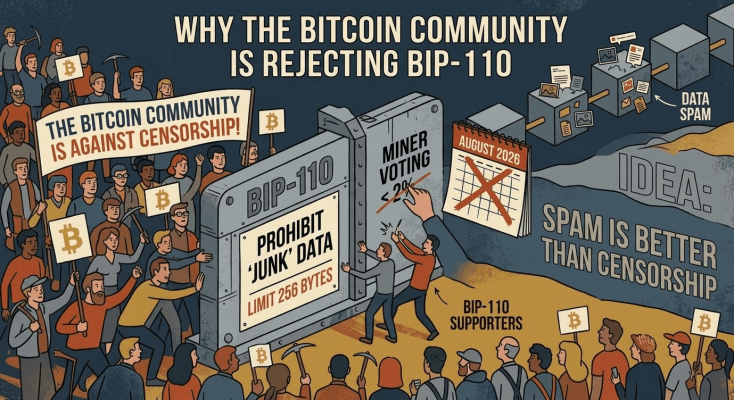
- What BIP-110 Proposes
- The Anatomy of “Spam”: Where the Network Congestion Comes From
- Why Crypto Giants Said “No”
- The MARA Lesson: When Censorship Failed
- Economics Over Ethics: Why Spam Is Profitable
- Conclusion: The Price of Immutability
The Bitcoin ecosystem is facing a growing ideological divide that strikes at the very foundation of the world’s first cryptocurrency. As network activity reaches unprecedented levels—with daily transactions surpassing 760,000, roughly 50% above the 2025 average—developers have proposed a radical solution to blockchain congestion.
The proposal, known as BIP-110 (Bitcoin Improvement Proposal), aims to limit the amount of “junk” data written to the Bitcoin blockchain. However, the initiative has encountered overwhelming resistance—not only from miners but also from some of the industry’s most influential figures. For much of the Bitcoin community, tolerating spam is preferable to creating a precedent for censorship.
What BIP-110 Proposes
BIP-110 calls for a temporary protocol change that would remain in effect for one year. Its primary objective is to reduce non-financial data that clutters Bitcoin blocks. The proposal would cap the size of non-standard transactions at 256 bytes.
Supporters argue that the update would improve network efficiency by:
-Preserving Bitcoin’s primary role as a payment network.
-Reducing hardware requirements for full nodes.
-Speeding up standard BTC transactions by freeing up block space.
However, activating such an upgrade requires majority approval from the network through hashrate-based signaling. As of mid-July, the proposal has gained support from less than 2% of the network. With the decision deadline set for August 2026, its chances of adoption are effectively nonexistent.
The Anatomy of “Spam”: Where the Network Congestion Comes From
The current surge in blockchain activity is largely driven by the Ordinals, Runes, and BRC-20 protocols. These technologies allow users to inscribe images, text, and NFT-like digital assets directly onto satoshis—the smallest units of Bitcoin.
To Bitcoin purists, this represents a violation of Satoshi Nakamoto’s original vision. Others see it as a natural evolution of how unused block space can be utilized. The debate is further complicated by the fact that every transaction—regardless of its purpose—generates revenue for miners.
A miner’s income consists of two sources:
-Block subsidy: Newly issued bitcoins generated by the network (currently about 450 BTC per day).
-Transaction fees: Fees paid by users to have their transactions included in a block.
Under normal conditions, transaction fees account for only a tiny share of miners’ revenue—currently less than 1% of the block reward. But the upside can be enormous. During the peak of the Runes token frenzy in 2024, miners earned as much as 1,200 BTC in transaction fees alone. As a result, miners have faced a difficult choice: preserve the purity of the blockchain or earn hundreds of millions of dollars from images and other data embedded in it.
Why Crypto Giants Said “No”
The rejection of BIP-110 is driven not by developer inertia but by deeply held philosophical principles. Many influential Bitcoin advocates view transaction-size restrictions as the first step toward centralization and government control over financial networks.
Adam Back’s Position: Censorship Resistance Above All
Adam Back, founder of Blockstream, one of the crypto industry’s most respected pioneers, and frequently cited as a possible inspiration for Satoshi Nakamoto, has been unequivocal in his opposition.
His statement has become a rallying cry for critics of the proposal:
“Bitcoin respectfully says ‘no’ to what you want. You can coordinate and launch a fork, but Bitcoin won’t join you.”
Back argues that Bitcoin’s decentralized architecture depends on protocol neutrality. If a group of people gains the authority to decide which transactions are “legitimate” and which are “spam,” that group effectively becomes a central authority. At the same time, Back acknowledges that developers dislike blockchain spam just as much as everyone else. The difference lies in the solution: he believes spam should be addressed through economic incentives rather than protocol-level restrictions. Individual node operators are free to configure their own filtering policies, but the base protocol should remain open to all valid data.
Michael Saylor’s Position: The Danger of Setting a Precedent
Billionaire Michael Saylor, Executive Chairman of Strategy (formerly MicroStrategy), the world’s largest corporate holder of Bitcoin, echoed Back’s concerns. Responding to Back’s comments, Saylor summarized his position with a memorable remark:
“There are 110 things more dangerous to Bitcoin than spam.”
In Saylor’s view, the real threat is not someone embedding an image in block 900,000. The greater danger is introducing a mechanism capable of filtering transactions. Once the protocol can reject transactions based on size or content type, the same mechanism could eventually be used to block addresses associated with political opponents or entire countries. From this perspective, adopting BIP-110 would establish both the technical and legal groundwork for future censorship.
The MARA Lesson: When Censorship Failed
This is not Bitcoin’s first battle over transaction filtering. In 2021, one of the world’s largest publicly traded mining companies, MARA (formerly Marathon Digital), attempted to implement transaction filtering within its mining pool. The company began mining only blocks that excluded transactions involving addresses sanctioned by the U.S. Treasury’s Office of Foreign Assets Control (OFAC).
The community’s response was immediate and overwhelmingly negative. The idea that a U.S. corporation could dictate the rules of a global monetary network triggered widespread backlash among node operators. Many nodes disconnected from MARA’s pool, reducing its effectiveness. Within months, the company abandoned the initiative. MARA CEO Fred Thiel publicly acknowledged the outcome:
“We fully support the Bitcoin community,” while praising those advocating for maximum decentralization.
The episode became a defining lesson for institutional participants: the market may tolerate price volatility, but it is far less willing to accept interference with Bitcoin’s transaction neutrality.
Economics Over Ethics: Why Spam Is Profitable
Beyond philosophical principles such as free speech and resistance to tyranny, there is also a straightforward economic reason for rejecting BIP-110. Bitcoin’s monetary policy is built around the halving, which cuts the block subsidy in half every four years.
Once the issuance of new bitcoins eventually ends—around the year 2140—transaction fees will become miners’ only source of revenue.
If a $1 transaction fee seems reasonable today, maintaining the security of a multi-trillion-dollar network in the future may require average fees of tens or even hundreds of dollars. In that sense, spam generated by protocols like Runes serves as a real-world stress test for Bitcoin’s long-term fee market. It encourages users to compete for limited block space while demonstrating where miners’ future revenue will come from in a post-subsidy economy.
By limiting non-standard transactions to 256 bytes, the community would effectively sacrifice part of that future revenue in exchange for short-term convenience.
Conclusion: The Price of Immutability
The debate surrounding BIP-110 highlights both Bitcoin’s greatest strength and its greatest weakness: its extraordinary conservatism. Bitcoin cannot be changed on a whim. Any protocol modification requires broad consensus—something that is exceptionally difficult to achieve when core principles are at stake.
For now, the community has chosen to prioritize immutability over convenience, even if that means paying higher transaction fees and enduring slower wallet synchronization during periods of intense activity driven by meme coins and on-chain inscriptions.
