
- The Scale of the Threat: From $30 Million in Losses to Hundreds of Victims
- France: The Epicenter of the Crypto Crime Wave
- How These Attacks Are Carried Out
- The Effectiveness Paradox
- How to Protect Yourself in the Era of Wrench Attacks
The cryptocurrency industry is facing a threat that neither hardware wallets nor complex passwords can stop. According to a recent report by blockchain analytics firm Chainalysis, more than $30 million was stolen from digital asset holders through physical attacks during the first half of 2026.
If this trend continues, 2026 will surpass the previous record set in 2025 ($58 million) and become the worst year in the industry’s history. Experts attribute the surge in violence not only to Bitcoin’s rising price but also to large-scale personal data breaches.
The Scale of the Threat: From $30 Million in Losses to Hundreds of Victims
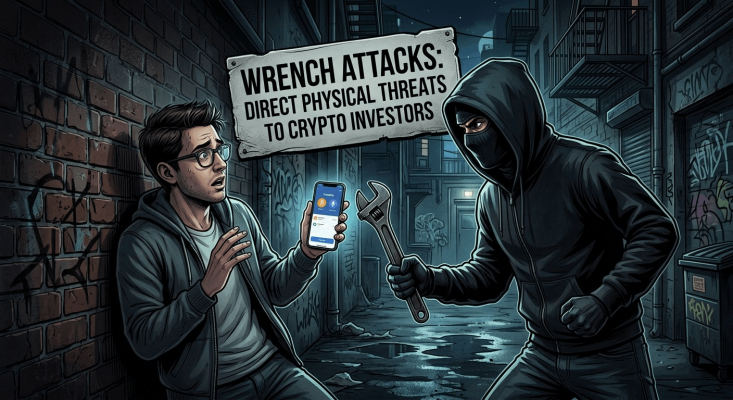
In English-speaking law enforcement circles, these crimes are known as wrench attacks. The term refers to incidents in which criminals locate a cryptocurrency owner and use physical violence or threats to force the victim to transfer funds or reveal their seed phrase. Unlike exchange hacks, these attacks target the individual directly—specifically those who self-custody their crypto assets.
Chainalysis paints an alarming picture of the escalating threat:
• First half of 2026: More than $30 million in successfully stolen cryptocurrency.
• Including attempted extortion: Total financial exposure reached $107 million, including frozen assets and failed transfer attempts.
• Previous years: $180 million in 2025 and $316 million in 2024. Although the overall losses have declined from their peak, the number of incidents has increased sharply, suggesting criminals are carrying out more attacks while becoming better at covering their tracks.
The real numbers are likely much higher. Many victims choose not to report these crimes to law enforcement because they fear exposing the true size of their crypto holdings to tax authorities.
France: The Epicenter of the Crypto Crime Wave
Chainalysis highlights France as a particularly concerning case. Until 2025, the country was considered relatively safe for wealthy crypto investors, with only isolated incidents reported. That changed after a corruption scandal involving the French tax administration.
A Data Leak Worth Millions
In 2024, an employee of the Paris tax authority was accused of selling databases containing information on wealthy taxpayers. The leaked data reportedly included names, home addresses, phone numbers, and tax filings of individuals who had declared cryptocurrency holdings.
For criminals, it became the perfect target list.
The consequences were dramatic:
• France has recorded 77 attacks since the beginning of the year (nearly 80 according to the Ministry of the Interior).
• The violence has spread well beyond affluent Paris neighborhoods. Incidents have been reported in Strasbourg, Marseille, Grenoble, Toulouse, and even quiet suburban communities where armed robberies had previously been virtually unheard of.
French Interior Minister Laurent Nuñez publicly acknowledged the problem, stating that concerns about these attacks are “entirely justified.”
How These Attacks Are Carried Out
According to the Chainalysis report, criminal tactics have changed dramatically. Rather than targeting random tourists carrying Ledger devices, attackers now conduct carefully planned, targeted operations.
Targeting Family Members
One of the most disturbing trends is the increasing involvement of victims’ relatives. In 2021, attacks against family members were extremely rare. By early 2026, they accounted for approximately 30% of incidents worldwide and more than 40% in France. Criminals have resorted to kidnapping children or spouses to pressure investors into surrendering their assets.
The focus has also shifted from street robberies to home invasions:
• The share of attacks involving home invasions rose from 14% in 2025 to 37% in 2026.
• Kidnappings now account for roughly 52% of all recorded incidents.
Most victims are local residents rather than tourists—93% in France, 82% in Brazil, and 77% in the United States. This suggests these crimes are not opportunistic robberies but carefully organized operations involving surveillance and intelligence gathering.
The Effectiveness Paradox
Despite the growing number of attacks, the percentage of successful thefts has been declining. By the end of June 2026, criminals succeeded in stealing funds in only 26% of cases, compared with 49% in 2025 and 67% in 2024.
Analysts believe this is because the surge of less sophisticated attacks—particularly in France—has displaced the highly targeted operations seen in previous years. Victims are increasingly resisting or activating account protection measures before being forced to hand over access.
Where Does the Money Go?
Once victims transfer funds to wallets controlled by criminals, the laundering process begins. Even so, recovery is sometimes possible.
According to industry experts, Bitcoin holders have historically suffered the largest financial losses. However, Bitcoin addresses themselves are often less attractive targets for laundering because the blockchain is highly transparent. Analytics firms such as TRM Labs and Elliptic work closely with law enforcement to flag stolen funds. If illicit cryptocurrency is deposited at a regulated exchange, the associated accounts can often be frozen.
How to Protect Yourself in the Era of Wrench Attacks
The crypto industry is beginning to adapt to this new reality, and wallet developers are introducing features designed specifically to mitigate physical coercion.
Some of the most promising security mechanisms include:
• Duress PIN: A special PIN that appears to unlock the wallet while secretly sending an emergency alert or displaying a decoy wallet with little or no balance.
• Time Locks: A feature that delays large withdrawals—typically by 24 to 48 hours—and requires confirmation from a second key held by a trusted third party, such as an attorney or a bank.
• Geofencing: Automatically restricting wallet access if the device is located in a predefined high-risk area or is moving at an unusually high speed.
The biggest lesson of 2026 is straightforward: your real-world privacy matters even more than the privacy of your blockchain address. Any information about your crypto holdings that falls into the wrong hands can turn digital wealth into a very real threat to your personal safety.
